Nikhil Prasad Fact checked by:Thailand Medical News Team Aug 25, 2026 1 month, 2 weeks, 1 day, 5 hours, 23 minutes ago
Aging may create metabolic conditions that make cells more vulnerable to cancer-like behavior, according to a new computational study examining how declining mitochondrial function affects energy production, cell growth, and cell death.
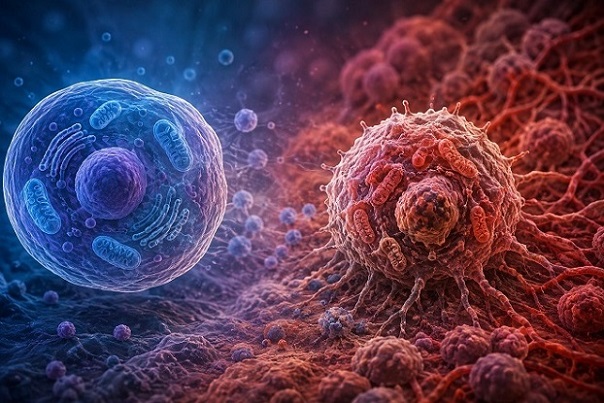 Aging-related mitochondrial decline may create reversible metabolic conditions that make stressed cells more likely
to develop cancer-like behavior.
The research suggests that falling levels of NAD+, a molecule essential for cellular energy processes, can gradually push aging cells away from efficient mitochondrial energy production and toward glycolysis, an alternative energy pathway commonly increased in cancer cells.
How Aging Changes Cellular Energy
The study used a computational network containing 94 biological components and 370 connections. It modeled how metabolism, cell division, programmed cell death, and mitochondrial aging interact under different conditions.
Young cells showed an oxidative phosphorylation, or OXPHOS, propensity of 0.686, compared with 0.186 in old cells. Meanwhile, glycolysis increased from 0.256 in young cells to 0.426 in old cells.
Importantly, declining NAD+ alone mainly changed metabolism rather than immediately producing uncontrolled growth. The dangerous shift appeared when mitochondrial decline was combined with low oxygen, reactive oxygen species, and strong growth signals.
Stress Pushed Aging Cells Toward Cancer-Like Behavior
Under severe hypoxia, glycolytic propensity reached 0.922. When older modeled cells also experienced increasing oxidative stress and growth signaling, proliferation rose dramatically, eventually approaching 0.98 under the highest-stress condition. At the same time, apoptosis—the natural process cells use to destroy damaged or unwanted cells—fell to nearly zero.
This Thailand
Medical News report highlights an important distinction: the findings do not show that normal aging automatically causes cancer. Instead, mitochondrial aging may create a vulnerable metabolic environment in which additional stresses make tumor-associated behavior easier to establish.
Analysis of human Basal-like breast tumors provided additional support. Among 92 OXPHOS-related genes examined, 73 showed decreasing expression patterns with increasing age. Older tumors also displayed signs of both oxidative and glycolytic activity, suggesting cancer metabolism may remain flexible rather than simply switching from one energy system to another.
Cancer-Like Changes Could Be Reversible
The model produced another striking finding. Blocking receptor tyrosine kinase signaling sharply reduced proliferation and increased programmed cell death. Under the strongest stressed condition, complete RTK inhibition reduced proliferation from approximately 0.98 to zero while increasing apoptosis from nearly zero to approximately 1.00.
Adding extracellular pyruvate produced a different effect, restoring oxidative metabolism while reducing glycolysis and the hybrid metabolic state. C
ancer-related changes involving VHL, RAS, PI3K, and AKT also strengthened glycolytic or hybrid metabolism under pyruvate-limited conditions.
Research Institutions
The work involved the Biomedical Informatics and Engineering Research Laboratory and Department of Life Sciences at Lahore University of Management Sciences in Pakistan, along with the Department of Medicine at Mayo Clinic School of Medicine in Jacksonville, Florida.
Conclusions
The findings suggest mitochondrial aging may prime cells for tumor-friendly metabolic behavior without independently causing cancer. Environmental stress, growth signals, nutrients, and cancer-related genetic changes may determine whether vulnerable aging cells progress toward dangerous states. Because these results largely come from computational modeling, laboratory and clinical validation will be essential before therapeutic conclusions can be made.
The study findings were published in the peer reviewed journal: Biology.
https://www.mdpi.com/2079-7737/15/16/1443
Read Also:
https://www.thailandmedical.news/articles/cancer
https://www.thailandmedical.news/articles/anti-aging 



 Share
Share
 Tweet
Tweet
 Share
Share