Researchers Warn That New Illegal Opioids in Circulation Called Nitazenes Can Damage Human DNA
Nikhil Prasad Fact checked by:Thailand Medical News Team Jun 14, 2026 3 months, 3 weeks, 13 hours, 50 minutes ago
Medical News: Scientists are raising fresh concerns about a dangerous class of synthetic opioids known as nitazenes after new research revealed that some of these substances may damage human DNA and trigger harmful cellular changes. The findings add a new dimension to growing public health fears surrounding nitazenes, which have already been linked to a rising number of overdoses and deaths around the world.
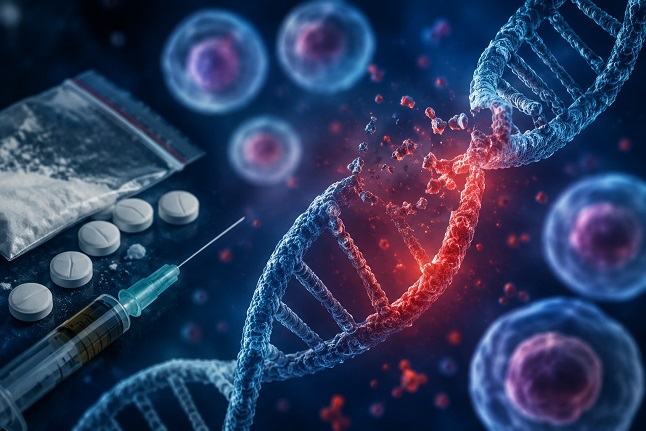 Scientists have found that two emerging nitazene opioids can damage human DNA and increase oxidative stress in
laboratory-grown human cells
The study focused on two emerging nitazene compounds, metodesnitazene and etodesnitazene, both of which have increasingly appeared in illicit drug markets. Most of these illegal opioids are either made in China or in India for distribution/sale to Western markets.
Researchers discovered that these substances can cause genetic damage in human cells while also increasing oxidative stress, a process known to contribute to aging, disease development, and cellular dysfunction.
The research was conducted by scientists from the Department of Pharmacy and Biotechnology, Alma Mater Studiorum University of Bologna; the Department of Biomedical and Neuromotor Sciences, Alma Mater Studiorum University of Bologna; the Department of Environmental and Prevention Sciences, University of Ferrara; the Department for Life Quality Studies, Alma Mater Studiorum University of Bologna; the Department of Translational Medicine, University of Ferrara; and the Collaborative Center for the Italian National Early Warning System (NEWS-D), Department of Anti-Drug Policies and Other Addictions, Presidency of the Council of Ministers, Italy.
Nitazenes Are Emerging as a Serious Public Health Threat
Nitazenes are synthetic opioids that were originally developed decades ago as potential painkillers. However, they were never approved for medical use because of safety concerns and a narrow therapeutic window. In recent years, underground drug manufacturers have resurrected these compounds and introduced numerous new variants into the illegal drug supply.
The problem has become increasingly severe because nitazenes are often mixed with heroin, counterfeit prescription medications, and other recreational drugs. Many users are completely unaware that they are consuming these powerful substances.
Health authorities have already linked nitazenes to fatal poisoning outbreaks in several countries. Their potency can rival or exceed that of fentanyl, making them particularly dangerous even in tiny amounts.
Looking Beyond Overdose Risks
While most studies have focused on overdose dangers, scientists wanted to determine whether nitazenes could also cause long-term biological harm.
To investigate, researchers exposed human TK6 cells, a standard laboratory model used for genetic safety testing, to varying concentrations of metodesnitazene and etodesnitazene. They then measured the formation of micronuclei, tiny fragments of chromosomes that appear when DNA becomes damaged.
Micronuclei are widely recognized as important indicators of
genotoxicity, meaning a substance has the ability to harm genetic material and potentially contribute to future disease processes.
The results were concerning. Metodesnitazene caused a significant increase in DNA damage markers even at relatively low concentrations. Etodesnitazene also produced genetic damage, although the effects became apparent only at higher exposure levels.
DNA Damage Occurred Even When Cells Survived
One of the most alarming findings was that many cells remained alive despite accumulating genetic damage.
Normally, severely damaged cells are eliminated through protective biological mechanisms. However, the researchers observed that these nitazenes could injure DNA without causing widespread cell death. This means damaged cells could potentially continue dividing and pass genetic abnormalities to future generations of cells.
Further testing examined what happened after the drugs underwent metabolic processing similar to what occurs inside the human body. Metodesnitazene showed even stronger DNA-damaging effects after metabolic activation, suggesting that some of its breakdown products may be particularly harmful.
This
Medical News report notes that genetic damage is a major concern because persistent DNA alterations have long been associated with the development of cancer, neurodegenerative disorders, and other chronic diseases.
Oxidative Stress May Be Part of the Problem
To better understand how the damage occurs, the research team also investigated oxidative stress.
Both nitazenes increased production of reactive oxygen species, commonly called ROS. These highly reactive molecules can attack DNA, proteins, and cell membranes, causing widespread cellular injury.
Metodesnitazene triggered a rapid increase in oxidative stress within hours of exposure. Etodesnitazene also increased ROS production, although its effects appeared later.
The findings suggest that oxidative stress may be one of the mechanisms contributing to the genetic damage observed in the study.
Growing Concerns About Long-Term Health Effects
The researchers emphasized that the experiments were conducted in laboratory-grown human cells and do not directly predict what happens in people.
Nevertheless, the findings provide some of the strongest evidence to date that certain nitazenes may possess genotoxic properties.
The study also revealed that even minor chemical differences between nitazene compounds can dramatically alter their biological effects, making it difficult for health authorities to predict the risks posed by newly emerging variants.
In conclusion, the research suggests that metodesnitazene and etodesnitazene may pose dangers that extend beyond overdose and addiction. By damaging DNA and promoting oxidative stress, these substances could potentially contribute to long-term health problems that remain largely unexplored. As nitazenes continue to spread through global illicit drug markets, scientists stress the importance of expanded toxicological studies, improved monitoring, and greater public awareness of the hidden risks associated with these powerful synthetic opioids.
The study findings were published in the peer reviewed International Journal of Molecular Sciences.
https://www.mdpi.com/1422-0067/27/12/5360
For the latest on illegal opioids and their dangerous effects on human health, keep on logging to Thailand
Medical News.
Read Also:
https://www.thailandmedical.news/news/sharp-rise-in-deaths-linked-to-novel-benzodiazepines-raises-public-health-concerns
https://www.thailandmedical.news/news/fake-drugs-from-illicit-online-pharmacies-found-to-contain-deadly-opioids-and-are-causing-many-deaths-in-the-united-kingdom
https://www.thailandmedical.news/news/popular-painkiller-prescribed-often-by-doctors-linked-to-long-term-brain-decline-in-younger-adults




 Share
Share
 Tweet
Tweet
 Share
Share