The Cholinergic System Under Siege: Exploring Acetylcholine and the Battle Against Long COVID
Nikhil Prasad Fact checked by:Thailand Medical News Team Aug 03, 2026 2 months, 19 hours, 5 minutes ago
For millions of people living with post-acute sequelae of SARS-CoV-2 (PASC), better known as long COVID, the search for effective treatments has been marked by uncertainty and frustration. Persistent symptoms such as crushing fatigue, memory impairment, poor concentration, dizziness, abnormal heart rate, digestive disturbances, and exercise intolerance often continue for months or even years after the initial infection has resolved. Standard laboratory tests and imaging frequently fail to explain these lingering problems, leaving many patients without clear answers.
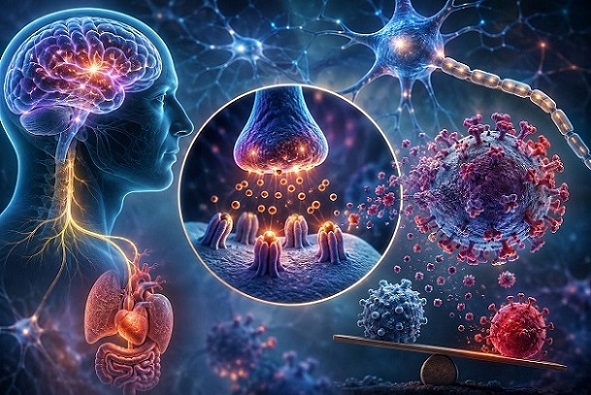 Scientists uncover mounting evidence that disrupted acetylcholine signaling may be a central driver of long COVID, opening new possibilities for targeted therapies
An increasingly influential body of scientific evidence now points toward dysfunction of the body's cholinergic signaling system as a major contributor to long COVID. At the heart of this network lies acetylcholine, an essential neurotransmitter that regulates cognition, learning, memory, muscle activity, heart rhythm, digestion, and communication between the nervous and immune systems. This
Thailand Medical News report examines how growing evidence suggests that disruptions in acetylcholine signaling may help explain the complex and multisystem nature of long COVID.
Recent research, including a landmark investigation by scientists from Tokyo Jikei University School of Medicine, has provided compelling evidence that patients experiencing severe long COVID fatigue and depression have significantly reduced acetylcholine levels within the brain. The findings strengthen the hypothesis that long COVID is not merely a lingering viral illness but also a disorder involving impaired cholinergic neurotransmission.
The Cholinergic Hypothesis: How the Spike Protein Blockades Receptors
Under normal physiological conditions, acetylcholine plays a central role in maintaining communication between the brain, peripheral nerves, and vital organs. It is equally important in regulating immune activity through the cholinergic anti-inflammatory pathway, a mechanism largely mediated by alpha-7 nicotinic acetylcholine receptors (α7 nAChRs) found on immune cells. When acetylcholine binds to these receptors, it suppresses excessive inflammatory responses, preventing immune-mediated tissue damage.
Researchers have proposed that SARS-CoV-2 may interfere directly with this protective system. Molecular modeling studies and theoretical investigations indicate that portions of the viral spike protein possess structural similarities to certain neurotoxins known to target nicotinic acetylcholine receptors. These spike protein fragments may bind with high affinity to nAChRs, effectively occupying receptor sites without activating them.
If this occurs, acetylcholine is prevented from binding normally, disrupting neural communication and weakening the body's natural anti-inflammatory brake. The resulting impairment could contribute to persistent immune activation, chronic low-grade inflammation, and autonomic nervous system dysfunction. Scientists believe this mechanism may help explain why many long COVID patients develop symptoms inclu
ding Postural Orthostatic Tachycardia Syndrome (POTS), abnormal heart rate regulation, gastrointestinal dysmotility, cognitive impairment, poor memory, and debilitating fatigue.
The Japanese study adds further weight to this hypothesis by demonstrating measurable reductions in central acetylcholine activity among patients with severe long COVID manifestations. Researchers found that lower acetylcholine availability closely correlated with worsening fatigue and depressive symptoms, suggesting that cholinergic dysfunction is not simply associated with the illness but may actively drive many of its neurological and systemic complications.
The Nicotine Patch Experiment: Displacing the Viral Remnants
The possibility that spike protein fragments may occupy nicotinic acetylcholine receptors has inspired one of the most unconventional therapeutic approaches proposed for long COVID: low-dose nicotine replacement therapy.
Popularized through the Leitzke hypothesis and other theoretical publications, the concept is based on nicotine's exceptionally strong affinity for nicotinic acetylcholine receptors. Investigators propose that nicotine binds to these receptors far more effectively than acetylcholine and may potentially compete with or displace residual spike protein fragments that remain attached to receptor sites. If successful, normal receptor activity could gradually resume, allowing acetylcholine signaling to recover and restoring communication between the nervous and immune systems.
This hypothesis rapidly attracted attention within long COVID patient communities. Small published case reports and observational case series described individuals experiencing noticeable improvements after using low-dose transdermal nicotine patches. Reported benefits included increased energy levels, reduced brain fog, improved concentration, enhanced mental clarity, better exercise tolerance, and partial relief from chronic fatigue, sometimes within only several days of treatment.
Researchers note that transdermal nicotine patches provide a slow and relatively stable delivery of nicotine compared with smoking or vaping, reducing rapid fluctuations in blood nicotine levels. Preliminary observations have suggested that short-term therapeutic use in non-smokers may carry a relatively low risk of dependence when carefully supervised, although robust evidence remains unavailable.
Despite these encouraging reports, scientists emphasize that the available evidence remains preliminary. Most published data consist of isolated case studies, computational modeling, theoretical analyses, and patient-led observational surveys rather than rigorous clinical investigations capable of establishing effectiveness or safety.
The Crucial Need for Rigorous Clinical Trials
Although the cholinergic hypothesis has become one of the most promising biological explanations for long COVID, substantial scientific questions remain unanswered. No large randomized, placebo-controlled clinical trials have yet confirmed that nicotine patches consistently improve long COVID symptoms or that receptor blockade by spike protein fragments occurs to the extent proposed.
Nicotine itself presents important safety concerns. As a potent stimulant, it can constrict blood vessels, increase heart rate, elevate blood pressure, and potentially aggravate cardiovascular instability. For patients already suffering from dysautonomia, POTS, palpitations, hypertension, or irregular blood pressure, unsupervised nicotine therapy could worsen existing symptoms rather than relieve them. Additional adverse effects including nausea, dizziness, headaches, sleep disturbances, vivid dreams, and skin irritation may further limit tolerability.
Consequently, medical experts strongly discourage self-treatment outside professional supervision. Instead, researchers are pursuing multiple evidence-based therapeutic strategies aimed at restoring cholinergic balance and autonomic regulation. The U.S. National Institutes of Health RECOVER Initiative continues evaluating interventions ranging from non-invasive vagus nerve stimulation and cognitive rehabilitation therapies to repurposed pharmaceutical agents that enhance cholinergic neurotransmission.
Particularly encouraging are findings from the Tokyo Jikei University School of Medicine study, where investigators successfully used medications originally developed for Alzheimer's disease that inhibit acetylcholine breakdown. By increasing acetylcholine availability within the brain, these drugs significantly improved fatigue and depressive symptoms in selected long COVID patients, offering a potentially safer pharmacological approach than nicotine while directly targeting the underlying cholinergic deficit identified by researchers.
As scientific understanding continues to evolve, the cholinergic system is emerging as one of the most important frontiers in long COVID research. Growing evidence suggests that restoring acetylcholine signaling could simultaneously address neurological dysfunction, chronic inflammation, autonomic imbalance, and cognitive impairment. While much remains to be validated through carefully designed clinical trials, these discoveries provide an increasingly coherent biological explanation for many of the condition's most disabling symptoms and may ultimately pave the way toward targeted therapies capable of improving the lives of millions of long COVID sufferers worldwide.
References:
https://www.frontiersin.org/journals/pharmacology/articles/10.3389/fphar.2026.1807203/full
https://link.springer.com/article/10.1186/s42234-025-00167-8
https://www.sciencedirect.com/science/article/pii/S2214750020304583
https://www.sciencedirect.com/science/article/pii/S2589004223010313
https://link.springer.com/article/10.1186/s42234-023-00104-7
https://esmed.org/cholinergic-anti-inflammatory-pathway-and-covid-19-insights/
https://esmed.org/cholinergic-pathway-vagus-nerve-and-nicotine-in-covid-19/
https://linkinghub.elsevier.com/retrieve/pii/S1357272524000104
https://www.mcgill.ca/oss/article/medical-health-and-nutrition-pseudoscience/strange-story-nicotine-patches-treat-long-covid
https://febs.onlinelibrary.wiley.com/doi/10.1111/febs.15521
https://www.researchsquare.com/article/rs-2063399/v1
https://www.wjgnet.com/2220-3141/full/v11/i4/228.htm
https://publications.ersnet.org/content/erjor/7/2/00713-2020
https://www.sciencedirect.com/science/article/pii/S2590041221000337
https://books.brightlearn.ai/c278d7e3-09db-47bf-b0c8-a79a6fcf93fe/the-open-gate-2nd-edition-unlocking-the-acetylcholine-storm-in-long-covid-and-beyond-c278d7e3-en.pdf
https://link.springer.com/article/10.1186/s42234-023-00104-7
https://www.sciencedirect.com/science/article/pii/S2214750020304583
For the latest on Long COVID-19 news, keep on logging to Thailand
Medical News.
Read Also:
https://www.thailandmedical.news/articles/long-covid




 Share
Share
 Tweet
Tweet
 Share
Share

































