Study Finds That SARS-CoV-2 BA.2.86 and JN.1 Variants Exhibit Enhanced Tropism for the Intestines and also Intestinal Adaptation
Nikhil Prasad Fact checked by:Thailand Medical News Team Jun 08, 2026 3 months, 3 weeks, 5 days, 4 hours, 14 minutes ago
Medical News: A new study by researchers in Hong Kong has revealed that two SARS-CoV-2 variants, BA.2.86 and JN.1, possess a unique biological advantage that may have helped them spread widely around the world. Unlike many previous Omicron variants that primarily focused on the respiratory tract, these newer variants appear to have developed an enhanced ability to infect and replicate in the human small intestine. The findings provide fresh insights into how SARS-CoV-2 continues to evolve and adapt within the human body.
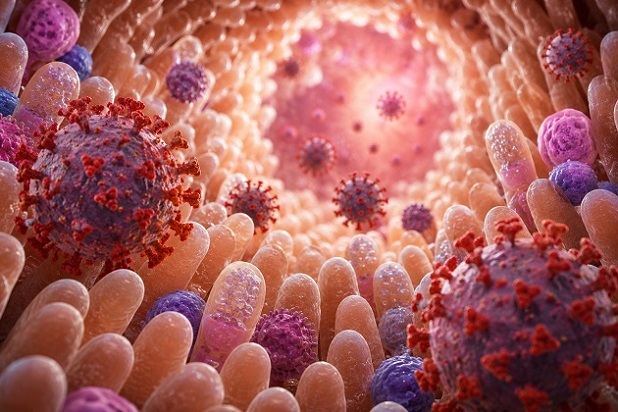 New research shows that SARS-CoV-2 BA.2.86 and JN.1 variants have evolved a remarkable ability to infect and
replicate within the human small intestine
The study was conducted by scientists from the School of Public Health, Li Ka Shing Faculty of Medicine, The University of Hong Kong; the Centre for Immunology and Infection (C2I), Hong Kong Science Park; and the Department of Pathology, Li Ka Shing Faculty of Medicine, The University of Hong Kong.
Researchers Investigate Tissue Preferences of Emerging Variants
Since the appearance of the Omicron variant in late 2021, numerous descendants have emerged, including BA.5, XBB.1.5, EG.5.1, BA.2.86, and JN.1. Although many studies have focused on immune evasion and respiratory transmission, less attention has been given to whether these variants prefer infecting different organs and tissues.
To answer this question, the research team used human bronchial tissues, lung tissues, airway organoids, colon cells, and laboratory-grown human proximal intestinal enteroids that closely mimic the upper small intestine. By comparing the replication abilities of multiple variants in these models, the scientists were able to determine where each variant grew most efficiently.
BA.2.86 and JN.1 Show Enhanced Ability to Infect the Small Intestine
One of the most important discoveries was that BA.2.86 and JN.1 replicated far more efficiently in proximal intestinal enteroids than the EG.5.1 variant. While EG.5.1 excelled in respiratory tissues, BA.2.86 and JN.1 demonstrated a clear preference for cells found in the upper small intestine.
The researchers observed that these variants successfully infected multiple intestinal cell types, including enterocytes, goblet cells, and Paneth cells. Enterocytes are responsible for nutrient absorption, goblet cells produce protective mucus, and Paneth cells play a crucial role in maintaining gut immunity. The ability to infect all of these cell types suggests that BA.2.86 and JN.1 have become particularly well adapted to the intestinal environment.
Importantly, this enhanced intestinal tropism was not observed in the same way within colon cells, indicating that the small intestine may be a particularly favorable site for these variants.
Respiratory Fitness Was Lower Than Some Earlier Variants
Although BA.2.86 and JN.1 performed well in intestinal tissues, they did not replicate as efficiently in respiratory tissues as certain other variants.
The study found that BA.5, XBB.1.5, and especially EG.5.1 achieved significan
tly higher replication levels in human bronchial and lung tissues. EG.5.1 also demonstrated enhanced infection of lung cells associated with more severe respiratory disease.
These findings suggest that BA.2.86 and JN.1 may have followed a different evolutionary path. Rather than maximizing replication in the respiratory tract, these variants appear to have gained advantages through adaptation to the intestinal tract.
Possible Implications for Viral Shedding and Transmission
Another significant finding involved the immune response triggered by these variants. JN.1 generated relatively low levels of pro-inflammatory cytokines despite replicating efficiently in intestinal tissues. This means the virus may be capable of extensive replication without causing strong intestinal symptoms.
The researchers noted that previous clinical studies have reported increased viral shedding in fecal samples from individuals infected with BA.2.86 and JN.1. Their laboratory findings provide a possible explanation for these observations.
This
Medical News report notes that efficient intestinal replication combined with limited inflammation may allow infected individuals to shed virus through fecal material while experiencing few or no digestive symptoms. Such characteristics could potentially support continued transmission and contribute to the widespread success of these variants.
ACE2 Receptors Play a Key Role
The study also revealed that BA.2.86 and JN.1 depend heavily on ACE2 receptors and the TMPRSS2 enzyme to infect intestinal cells. The small intestine naturally contains high levels of ACE2 receptors, making it an ideal environment for these variants.
When researchers blocked ACE2 or TMPRSS2 activity, viral replication dropped dramatically. JN.1 was particularly dependent on ACE2, suggesting that stronger receptor utilization may be a key factor behind its enhanced intestinal adaptation.
These findings help explain why BA.2.86 and JN.1 replicate so effectively in the small intestine and may partially account for their ability to outcompete other variants in global circulation.
Conclusions
The findings demonstrate that SARS-CoV-2 continues to evolve through complex biological adaptations that extend beyond the respiratory tract. BA.2.86 and JN.1 appear to have developed enhanced tropism for the human small intestine and show clear evidence of intestinal adaptation. Their ability to efficiently infect multiple intestinal cell types, exploit ACE2-rich environments, and replicate while inducing relatively limited inflammation may provide important advantages for persistence and transmission. The study highlights the importance of monitoring gastrointestinal infection patterns alongside respiratory disease characteristics when evaluating future SARS-CoV-2 variants. Understanding these adaptations may prove critical for anticipating how emerging variants spread and for developing more comprehensive surveillance strategies in the years ahead.
The study findings were published in the peer reviewed journal: Nature Communications.
https://www.nature.com/articles/s41467-026-74111-y
For the latest COVID-19 news, keep on logging to Thailand
Medical News.
Read Also:
https://www.thailandmedical.news/articles/coronavirus
https://www.thailandmedical.news/articles/long-covid




 Share
Share
 Tweet
Tweet
 Share
Share

































