Researchers from Japan Warn That COVID-19 Can Cause Platypnea-Orthodeoxia Syndrome
Nikhil Prasad Fact checked by:Thailand Medical News Team Jul 19, 2026 1 month, 2 weeks, 16 hours, 18 minutes ago
Medical News: A team of researchers from the Department of Rehabilitation at Saitama Cardiovascular and Respiratory Center, the Department of Rehabilitation at Saitama Medical University International Medical Center, and the Department of Rehabilitation at Hannou Seiwa Hospital, all in Saitama, Japan, is warning that COVID-19 can leave some patients with a rare but potentially disabling complication known as Platypnea-Orthodeoxia Syndrome (POS). While most people associate COVID-19 recovery with gradually improving breathing, this unusual condition causes the exact opposite when patients sit or stand, making even simple daily activities extremely difficult.
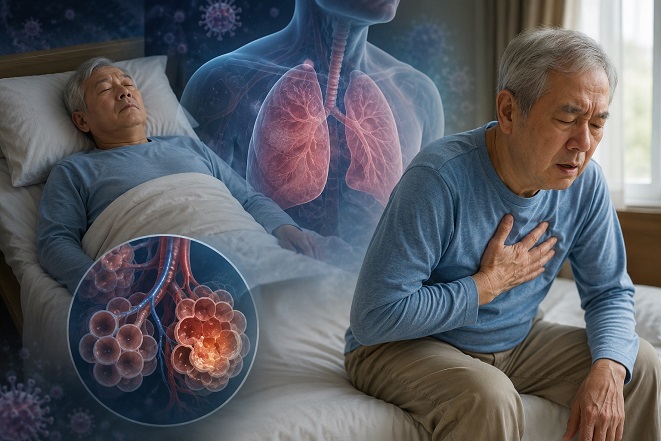 Japanese researchers report that COVID-19 can cause prolonged Platypnea-Orthodeoxia Syndrome, leaving patients
breathless and dangerously low on oxygen whenever they sit or stand
The researchers described the case of a 76-year-old man whose symptoms persisted for more than 100 days after developing COVID-19 pneumonia, showing that the condition can continue well beyond the acute phase of infection.
What Is Platypnea-Orthodeoxia Syndrome?
Platypnea-Orthodeoxia Syndrome is a rare medical condition in which a person develops severe shortness of breath when sitting or standing upright, but the symptoms improve almost immediately after lying down. "Platypnea" refers to breathlessness caused by being upright, while "orthodeoxia" refers to a significant drop in blood oxygen levels in the same position.
Doctors diagnose the condition when blood oxygen saturation falls by at least 5 percent or arterial oxygen levels decrease significantly after moving from a lying position to sitting or standing. In many cases, POS is caused by blood flowing through an abnormal opening in the heart, such as a patent foramen ovale (PFO) or an atrial septal defect (ASD), allowing oxygen-poor blood to bypass the lungs. It can also develop because of lung disorders that create severe ventilation-perfusion mismatch, where blood continues flowing through damaged parts of the lungs that are no longer able to absorb enough oxygen.
An Unusual COVID-19 Complication
The patient initially received antiviral medications, antibiotics and corticosteroids for COVID-19 pneumonia and gradually improved. However, every time he sat upright, his oxygen levels dropped dramatically into the 70 percent range within about one minute, leaving him breathless and unable to participate in rehabilitation.
After transfer to a rehabilitation ward, doctors performed detailed testing. They found that his oxygen saturation fell from 97 percent while lying down to just 84 percent after sitting for 20 minutes. His arterial oxygen level also dropped by 21.9 mmHg, confirming Platypnea-Orthodeoxia Syndrome. Chest CT scans showed persistent ground-glass opacities, scarring and fibrotic changes affecting both lower lungs. Further investigations ruled out heart defects and pulmonary embolism, indicating that lingering COVID-19 lung damage was responsible for the syndrome.
Rehabilitation Offered Hope Despite Months of Illness
Rather than using intensive exercise, the rehabili
tation team adopted frequent short therapy sessions combined with diaphragmatic breathing, pursed-lip breathing and gradual sitting and standing exercises while carefully adjusting supplemental oxygen. This
Medical News report highlights that therapists immediately stopped each session whenever oxygen levels became unsafe, allowing the patient to recover while lying flat before resuming therapy.
As treatment progressed, the patient gradually tolerated sitting for longer periods. Standing exercises began around day 46, walking exercises started on day 61, and his ability to perform everyday activities steadily improved. Although he still required home oxygen therapy at discharge, he became independent in eating and toileting, required only minimal assistance for transfers and was able to return home after approximately 100 days of rehabilitation.
The researchers explained that aggressive exercise could have worsened the patient's condition because damaged lower lung tissue was unable to adequately oxygenate the increased blood flow during physical activity. Instead, carefully paced rehabilitation helped prevent muscle loss while gradually improving breathing efficiency and physical function.
Important Lessons for Doctors and Patients
The case demonstrates that Platypnea-Orthodeoxia Syndrome following COVID-19 may be overlooked because oxygen levels often appear normal while patients are lying in bed. Unless healthcare providers specifically measure oxygen levels after patients sit or stand, the disorder can easily go undiagnosed. The researchers emphasize that prolonged breathlessness during recovery should never be dismissed, particularly when symptoms worsen in an upright position.
Conclusions
The findings demonstrate that Platypnea-Orthodeoxia Syndrome is an important but underrecognized long-term complication of COVID-19 pneumonia that can persist for several months. Early recognition, posture-based oxygen testing, careful rehabilitation, appropriate oxygen supplementation and timely planning for home oxygen therapy can significantly improve independence and quality of life, even when permanent lung damage prevents complete recovery.
The study findings were published in the peer reviewed Japanese Journal of Comprehensive Rehabilitation Science.
https://www.jstage.jst.go.jp/article/jjcrs/17/0/17_46/_article
For the latest COVID-19 news, keep on logging to Thailand
Medical News.
Read Also:
https://www.thailandmedical.news/articles/coronavirus
https://www.thailandmedical.news/articles/long-covid




 Share
Share
 Tweet
Tweet
 Share
Share

































