Peptides from the Diatom Microalgae Phaeodactylum Tricornutum Exhibit Antiviral Properties Against SARS-CoV-2
Nikhil Prasad Fact checked by:Thailand Medical News Team Mar 26, 2026 5 months, 1 week, 8 hours, 52 minutes ago
Medical News: Scientists are continuing to search for safer and more effective ways to fight COVID-19, especially as new variants keep emerging. A new study has now revealed that a marine microalgae called Phaeodactylum tricornutum could provide a natural solution. Researchers found that tiny protein fragments, known as peptides, derived from this microalgae show strong antiviral activity against SARS-CoV-2 while remaining safe for human cells.
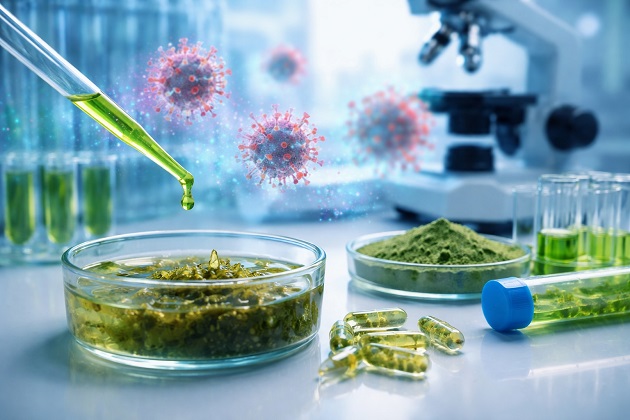 Natural microalgae peptides show strong antiviral effects against COVID-19 with low toxicity
A Natural Source of Antiviral Compounds
Natural microalgae peptides show strong antiviral effects against COVID-19 with low toxicity
A Natural Source of Antiviral Compounds
Marine microalgae are increasingly being studied because they produce a wide range of bioactive compounds. These natural substances are often less toxic and more compatible with the human body compared to synthetic drugs. In this case, scientists focused on peptides obtained from Phaeodactylum tricornutum, a fast-growing microalgae known for its rich protein content and ability to produce useful biological molecules.
Who Conducted the Study
The research was carried out by scientists from the Laboratorio de Virología Molecular at the Unidad de Investigación Biomédica de Zacatecas, Instituto Mexicano del Seguro Social; the Facultad de Medicina at Universidad Autónoma de Sinaloa; the Department of Infectomics and Molecular Pathogenesis at CINVESTAV-IPN; the Instituto Nacional de Perinatología “Isidro Espinosa de los Reyes”; Investigadores por México (SECIHTI); and the Faculty of Medicine at Autonomous University of Sinaloa, all based in Mexico.
How the Study Was Done
Researchers extracted proteins from the microalgae and broke them down into smaller peptides. These peptides were grouped based on their size and then tested on human lung cells infected with the SARS-CoV-2 Omicron variant. The goal was to evaluate both their safety and their ability to reduce viral infection.
Strong Safety Profile Observed
One of the most important findings was the low toxicity of these peptides. Even at high concentrations, most of the peptide groups did not significantly damage the human cells. Larger peptide groups, particularly those in the 10–30 kDa and 5–10 kDa range, maintained high levels of cell survival.
In contrast, a commonly studied antiviral drug used for comparison showed a clear increase in toxicity as its concentration increased. This suggests that the microalgae-derived peptides may offer a much safer alternative.
Powerful Antiviral Effects
The study also showed that these peptides can effectively reduce SARS-CoV-2 infection in cells. Smaller peptides worked quickly at lower doses but produced inconsistent results. Larger peptides, however, showed stronger and more reliable antiviral effects as their concentration increased.
At higher doses, the larger peptide groups were able to reduce infection levels to nearly the same as uninfected cells. This indicates that they may interfere with the virus’s ability
to replicate or infect new cells.
Why Size Makes a Difference
An important discovery was that the effectiveness of these peptides depends on their size. Larger peptides appear to interact more strongly with key viral components, making them more stable and effective at blocking infection.
This
Medical News report highlights that while smaller peptides may act faster, larger peptides provide more consistent and sustained antiviral activity, making them more suitable for future drug development.
Better Balance Between Safety and Effectiveness
Compared to the reference antiviral drug used in the study, the microalgae peptides demonstrated a better balance between safety and antiviral activity. They were able to reduce viral infection while maintaining high cell viability, which is a key factor in developing safe treatments.
What Comes Next
Researchers plan to identify the specific peptides responsible for the antiviral effects and understand how they work at a molecular level. Further studies in more advanced biological models and eventually in humans will be needed before these findings can be translated into real-world treatments.
Conclusion
This study offers promising evidence that marine microalgae could become an important source of new antiviral therapies. The peptides derived from Phaeodactylum tricornutum showed strong ability to reduce SARS-CoV-2 infection while maintaining a high safety profile in laboratory conditions. Their size-dependent effectiveness provides valuable insight into how natural compounds can be optimized for better results. With continued research, these peptides could play a key role in developing safer and more effective antiviral treatments for COVID-19 and other emerging viral threats.
The study findings were published in the peer reviewed journal: Marine Drugs.
https://www.mdpi.com/1660-3397/24/4/122
For the latest on COVID-19, keep on logging to Thailand
Medical News.
Read Also:
https://www.thailandmedical.news/articles/coronavirus




 Share
Share
 Tweet
Tweet
 Share
Share