Nikhil Prasad Fact checked by:Thailand Medical News Team Apr 16, 2026 5 months, 2 weeks, 4 days, 2 hours, 46 minutes ago
Medical News: A major new study is reshaping how scientists understand chronic diseases, revealing that common herpesviruses may be quietly influencing long-term health by triggering immune responses against the body itself. Using cutting-edge antibody profiling, researchers have uncovered thousands of previously hidden links between viral exposures and autoantigens - human proteins that become unintended targets of the immune system.
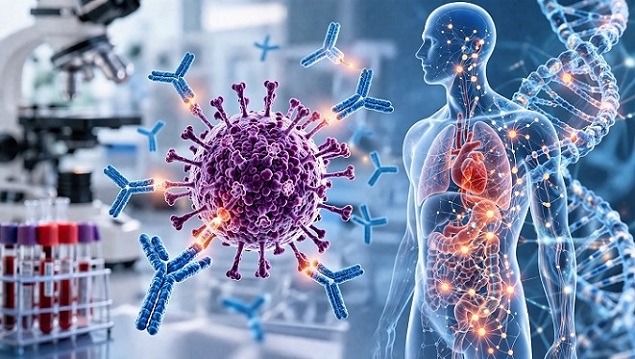 New research maps how herpesvirus-driven immune reactions may silently contribute to chronic diseases
A New Way to Map the Immune System
New research maps how herpesvirus-driven immune reactions may silently contribute to chronic diseases
A New Way to Map the Immune System
In this large-scale investigation, scientists analyzed blood samples from two major cohorts within the Mass General Brigham Biobank, tracking immune responses in more than 2,000 individuals. By examining immunoglobulin G (IgG) antibodies, the team measured how the body reacts to over 4,600 herpesvirus peptides and more than 15,000 human proteins simultaneously.
The research team included experts from the Channing Division of Network Medicine at Brigham and Women’s Hospital, Harvard T.H. Chan School of Public Health, Massachusetts General Hospital, Duke University, Boston Children’s Hospital, University of Strathclyde, and Johns Hopkins School of Medicine.
This approach allowed researchers to build what they describe as a “reactome” - a comprehensive map of immune activity linking past viral infections to potential autoimmune reactions.
Thousands of Hidden Viral - Human Connections
The findings were remarkable. In the initial analysis, over 19,000 associations were identified between herpesvirus fragments and human proteins. After rigorous validation in a second independent group, 3,943 of these associations were confirmed, spanning 93 distinct autoantigens.
Importantly, most of these autoantigens were linked to specific viruses rather than shared broadly, suggesting that each herpesvirus leaves a unique immune signature. Cytomegalovirus (CMV) showed the widest influence, connecting to 43 different autoantigens, while Epstein-Barr virus (EBV), herpes simplex virus type 1 (HSV-1), and HSV-2 also demonstrated strong but more focused patterns.
Among the most striking examples was a powerful association between HSV-1 and the human protein PHLDA1. This link was consistently observed across datasets and showed extremely strong statistical significance. Similarly, CMV was strongly tied to ZNF550, FUT8, and IQCB1—proteins that may play roles in immune regulation and disease development.
Predicting Autoimmunity Before It Appears
One of the most important breakthroughs in the study was the ability to predict autoimmune responses based on viral exposure patterns. The researchers found that antibody reactions to specific viral peptides could predict the presence of certain autoantibodies with more than 85 percent accuracy.
For example, CMV-related immune signatures successfully predicted multiple autoantigen responses, while EBV and HSV-1 were linked to specific targets such as PSMB6, KCNMB3, and PHLDA1. These predictive relationships suggest that viral exposure history ma
y serve as an early warning system for future disease risk.
This
Medical News report highlights how such predictive immune markers could eventually allow doctors to identify individuals at risk for autoimmune diseases years before symptoms develop.
Molecular Mimicry and Immune Confusion
The study also provides strong evidence for molecular mimicry, a process in which viral proteins resemble human proteins closely enough to confuse the immune system. In several cases, viral peptides shared structural similarities with autoantigens, making it more likely that immune responses could mistakenly target healthy tissues.
For instance, segments of HSV-1 closely resembled regions of PHLDA1, while CMV peptides showed similarity to ZNF550. These overlaps offer a plausible biological explanation for how infections may initiate autoimmune reactions without direct tissue damage.
Links to Chronic Diseases Across the Body
Beyond immune reactions, the researchers mapped how these viral–autoantigen interactions connect to real-world health outcomes. By integrating long-term medical records, they identified networks linking viral exposure to a wide range of diseases.
CMV emerged as the most influential virus, forming a large network connected to autoimmune disorders, cancers, cardiovascular conditions, and neurological diseases. It was associated with conditions such as Sjögren’s syndrome, multiple sclerosis, melanoma, and even cognitive decline.
EBV displayed a different pattern, acting through fewer but more versatile autoantigens that linked autoimmune diseases, cardiovascular issues, and respiratory conditions. Meanwhile, HSV-1 and HSV-2 were associated with more compact networks, particularly involving respiratory and inflammatory diseases.
Why These Findings Matter
The implications of this research are far-reaching. Instead of viewing chronic diseases as isolated conditions, the study suggests they may be connected through shared immune pathways shaped by past viral infections. This could help explain why many patients develop multiple conditions over time.
Conclusion
This study provides one of the most comprehensive views to date of how common viral infections may influence human health far beyond the initial illness. By mapping thousands of herpesvirus–autoantigen associations and linking them to chronic disease outcomes, researchers have uncovered a complex immune network that could redefine how diseases are predicted, prevented, and treated.
While the findings do not prove direct causation, they offer a powerful framework for future research and open the door to earlier detection and targeted interventions that may reduce the burden of chronic diseases worldwide.
The study findings were published in the peer reviewed journal: Research Square.
https://www.researchsquare.com/article/rs-9371123/v1
For the latest research on herpesviruses, keep on logging to Thailand
Medical News.
Read Also:
https://www.thailandmedical.news/articles/stds




 Share
Share
 Tweet
Tweet
 Share
Share

































