Nikhil Prasad Fact checked by:Thailand Medical News Team Jun 05, 2026 3 months, 4 weeks, 1 day, 4 hours, 56 minutes ago
Medical News: Scientists Discover Natural Molecule That Restores Cellular Cleanup Systems
A team of international researchers has identified a naturally occurring marine compound that could open a new avenue in the fight against Alzheimer’s disease. The molecule, known as Sarmentoside B, was found to help brain cells remove toxic amyloid protein accumulations by restoring the cells’ internal waste disposal systems and reducing processes linked to neurodegeneration.
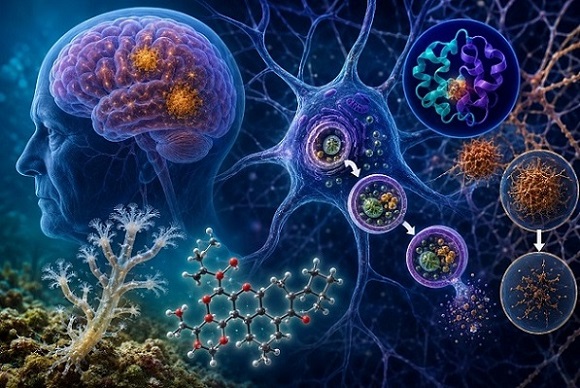 Marine-derived Sarmentoside B helped brain cells clear toxic amyloid aggregates and restored critical cellular
recycling functions linked to Alzheimer’s disease
Alzheimer’s disease is the most common form of dementia and affects millions of people worldwide. One of its defining characteristics is the buildup of beta-amyloid proteins in the brain. These proteins clump together to form toxic aggregates that damage neurons, interfere with communication between brain cells, and contribute to memory loss and cognitive decline.
The new study was conducted by researchers from the Laboratório de Produtos Naturais, Universidade São Francisco, Bragança Paulista, Brazil; the Laboratório de Bioquímica e Biofísica, Instituto Butantan, São Paulo, Brazil; and the Centre for Motor Neuron Disease Research and the Institute for Molecular Biosciences, The University of Queensland, Brisbane, Australia.
Searching the Ocean for New Alzheimer’s Treatments
Because Alzheimer’s disease involves multiple biological processes, scientists are increasingly looking beyond traditional drug targets. Marine organisms have become an important source of potential therapeutic compounds because they produce a wide variety of unique chemicals not commonly found on land.
The researchers focused on Eudendrium carneum, a marine hydrozoan. After separating its chemical components, they tested 12 different fractions on human neuron-like cells that had been exposed to toxic oligomerized beta-amyloid proteins.
Among all the fractions tested, one known as EC5 demonstrated the strongest neuroprotective activity. Further chemical analysis suggested that the active compound was Sarmentoside B, a steroid glycoside that has previously been reported in certain plants and microorganisms but had not been extensively studied for its effects on Alzheimer’s-related cellular damage.
Remarkable Protection Against Neuronal Death
The laboratory experiments showed that exposure to toxic amyloid proteins significantly reduced neuron survival. However, treatment with Sarmentoside B restored cell viability to nearly normal levels.
Researchers found that neurons exposed to amyloid proteins suffered extensive cellular stress and damage. When Sarmentoside B was introduced, the cells showed a dramatic recovery, indicating that the compound was helping them withstand the toxic effects of amyloid accumulation.
The findings suggest that Sarmentoside B does not merely shield neurons from damage but may actually reverse some of the harmful cellular changes triggered b
y amyloid proteins.
Restoring the Cell’s Recycling Machinery
One of the most important discoveries involved lysosomes, tiny structures inside cells that function as recycling and waste-processing centers.
In healthy neurons, lysosomes break down damaged proteins and cellular debris. In Alzheimer’s disease, however, lysosomal function often becomes impaired, leading to the accumulation of toxic proteins.
The researchers observed that amyloid exposure disrupted lysosomal integrity and reduced the activity of cathepsin D, an enzyme crucial for breaking down unwanted proteins. Treatment with Sarmentoside B restored both lysosomal structure and enzyme activity.
This
Medical News report highlights that restoring lysosomal function may be just as important as directly targeting amyloid proteins themselves. By repairing the cellular machinery responsible for waste disposal, neurons may regain the ability to naturally remove toxic material before irreversible damage occurs.
Blocking a Key Alzheimer’s Disease Pathway
The study also revealed that Sarmentoside B reduced the activity of mTOR, a major cellular regulator that controls growth, metabolism, and autophagy.
Autophagy is the process by which cells identify, collect, and dispose of damaged proteins and organelles. Excessive mTOR activity suppresses autophagy and is frequently observed in Alzheimer’s disease.
Researchers found that amyloid proteins increased mTOR activity, while Sarmentoside B reversed this effect. Computer modeling studies further suggested that the molecule may directly interact with important regions of the mTOR protein, supporting its potential role as an mTOR inhibitor.
This is significant because reactivating autophagy could help neurons eliminate harmful protein accumulations that contribute to disease progression.
Clearing Toxic Amyloid Aggregates
The team also measured amyloid aggregation levels using specialized fluorescent testing methods. Cells exposed to toxic amyloid proteins showed substantial accumulation of protein aggregates.
After treatment with Sarmentoside B, aggregate levels fell dramatically and returned to values similar to those seen in healthy control cells. The findings strongly suggest that the compound enhances the removal of amyloid material from neurons.
Importantly, the molecule did not appear to interfere with calcium signaling or sodium channel function, reducing concerns that it might cause harmful neurological side effects.
Conclusions
The study provides compelling evidence that Sarmentoside B may represent a promising new therapeutic candidate for Alzheimer’s disease. Rather than focusing solely on preventing amyloid formation, the compound appears to restore the cell’s natural ability to remove toxic protein accumulations through improved lysosomal function and enhanced autophagy. By reducing mTOR activity, restoring cathepsin D function, repairing lysosomal integrity, and dramatically lowering amyloid aggregate levels, the molecule demonstrated multiple beneficial effects in laboratory-grown neurons. Although these findings are currently limited to in vitro experiments and much more research is needed before human applications can be considered, the results highlight an exciting new strategy for combating Alzheimer’s disease by rejuvenating the brain’s own cellular cleanup systems.
The study findings were published in the peer reviewed journal: Pharmaceutics.
https://www.mdpi.com/1999-4923/18/6/696
For the latest research on Alzheimer’s Disease, keep on logging to Thailand
Medical News.
Read Also:
https://www.thailandmedical.news/articles/alzheimer,-dementia-




 Share
Share
 Tweet
Tweet
 Share
Share

































