Nikhil Prasad Fact checked by:Thailand Medical News Team Aug 20, 2026 56 minutes ago
A six-week course of specially selected probiotic bacteria may substantially reduce anxiety and depressive symptoms in people struggling with post-COVID syndrome, according to a new randomized clinical trial. The findings add to growing evidence that changes in the gut may influence mental health through the gut-brain connection.
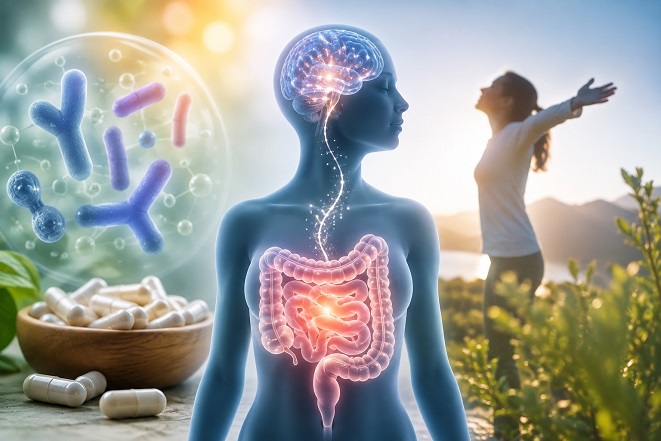 A clinical trial found that six weeks of targeted psychobiotic supplementation significantly reduced anxiety and depressive
symptoms in people with post-COVID syndrome
Researchers tested two bacterial strains known as “psychobiotics” because of their potential effects on psychological well-being: Lactobacillus helveticus Rosell-52 and Bifidobacterium longum Rosell-175. The study involved people experiencing anxiety or depressive symptoms around five to six months after COVID-19.
Researchers And Institutions Involved
The researchers were from the Department of Pediatric Gastroenterology and Metabolic Diseases, Poznan University of Medical Sciences; Complex of Healthcare Institutions in Czarnków; Department of Mathematical and Statistical Methods, Poznan University of Life Sciences; and Department of Bromatology, Poznan University of Medical Sciences, all in Poland.
How The Study Was Conducted
The trial initially randomized 62 adults. Participants received either a daily psychobiotic capsule containing three billion colony-forming units of the two bacterial strains or an identical placebo for six weeks. Ultimately, 56 people completed the study, leaving 28 participants in each group for analysis.
Importantly, this was a randomized, double-blind, placebo-controlled trial, meaning neither participants nor the investigators assessing them knew who was receiving the active supplement.
Anxiety and depression were measured using several established questionnaires, including HADS, GAD-7, BDI and SCL-90. Researchers also measured short-chain fatty acids in stool to explore whether changes inside the gut were connected with psychological improvements.
Anxiety And Depression Fell Sharply
The results were striking. After six weeks, people taking the psychobiotics had significantly lower anxiety and depression scores than those taking placebo.
GAD-7 results showed a 57.2 percent reduction in anxiety severity, while BDI scores indicated a 50.9 percent reduction in depressive symptoms.
The number of people meeting questionnaire thresholds for problems also changed substantially. In the psychobiotic group, HADS-defined anxiety fell from 21 people to four, while GAD-7-defined anxiety dropped from 22 to just two. BDI-defined depression declined from 18 participants to eight.
As highlighted in this Thailand
Medical News report, these changes suggest that the benefit was not merely a small shift in questionnaire scores but was substantial enough to move numerous participants below established symptom thresholds.
Gut Changes May Offer an Important Clue
Researchers found another intriguing result involving butyric acid, a short-chain fatty acid produced through microbial activity in the gut. Butyric acid increased significantly in the psychobiotic group and was higher than in the placebo group at the end of the study.
Changes in acetic, propionic and butyric acids were also correlated with reductions in anxiety measured by HADS. However, the researchers stressed that this association does not prove that these fatty acids caused the psychological improvements.
Important Limitations Remain
The trial was relatively small, did not directly analyze gut microbiome composition and mainly included overweight participants. Researchers also did not study people with severe depression, meaning the results should not be interpreted as evidence that psychobiotics can replace established treatment for serious depressive illness.
Conclusions
The findings suggest that six weeks of Lactobacillus helveticus Rosell-52 and Bifidobacterium longum Rosell-175 supplementation could become a useful supportive approach for some post-COVID patients experiencing anxiety and depressive symptoms. Larger and longer studies involving more diverse populations are now needed to establish how durable the benefits are, determine who is most likely to respond and clarify exactly how gut-derived metabolic changes may influence the brain.
The study findings were published in the peer reviewed journal: Metabolites.
https://www.mdpi.com/2218-1989/16/8/594




 Share
Share
 Tweet
Tweet
 Share
Share