Nikhil Prasad Fact checked by:Thailand Medical News Team Jul 30, 2026 2 months, 4 days, 22 hours, 12 minutes ago
Medical News: For many people, recovering from COVID-19 means the infection is over, but the journey back to full health may be far from complete. A new study from Iran has found that a large proportion of people who were hospitalized with COVID-19 continue to struggle with insomnia months after their recovery, and those persistent sleep problems are closely linked to depressive symptoms. The findings add to growing evidence that COVID-19 can leave lasting effects on mental health long after the virus has been cleared.
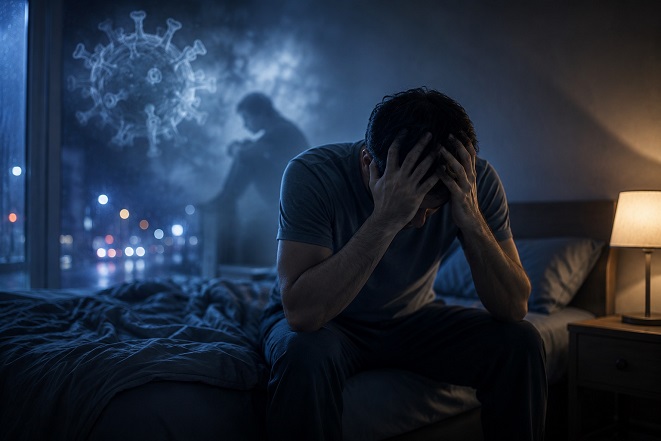 New research shows that many hospitalized COVID-19 survivors continue to experience insomnia and
depression months after recovery, with both conditions appearing to reinforce each other.
Researchers Investigate Lasting Effects of COVID-19
The study was conducted by researchers from the Psychiatry Department, School of Medicine, Zanjan University of Medical Sciences, Hormozgan University of Medical Sciences, and the College of Interdisciplinary Sciences and Technologies at the University of Tehran, all in Iran. The team wanted to determine how common insomnia is among people who had recovered from COVID-19 after being hospitalized and whether poor sleep was associated with depression.
The researchers recruited 70 adults between the ages of 23 and 50 who had previously been hospitalized with PCR-confirmed COVID-19. Every participant had recovered for at least six months before being assessed. Standardized questionnaires were used to evaluate both insomnia severity and depressive symptoms.
Sleep Problems Remain Common Months After Recovery
The results showed that insomnia remained a significant problem even six months after recovery. Overall, 40 percent of participants experienced at least mild insomnia, while 17.1 percent met the criteria for moderate to severe clinical insomnia. Although 60 percent of participants did not have clinically significant sleep problems, nearly two out of every five continued to experience difficulty falling asleep, staying asleep, waking too early, or feeling dissatisfied with their sleep.
The study also found that 30 percent of participants experienced some level of depressive symptoms. Most had mild or moderate symptoms, while a smaller number suffered from severe or very severe depression. These findings suggest that emotional and psychological challenges remain common long after hospitalization for COVID-19.
Depression and Insomnia Reinforce One Another
This
Medical News report highlights the study's most important finding: depressive symptoms were the strongest factor associated with insomnia severity. Statistical analysis showed that for every one-point increase in depression scores, insomnia severity increased by approximately half a point, even after accounting for age, gender, education, employment, income, marital status, place of residence, and other medical conditions.
Interestingly, educational level initially appeared to influence sleep quality, with participants who had higher education reporting less se
vere insomnia. However, after adjusting for other factors, education was no longer an independent predictor, leaving depression as the only factor consistently linked to worsening insomnia.
The researchers believe this relationship is likely bidirectional. Persistent insomnia may increase emotional distress by disrupting normal brain function, reducing resilience to stress, and affecting mood regulation. At the same time, depression can make it harder to fall asleep, cause repeated awakenings during the night, and trigger early morning waking. As a result, both conditions may reinforce one another, creating a cycle that becomes increasingly difficult to break.
Why COVID May Trigger Long-Term Sleep Problems
The researchers suggest several possible reasons for these persistent symptoms. Patients who required hospitalization often experienced isolation, fear, uncertainty, and emotional stress during their illness. In addition, COVID-19 itself may produce lasting biological changes, including persistent inflammation, immune system abnormalities, nervous system involvement, and lingering symptoms such as fatigue, breathing difficulties, pain, and reduced physical activity. Together, these factors may contribute to long-lasting disturbances in both sleep and mental health.
Conclusion
The findings indicate that recovery from COVID-19 should not be measured solely by the disappearance of respiratory symptoms. Many survivors continue to experience a persistent cycle in which insomnia and depression appear to fuel one another months after hospitalization. Routine screening for both sleep disturbances and depressive symptoms, together with timely psychological support and appropriate treatment, may help improve long-term recovery and quality of life for patients recovering from severe COVID-19.
The study findings were published on a preprint server and have yet to be peer reviewed.
https://www.medrxiv.org/content/10.64898/2026.07.26.26358944v1
For the latest COVID-19 news, keep on logging to Thailand
Medical News.
Read Also:
https://www.thailandmedical.news/articles/coronavirus
https://www.thailandmedical.news/articles/long-covid




 Share
Share
 Tweet
Tweet
 Share
Share

































