Nikhil Prasad Fact checked by:Thailand Medical News Team May 06, 2026 4 months, 4 weeks, 21 hours, 32 minutes ago
Medical News: Scientists in China have identified a phytochemical compound from the traditional medicinal herb Rhodiola rosea that could potentially help fight dangerous lung and kidney scarring diseases. The compound, called herbacetin, was found to significantly reduce fibrosis in both lung and kidney tissues by targeting a key pathway linked to organ damage and chronic disease progression.
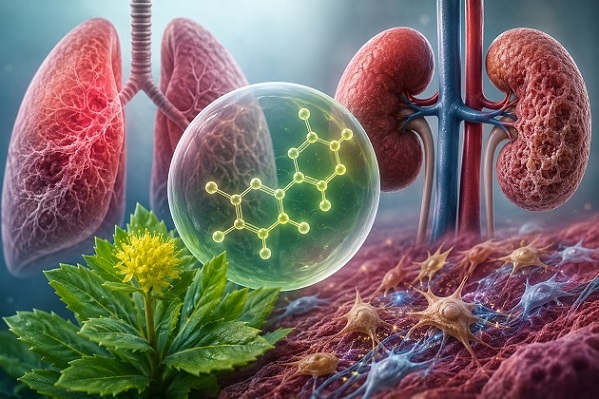 The phytochemical herbacetin from Rhodiola rosea dramatically reduced lung and kidney scarring in new
experimental studies
The research was conducted by scientists from the Guangdong-Hong Kong Joint Laboratory on Immunological and Genetic Kidney Diseases at Guangdong Provincial People's Hospital and Southern Medical University, the State Key Laboratory of Traditional Chinese Medicine Syndrome at Guangzhou University of Chinese Medicine, Xiyuan Hospital of the China Academy of Chinese Medical Sciences in Beijing, the Third Affiliated Hospital of Southern Medical University, the School of Pharmaceutical Sciences at Guangzhou University of Chinese Medicine, and the Chinese Medicine Guangdong Laboratory in Hengqin, China.
Why Fibrosis Is So Dangerous
Fibrosis occurs when excessive scar tissue builds up inside organs. Over time, this stiffening damages normal tissue and can eventually lead to organ failure.
Pulmonary fibrosis affects the lungs, making breathing progressively harder, while renal fibrosis damages the kidneys and contributes to chronic kidney disease. Current treatments for pulmonary fibrosis can only slow disease progression and are often limited in effectiveness. For kidney fibrosis, there are still no truly effective therapies capable of reversing tissue scarring. Many patients eventually require organ transplantation.
Researchers have long known that a signaling pathway called TGF-β/Smad3 plays a major role in driving fibrosis. Once activated, it switches on genes that stimulate the production of collagen and other scar-forming proteins inside tissues.
Natural Herb Leads Scientists to Key Discovery
Rhodiola rosea has been used in traditional Chinese medicine for years to treat fatigue, lung diseases, and inflammatory conditions. However, scientists had not fully understood which compounds inside the herb were responsible for its anti-fibrotic effects.
The team tested several compounds extracted from the herb and found that herbacetin showed the strongest anti-fibrotic activity. Laboratory experiments revealed that herbacetin sharply reduced levels of fibrosis-related proteins including fibronectin, collagen I, and Snail in both lung and kidney cells. Importantly, the compound did this without causing major toxicity to healthy cells.
Remarkable Results in Animal Studies
The researchers then tested herbacetin in mice with severe fibrosis. In mice with bleomycin-induced pulmonary fibrosis, a widely used model that mimics human lung scarring, treatment with herbacetin dramatically reduced lung damage, inflammation, and collagen buildup. The treated mice also maintained better body weight and survival rates compared to untreated animals.
The compound was equally impressive in mice with kidney fibrosis caused by unilateral ureteral obstruction, a model often used to study chronic kidney disease. Herbacetin significantly reduced kidney scarring and lowered the levels of several proteins associated with fibrosis progression.
This
Medical News report highlights that the compound worked effectively in both lung and kidney tissues, suggesting it may have broad anti-fibrotic potential across multiple organs.
How the Phytochemical Actually Works
The study uncovered an especially interesting mechanism behind herbacetin’s action.
The phytochemical directly targets a receptor called TGF-β receptor II, which sits on the surface of cells and acts as an important trigger for fibrosis signaling. Herbacetin binds to this receptor and causes it to break down through the cell’s lysosomal waste-disposal system.
Once the receptor is destroyed, the harmful TGF-β/Smad3 fibrosis pathway becomes much less active. As a result, cells produce lower amounts of collagen and other scar-forming substances.
Researchers also confirmed through molecular docking and binding studies that herbacetin strongly attached itself to the receptor, strengthening evidence that this interaction is central to its anti-fibrotic effects.
A Potential New Direction for Fibrosis Treatment
The scientists believe herbacetin could eventually become a promising therapeutic candidate for treating fibrosis-related diseases. Since fibrosis contributes to many serious conditions involving the lungs, kidneys, heart, and liver, the discovery may have implications beyond just pulmonary and renal disease.
However, the researchers also noted that more work is needed before human clinical use becomes possible. They still need to identify certain molecular processes involved in receptor degradation and confirm long-term safety in larger studies.
Conclusion
The findings represent an important breakthrough in fibrosis research because they identify both a natural compound and a precise biological target capable of slowing dangerous tissue scarring. By directly degrading TGF-β receptor II and shutting down a major fibrosis signaling pathway, herbacetin demonstrated powerful protective effects in multiple experimental disease models. Although human trials are still needed, the study opens the door to a potentially safer and more effective class of anti-fibrotic therapies derived from natural medicinal plants.
The study findings were published in the peer reviewed journal: Molecular Therapy.
https://www.sciencedirect.com/science/article/pii/S1525001626003837
For the latest on herbs and phytochemicals, keep on logging to Thailand
Medical News.




 Share
Share
 Tweet
Tweet
 Share
Share

































