AI Revolution in Cancer Care Gains Speed as New Breakthroughs Surpass Doctors’ Capabilities
Nikhil Prasad Fact checked by:Thailand Medical News Team Apr 14, 2025 1 year, 5 months, 2 weeks, 5 days, 18 hours, 3 minutes ago
Medical News: Artificial Intelligence Is Rapidly Transforming How Cancer Is Diagnosed and Treated
A groundbreaking review conducted by researchers from the School of Medicine at New York Medical College in Valhalla, USA, along with the Barshop Institute at The University of Texas Health Science Center in San Antonio, has revealed how artificial intelligence (AI) is not only revolutionizing cancer diagnosis and treatment but also steadily outperforming human doctors in many areas.
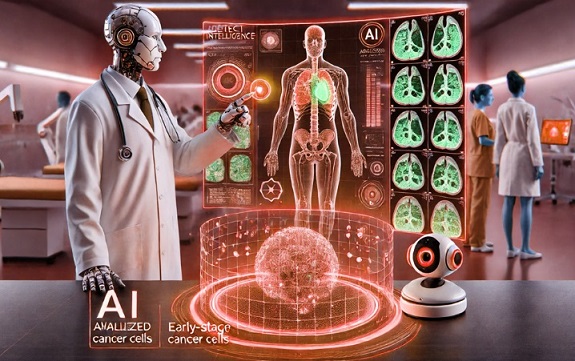 AI Revolution in Cancer Care Gains Speed as New Breakthroughs Surpass Doctors’ Capabilities
Cancer remains one of the deadliest diseases in the world, claiming nearly 10 million lives in 2022 and predicted to affect 35 million people annually by 2050. To address this growing crisis, scientists and clinicians are increasingly turning to AI to improve how cancers are detected and treated. This
Medical News report delves deep into the most promising advances.
AI in Early Diagnosis and Imaging
AI-powered systems, especially those using deep learning (DL) and machine learning (ML), have shown superior performance compared to traditional diagnostic tools. For example, AI-assisted cytology was found to be 5.8% more sensitive in detecting cervical cancer compared to manual analysis. In lung cancer diagnosis, a system called CheXNeXt showed 52.3% better detection of lung masses and 20.4% better nodule detection than top radiologists.
A major development involves CAD (computer-aided diagnosis) systems that help doctors interpret medical images quickly and accurately. CADe systems spot abnormalities, while CADx tools help categorize them. Used during colonoscopies, these AI tools drastically improved the detection of dangerous growths like adenomas.
Merging Data for Precision
One of the key advantages of AI is its ability to merge various types of medical data — from scans and lab results to patient history and genetic data. This multimodal approach gives doctors a comprehensive view of a patient’s condition. In prostate and lung cancer, integrating PET and CT imaging through AI led to tumor detection accuracy as high as 99.29%.
AI systems have also outperformed traditional doctors in breast cancer diagnosis, with deep learning models achieving over 96% accuracy. For lung cancer, AI models reached a combined 87% accuracy in sensitivity and specificity, drastically reducing the risk of missed or wrong diagnoses.
The Power of Deep Learning and Tumor Microenvironment Analysis
Deep learning models like CNNs (convolutional neural networks) and RNNs (recurrent neural networks) can analyze massive medical datasets with astonishing precision. These models can detect and classify cancer cells in images, predict how tumors might grow, and even track patient responses over time. One model, DenseNet121, achieved a 99.4% accuracy in identifying seven types of cancer.
AI also offers insight into the tumor microenvironment &
;mdash; the complex system of cells and molecules surrounding a tumor. One study successfully used a deep learning model to classify immune cells involved in tumor inflammation with over 90% accuracy, helping personalize treatments based on how the body is reacting to the tumor.
AI in Nanomedicine and Personalized Treatments
The marriage of AI with nanotechnology is pushing cancer treatment into an exciting new era. AI helps design drug delivery systems using tiny nanoparticles, ensuring that medications go directly to cancer cells with minimal damage to healthy tissue. In prostate cancer, AI-driven nanomedicine improved targeted drug delivery by 40% and reduced unwanted side effects by 30%.
Additionally, AI can now analyze data from advanced nanosensors to detect cancer at its earliest stages. One deep learning system known as TOAD, trained on over 22,000 pathology images, could identify the origin of tumors of unknown origin in 83% of cases — a huge leap in solving difficult diagnoses.
AI and Immunotherapy
AI is also showing strong potential in enhancing immunotherapy — treatments that help the immune system fight cancer. It can predict which patients will respond best to certain immunotherapy drugs, such as PD-1 or PD-L1 inhibitors.
For instance, the ELISE AI model was able to predict the effectiveness of these drugs in bladder cancer patients with an impressive 88.86% accuracy.
By analyzing genes, proteins, and images, AI can provide a clear picture of how a tumor interacts with the body’s immune cells, helping guide doctors in selecting the most effective immunotherapy for each patient.
Conclusions
Artificial intelligence is rapidly becoming an indispensable tool in cancer care. It enhances the accuracy of early detection, reduces diagnostic errors, and personalizes treatments in ways that were unimaginable a decade ago. Whether it’s scanning pathology slides, predicting drug responses, or designing nanoparticle-based therapies, AI is helping doctors treat patients faster, safer, and more effectively. However, experts caution that more clinical validation is needed to ensure these tools are reliable and unbiased. The future of cancer care is becoming more data-driven, personalized, and accessible, with AI leading the way to longer lives and better outcomes.
The study findings were published in the peer reviewed journal: Biomedicines
https://www.mdpi.com/2227-9059/13/4/951
For the latest on AI in Medicine, keep on logging to Thailand
Medical News.
Read Also:
https://www.thailandmedical.news/news/ai-in-medicine-new-artificial-intelligence-based-platform-able-to-predict-lung-cancer-metastasis
https://www.thailandmedical.news/news/ai-in-medicine-revolutionizing-colorectal-cancer-screening:-the-impact-of-ai-assisted-colonoscopy-on-adenoma-detection
https://www.thailandmedical.news/news/ai-news-new-ai-platform-by-ucla-can-predict-survival-outcomes-of-cancer-patients-based-on-epigenetic-factors
https://www.thailandmedical.news/articles/ai-in-medicine
https://www.thailandmedical.news/pages/thailand_doctors_listings




 Share
Share
 Tweet
Tweet
 Share
Share

































