Scientists Warn That SARS-CoV-2 Spike Proteins Are Reactivating Dormant Herpesviruses
Nikhil Prasad Fact checked by:Thailand Medical News Team Jul 14, 2026 1 month, 2 weeks, 5 days, 10 hours, 4 minutes ago
Medical News: New review suggests persistent spike proteins may awaken lifelong viruses and help drive long COVID and chronic post-viral illnesses
Scientists from the Institute of Microbiology and Virology, Rīga Stradiņš University Research Centre, Rīga, Latvia, have unveiled a compelling new hypothesis that could help explain why millions of people continue to suffer debilitating health problems months or even years after recovering from COVID-19. Their comprehensive review proposes that persistent SARS-CoV-2 spike proteins may reactivate dormant herpesviruses already present in the body, setting off a cascade of immune, neurological, and metabolic disturbances that contribute to long COVID and other chronic post-viral diseases.
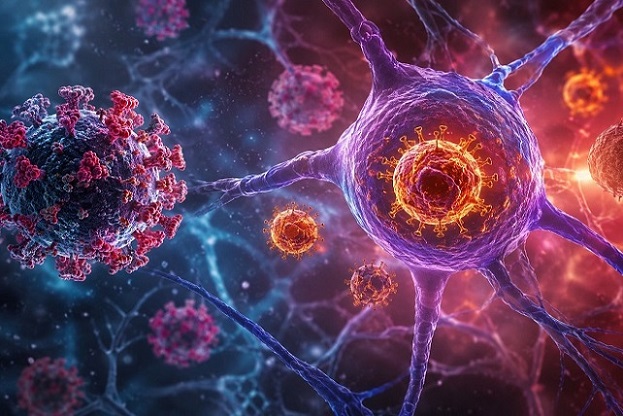 Scientists propose that persistent SARS-CoV-2 spike proteins may reactivate dormant herpesviruses, potentially
fueling long COVID and other chronic post-viral illnesses
The researchers argue that this interaction between SARS-CoV-2 and latent herpesviruses represents a biologically plausible mechanism linking COVID-19 to prolonged illness, while also offering new opportunities for improved diagnostics and targeted treatments.
Lifelong Viruses May Be Reactivated After COVID-19
Many people are unaware that once infected with viruses such as Epstein-Barr virus (EBV), human herpesvirus-6 (HHV-6), and human herpesvirus-7 (HHV-7), these viruses remain inside the body for life. Normally they stay in a dormant state because the immune system successfully keeps them under control.
However, the researchers suggest that SARS-CoV-2 infection, particularly the persistence of its spike protein after the initial illness, may upset this delicate balance. Instead of disappearing completely after recovery, spike proteins have been detected in blood, immune cells, and tissues for months in some individuals. Their continued presence may constantly stimulate the immune system and create an environment that allows dormant herpesviruses to become active once again.
According to the review, this viral reactivation could help explain why many long COVID patients experience persistent exhaustion, brain fog, poor concentration, muscle pain, sleep disturbances, dizziness, and autonomic nervous system dysfunction that closely resemble myalgic encephalomyelitis/chronic fatigue syndrome (ME/CFS).
Persistent Spike Proteins May Keep the Body in a Constant State of Stress
The review explains that the spike protein is far more than simply the structure that allows SARS-CoV-2 to enter cells. It can also activate powerful inflammatory pathways involving Toll-like receptors and NF-κB signaling, resulting in the continued release of inflammatory molecules including IL-6 and TNF-α.
This prolonged immune activation places tremendous stress on cells while disrupting normal mitochondrial function. Mitochondria act as the body's energy generators, and when they become damaged, cells produce less energy while generating excessive oxidative stress.
The authors note that these exact conditions—including oxidative stress, mitochondrial dysfunction, chronic inflammation, immu
ne exhaustion, and metabolic disruption—are already well recognized as major triggers capable of reactivating dormant herpesviruses.
This
Medical News report highlights that the review integrates growing experimental and clinical evidence into a single biological model, suggesting that persistent spike proteins create the conditions that permit herpesvirus reactivation, while the reactivated viruses further intensify inflammation and cellular dysfunction, creating a self-perpetuating cycle.
Brain and Nervous System Could Bear the Greatest Impact
The review also proposes that reactivated HHV-6 and HHV-7 may contribute directly to neurological complications. These viruses possess the ability to affect the central nervous system through infected immune cells, the blood-brain barrier, and even the olfactory nerve.
Once reactivated, they may promote chronic neuroinflammation, interfere with communication between neurons, damage supporting brain cells, impair mitochondrial activity, and reduce cellular energy production. The researchers explain that when combined with the inflammatory effects of persistent spike proteins, these viruses could significantly worsen cognitive impairment, memory problems, brain fog, profound fatigue, sensory abnormalities, and autonomic dysfunction commonly reported by long COVID sufferers.
The review further discusses evidence showing that many long COVID patients exhibit exhausted immune cells with reduced antiviral activity, making it increasingly difficult for the body to suppress dormant viruses once they begin reactivating.
New Biomarkers and More Personalized Treatments May Follow
Several studies reviewed by the researchers have detected elevated HHV-6 antibodies, viral DNA, and proteins linked to active herpesvirus infection in subsets of long COVID patients. These biological markers could eventually help physicians identify patients whose symptoms are driven, at least in part, by herpesvirus reactivation.
The authors also examine current antiviral therapies. While drugs targeting herpesviruses have shown encouraging results in carefully selected patients with confirmed viral reactivation, they caution that existing evidence does not support treating every long COVID patient with antiviral medications. Instead, future therapies may need to combine antiviral drugs with treatments that reduce inflammation and restore normal immune and mitochondrial function.
Conclusion
The review presents one of the most comprehensive biological frameworks to date explaining how persistent SARS-CoV-2 spike proteins may trigger the reactivation of dormant herpesviruses, allowing the two viral processes to reinforce one another and drive chronic inflammation, neurological dysfunction, immune exhaustion, and long-lasting fatigue. Although the evidence remains largely associative and further clinical studies are required to establish direct causation, the authors believe this model could reshape future research into long COVID, ME/CFS, and related post-viral disorders while accelerating the development of more accurate biomarkers and targeted therapies.
The study findings were published in the peer reviewed journal: Trends Open.
https://www.sciencedirect.com/science/article/pii/S3117347026000490
For the latest COVID-19 news, keep on logging to Thailand
Medical News.
Read Also:
https://www.thailandmedical.news/articles/coronavirus
https://www.thailandmedical.news/articles/long-covid




 Share
Share
 Tweet
Tweet
 Share
Share

































