Nikhil Prasad Fact checked by:Thailand Medical News Team Mar 08, 2026 6 months, 4 weeks, 1 day, 11 hours, 23 minutes ago
Medical News: Scientists have uncovered a surprising way the Zika virus hijacks human cells to help it spread inside the body. Using advanced gene-editing technology, researchers discovered that a human protein called RNF6 plays a key role in helping the virus multiply and cross into the brain. Their findings shed new light on how Zika infection damages the nervous system and could open the door to new antiviral treatments.
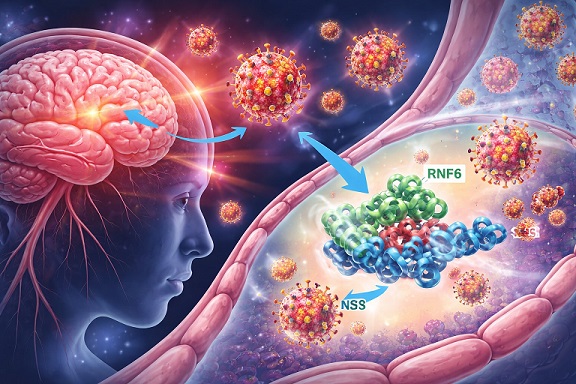 Scientists discover that the RNF6 protein helps Zika virus replicate and suppress immune defenses,
offering a potential new target for antiviral treatments
How Zika Virus Targets the Brain
Zika virus is known for its ability to affect the brain and nervous system. It can cross the blood–brain barrier, a protective shield formed by specialized cells called brain microvascular endothelial cells. Once the virus enters the brain, it can infect various neural cells and trigger inflammation and long-term neurological problems. These effects are particularly dangerous for unborn babies, where infection can lead to congenital Zika syndrome and severe developmental abnormalities.
Despite years of research, scientists still do not fully understand how the virus successfully invades brain tissues. In this
Medical News report, researchers used cutting-edge CRISPR gene-editing screening to systematically identify host proteins that Zika relies on during infection.
The research was conducted by scientists from the Institute of Medical Biology, Chinese Academy of Medical Sciences & Peking Union Medical College in Kunming, China, together with collaborators from the School of Life Sciences at Yunnan University in Kunming, China.
Massive Genetic Screening Reveals Critical Host Factor
The team built the first genome-wide CRISPR knockout library for the tree shrew, an animal whose biology closely resembles humans. This allowed scientists to switch off thousands of genes one by one in brain endothelial cells and observe how those changes affected Zika infection.
Their screening examined more than 15,000 genes and revealed 873 potential host factors linked to Zika infection. Among the top candidates, the protein RNF6 emerged as the most important proviral factor supporting viral replication.
Further experiments confirmed the discovery. When researchers reduced RNF6 levels in cells, the amount of Zika virus dropped sharply. However, when RNF6 was artificially increased, viral replication surged dramatically. Completely removing the RNF6 gene using CRISPR technology almost halted viral replication.
These experiments clearly demonstrated that RNF6 acts like a molecular helper for the virus.
How RNF6 Helps the Virus Multiply
To understand the mechanism behind this effect, scientists analyzed how RNF6 interacts with viral components. They discovered that RNF6 directly binds to a viral protein called NS5, which is essential for Zika virus replication.
The int
eraction appears to weaken the body’s natural antiviral defenses. Normally, infected cells activate the type I interferon pathway, which triggers protective genes that slow viral growth. However, RNF6 suppresses this immune signaling pathway, allowing the virus to replicate more easily.
The study also showed that RNF6 interferes with MAPK signaling pathways in cells. These pathways regulate important cellular responses to stress and infection. By disrupting these protective signals, RNF6 further creates a favorable environment for Zika virus survival and multiplication.
Findings Could Lead to New Antiviral Treatments
Interestingly, the RNF6 protein is highly conserved between humans and tree shrews, sharing about 87 percent identical amino acid sequences. Structural analyses also revealed that the protein’s key functional regions are nearly identical between the two species.
This strong similarity suggests that the same viral strategy may operate in human infections. Scientists believe RNF6 could therefore become an attractive target for new antiviral drugs designed to block Zika virus replication.
Conclusion
The discovery of RNF6 as a key host factor in Zika infection significantly advances our understanding of how the virus manipulates human cells to spread and invade the brain. By showing that RNF6 interacts with viral proteins and weakens the body’s antiviral defenses, the study highlights a potential vulnerability that future therapies could exploit. Targeting host proteins like RNF6 may provide a new strategy to stop Zika virus replication and reduce the severe neurological complications associated with infection.
The study findings were published in the peer reviewed journal: Viruses.
https://www.mdpi.com/1999-4915/18/3/323
For the latest on Zika viruses, keep on logging to Thailand
Medical News.
Read Also:
https://www.thailandmedical.news/articles/zika-virus




 Share
Share
 Tweet
Tweet
 Share
Share