Nikhil Prasad Fact checked by:Thailand Medical News Team Mar 19, 2026 6 months, 2 weeks, 1 day, 22 hours, 23 minutes ago
Medical News: A newly documented medical case is raising serious concerns about how COVID-19 may silently affect male fertility, even in men who never showed symptoms. Doctors have reported a rare but alarming situation where a previously healthy man developed complete testicular failure after what appears to be an unnoticed SARS-CoV-2 infection.
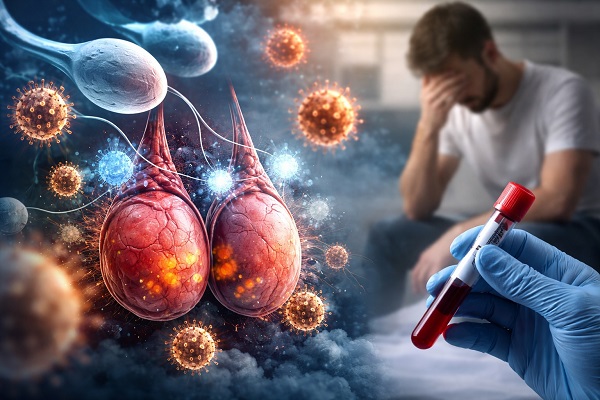 Silent COVID-19 infection triggers immune attack causing sudden male infertility
A Sudden and Rapid Decline in Fertility
Silent COVID-19 infection triggers immune attack causing sudden male infertility
A Sudden and Rapid Decline in Fertility
The case involves a 40-year-old man who initially had only mild fertility issues. Early tests showed slightly reduced sperm movement and count. However, within just a few months, his condition rapidly worsened. His sperm count dropped dramatically from millions to almost zero, eventually reaching complete absence of sperm, a condition known as azoospermia.
Doctors were alarmed by how quickly this decline occurred. Even attempts to preserve fertility through sperm freezing yielded only a very small number of viable sperm cells.
This sharp deterioration suggested something more aggressive than typical infertility causes.
Hidden Infection Triggers Immune Attack
Further investigations revealed something unexpected. Although the patient had no symptoms and had not been recently vaccinated, blood tests showed extremely high levels of antibodies against SARS-CoV-2. This indicated a recent, likely unnoticed COVID-19 infection.
What makes this case unique is how the body responded. Instead of simply clearing the virus, the immune system appeared to mistakenly attack the testes. Tissue analysis showed clear signs of immune cells, particularly T-cells, invading the testicular tissue. These immune cells are usually meant to fight infections but, in this case, they caused inflammation and damage to sperm-producing structures.
Genetic Vulnerability Made Things Worse
Doctors also discovered that the patient had a rare genetic condition known as a balanced chromosomal translocation involving chromosomes 2 and 8. While this condition can sometimes affect fertility, it usually does not lead to such rapid and complete failure.
Experts believe this genetic issue made the testes more vulnerable.
When combined with the immune response triggered by COVID-19, it created what researchers describe as a “second-hit” effect. In simple terms, the virus may have acted as the tipping point that accelerated damage in an already sensitive system.
What The Tissue Findings Revealed
Detailed examination of testicular tissue showed severe damage. The sperm-producing cells were largely absent, and only a few immature cells remained. At the same time, immune cells were actively present, confirming ongoing inflammation.
Hormone tests further supported the diagnosis. Levels of key reproductive hormones such as luteinizing hormone and follicle-stimulating hormone were abnormally high, a sign that the body was trying, unsuccessfully, to stimulate failing testes.
Urgent Need fo
r Awareness and Early Action
This
Medical News report highlights the importance of early fertility evaluation in men experiencing sudden changes. Doctors stress that men planning to have children should seek medical advice quickly if they notice fertility issues, especially after COVID-19 exposure.
The case also underscores the importance of sperm preservation. In this situation, early intervention allowed at least some sperm to be saved for future assisted reproduction.
Conclusion
This case provides a striking example of how COVID-19 may trigger severe and irreversible reproductive damage in rare situations, particularly in individuals with underlying genetic vulnerabilities. While such outcomes appear uncommon, the speed and severity of the damage emphasize the need for awareness, early testing, and proactive fertility preservation. More research is urgently needed to understand how viral infections interact with the immune system and reproductive health, and to identify those at highest risk before permanent damage occurs.
The study findings were published in the peer reviewed journal: Cureus.
https://www.cureus.com/articles/463614-immune-mediated-sars-cov-2-induced-orchitis-leading-to-complete-testicular-failure-a-report-of-a-rare-case#!/
For the latest COVID-19 News, keep on logging to Thailand
Medical News.
Read Also:
https://www.thailandmedical.news/articles/coronavirus
https://www.thailandmedical.news/articles/long-covid




 Share
Share
 Tweet
Tweet
 Share
Share

































