Nikhil Prasad Fact checked by:Thailand Medical News Team Jun 12, 2026 3 months, 3 weeks, 19 hours, 40 minutes ago
Medical News: Researchers are exploring a powerful new approach that could transform how scientists study and potentially treat infections caused by DNA viruses. Instead of merely blocking viral activity, this emerging technology allows researchers to selectively destroy proteins that viruses depend on for survival. The strategy, known as PROTAC-mediated targeted protein degradation, is drawing growing attention because it offers a way to eliminate both viral proteins and critical host proteins that viruses exploit during infection.
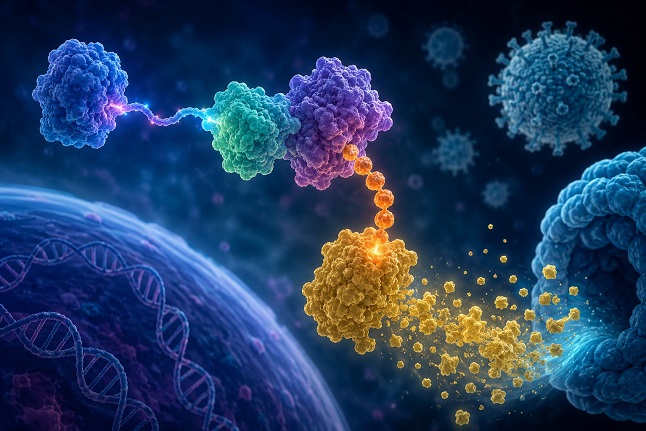 New PROTAC technology allows scientists to selectively destroy proteins that DNA viruses depend on for survival and persistence
The research was conducted by scientists Michael Lam, Chayah Hill, Ethan Thornburg, and Marsha DeSmet from the Tom and Julie Wood College of Osteopathic Medicine at Marian University in Indianapolis, Indiana, United States.
A New Way to Fight Viruses
DNA viruses, including hepatitis B virus (HBV), human papillomavirus (HPV), Epstein-Barr virus (EBV), human cytomegalovirus (HCMV), and Kaposi sarcoma-associated herpesvirus (KSHV), depend heavily on the cells they infect. Unlike many RNA viruses, these viruses use the host cell's machinery to copy their genetic material, produce proteins, and maintain long-term infections.
This reliance on host cells has made it difficult for scientists to identify safe therapeutic targets. Many of the cellular proteins used by viruses are also essential for normal human health. Traditional techniques such as gene editing and RNA interference can suppress these proteins, but the effects are often slow and sometimes permanent.
PROTACs, short for Proteolysis Targeting Chimeras, offer a different solution. These specially designed molecules act like molecular matchmakers. They bring a target protein into contact with the cell's natural protein disposal machinery. Once tagged, the unwanted protein is rapidly broken down and removed by the cell.
Why PROTACs Are Generating Excitement
One of the biggest advantages of PROTAC technology is speed. Protein degradation can occur within hours, allowing scientists to observe the immediate effects of removing a specific protein. Unlike gene-editing approaches, the process is reversible and does not permanently alter DNA.
Researchers believe this gives them a much clearer picture of how viruses exploit cellular pathways during infection. It also opens the possibility of targeting proteins previously considered "undruggable" because they lack conventional binding sites for medicines.
Revealing Hidden Viral Weaknesses
Several studies highlighted in the review demonstrated how PROTACs can uncover viral dependencies that traditional drug inhibitors often miss.
In hepatitis B virus research, scientists identified the cellular protein BRD4 as a key factor required for viral gene activity. When BRD4 was degraded using PROTAC molecules, viral RNA production dropped dramatically, indicating that HBV depends heavily on this host protein.
Similarly, studies involving human cytomegalovirus found that remov
ing the cellular protein CDK9 reduced viral replication more effectively than simply blocking its activity with standard inhibitors. This suggests that complete protein removal can expose vulnerabilities that conventional drugs fail to reveal.
Researchers studying HPV also used PROTACs to investigate proteins involved in viral transcription and replication. The findings showed that targeted degradation helped clarify the specific roles these host proteins play at different stages of the viral lifecycle.
This
Medical News report highlights how targeted protein degradation is becoming an increasingly valuable research tool for understanding the complex interactions between viruses and their host cells.
Directly Destroying Viral Proteins
Perhaps the most exciting development is the possibility of designing PROTACs that directly eliminate viral proteins themselves.
One notable example involves HPV. Scientists engineered a PROTAC-like molecule capable of targeting the viral E6 oncoprotein, a major driver of cervical cancer. Laboratory and animal studies showed that degradation of E6 restored the activity of the tumor-suppressor protein p53 and significantly reduced tumor growth.
Researchers have also developed approaches targeting EBV's EBNA1 protein, which is crucial for viral persistence and cancer development. Degrading EBNA1 not only reduced its activity but also revealed how it helps tumors evade the immune system.
Additional experimental systems have demonstrated successful degradation of important viral proteins in KSHV and HBV, further supporting the concept that targeted protein destruction could become a future antiviral strategy.
Future Possibilities
The researchers believe that many cellular proteins already known to be important for viral replication could become future PROTAC targets. Proteins involved in DNA repair, transcription control, chromatin regulation, and cell-cycle management are particularly attractive candidates because multiple DNA viruses rely on these pathways.
As scientists continue developing more precise and efficient PROTAC molecules, the technology may help uncover new therapeutic opportunities not only for viral infections but also for virus-associated cancers.
Conclusion
The growing field of targeted protein degradation represents one of the most innovative developments in modern virology. By enabling the selective destruction of proteins that viruses need to survive, PROTAC technology offers researchers an unprecedented level of control over viral and cellular processes. Although challenges remain, including drug delivery, target specificity, and the design of suitable binding molecules, the technology has already demonstrated remarkable potential in laboratory and animal studies. If future research continues to overcome these obstacles, PROTAC-based therapies could eventually provide a powerful new class of antiviral treatments capable of combating chronic viral infections and virus-driven cancers more effectively than many current approaches.
The study findings were published in the peer reviewed journal: Viruses.
https://www.mdpi.com/1999-4915/18/6/658
For the latest on viruses and antivirals, keep on logging to Thailand
Medical News.
Read Also:
https://www.thailandmedical.news/news/protacs-new-antiviral-approach-to-combatting-viruses
https://www.thailandmedical.news/news/antivirotics-based-on-defective-interfering-particles-a-new-frontier-in-targeting-viruses




 Share
Share
 Tweet
Tweet
 Share
Share

































