Nikhil Prasad Fact checked by:Thailand Medical News Team Aug 17, 2026 1 month, 2 weeks, 3 days, 21 hours, 19 minutes ago
COVID-19 may leave consequences that extend far beyond the lungs, with researchers warning that SARS-CoV-2 infection could disturb bone health from microscopic bone cells all the way to the overall strength of the skeleton. The new scientific review brings together clinical findings, animal experiments, advanced imaging and biomechanical research suggesting that COVID-19-associated bone damage is complex and may persist after the acute infection has ended.
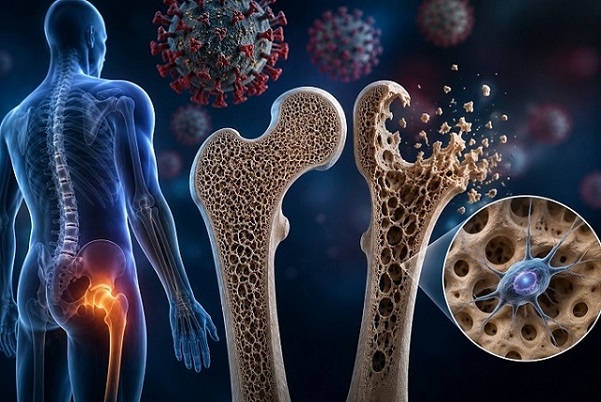 Researchers warn that COVID-19 may disrupt bone cells, weaken bone architecture and potentially increase long-term
skeletal fragility
The researchers are from the Department of Mechanical Engineering (DMEC), Politecnico di Milano, Milan, Italy, and IRCCS Galeazzi-Sant’Ambrogio, Milan, Italy.
Evidence Of Weaker Bone Structure
Researchers found evidence linking COVID-19 with reductions in bone mineral density, thinning of the hard outer cortical bone and deterioration of the internal sponge-like trabecular network. These changes matter because bone strength depends on more than simply how much mineral it contains.
Studies reviewed by the team indicated reduced stiffness, toughness and load-bearing ability, potentially making affected bones less resistant to fractures.
Animal experiments provided additional evidence. SARS-CoV-2-infected mice and golden Syrian hamsters showed reductions in trabecular bone volume and thickness. Some experiments found progressive deterioration that remained detectable weeks after infection.
Tiny Bone Cells May Also Be Altered
One particularly interesting finding involves osteocytes, specialized cells embedded inside bone that detect mechanical forces and help control continuous bone renewal.
Advanced three-dimensional imaging of human trabecular bone after COVID-19 revealed changes in the tiny spaces housing osteocytes, known as lacunae. These became larger, rounder and more numerous, with patterns resembling some abnormalities associated with osteoporosis.
Such microscopic remodeling could affect how mechanical forces travel through bone and how effectively tiny cracks are redirected, potentially influencing bone strength even before major deterioration becomes obvious.
As highlighted in this Thailand
Medical News report, skeletal complications can develop quietly, meaning people may not immediately realize that changes are occurring.
Why COVID-19 Could Affect Bones
The review describes several possible mechanisms working together. COVID-19-associated inflammatory molecules including IL-1, IL-6 and TNF-alpha can stimulate osteoclasts, the cells responsible for breaking down old bone, while interfering with osteoblasts that build new bone.
SARS-CoV-2 may also disrupt ACE2 and the renin-angiotensin system, contributing to inflammation, oxidative stress and impaired blood circulation within bone.Other factors can amplify the problem, including prolonged bed rest, reduced physical activity, corticosteroid treatment, vitamin D deficiency and abnormal
calcium-phosphate metabolism. Vascular injury and abnormal clotting may additionally contribute to avascular necrosis, where inadequate blood supply damages bone, particularly around the hip.
Damage May Outlast Infection
Importantly, bone recovery may be slower than recovery in other systems. Bone-resorption markers can rise during the first weeks after infection while markers of new bone formation decline. Although blood markers may later normalize, structural abnormalities can persist for months.
The researchers emphasize that stronger long-term human studies are still needed to determine who develops persistent damage and whether these skeletal changes eventually reverse.
Conclusions
Overall, the evidence suggests that COVID-19-related skeletal impairment should be viewed as a multifactorial process involving inflammation, altered immunity, vascular dysfunction, mechanical inactivity and disrupted bone-cell signaling. Long-term studies using bone-density measurements, advanced imaging and biological markers will be essential to determine the true fracture risk and identify people who may benefit from earlier monitoring or preventive intervention.
The study findings were published in the peer reviewed journal: Frontiers in Bioengineering and Biotechnology
https://www.frontiersin.org/journals/bioengineering-and-biotechnology/articles/10.3389/fbioe.2026.1812439/full
Read Also:
https://www.thailandmedical.news/articles/coronavirus
https://www.thailandmedical.news/articles/long-covid




 Share
Share
 Tweet
Tweet
 Share
Share

































