COVID-19 Exposure Causes Coronary Slow Flow Which Increases Risk of Heart Issues
Nikhil Prasad Fact checked by:Thailand Medical News Team Apr 22, 2026 5 months, 1 week, 4 days, 21 hours, 15 minutes ago
Medical News: A growing body of research is revealing that the effects of COVID-19 may linger far beyond the initial infection, with new evidence pointing to subtle but potentially dangerous changes in heart function. A recent study has found that individuals with a history of COVID-19 are significantly more likely to develop a condition known as coronary slow flow, even when their major heart arteries appear normal.
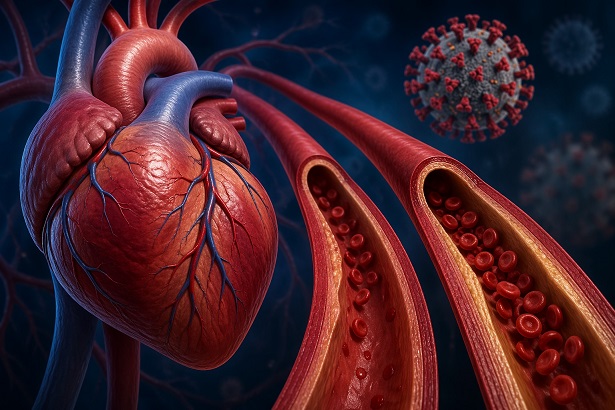 Study shows COVID-19 may slow heart blood flow even without blocked arteries.
Understanding Coronary Slow Flow
Study shows COVID-19 may slow heart blood flow even without blocked arteries.
Understanding Coronary Slow Flow
Coronary slow flow, sometimes called the coronary slow flow phenomenon or “Syndrome Y,” is a condition in which blood moves sluggishly through the heart’s arteries despite the absence of visible blockages. Normally, blood flows smoothly through these vessels to supply oxygen to the heart muscle. However, in coronary slow flow, this process is delayed, which can lead to chest pain, discomfort, and in some cases symptoms resembling a heart attack.
Doctors typically detect this condition during coronary angiography, a test where a special dye is injected into the arteries. If the dye takes longer than expected to travel through the vessels, it indicates slow blood flow. Although the arteries may look clear, the problem is believed to lie in the smaller vessels and the inner lining of the blood vessels, known as the endothelium.
Study Design and Key Findings
The study was conducted by researchers from Abant Izzet Baysal University in Bolu, Türkiye, and Bolu Abant Izzet Baysal Universitesi Tip Fakultesi, also in Bolu, Türkiye. It involved 190 patients who presented with unstable angina, a condition marked by sudden chest pain that can signal reduced blood flow to the heart.
Participants were divided into two equal groups. One group consisted of 95 patients who had previously been infected with COVID-19, confirmed through RT-PCR testing and imaging scans. The second group included 95 patients with no history of COVID-19. Importantly, all participants had normal coronary arteries based on angiography results.
To assess blood flow, researchers used a measurement technique called the TIMI frame count, which tracks how quickly contrast dye moves through the coronary arteries. A corrected TIMI frame count of 27 or higher was used to diagnose coronary slow flow.
The results were striking. Coronary slow flow was found in 18.9 percent of patients who had previously contracted COVID-19, compared to just 5.3 percent in those who had not. Additionally, blood flow measurements were consistently slower in all major coronary arteries among the COVID-19 group.
What This Means for Heart Health
These findings suggest that COVID-19 may cause long-term damage to the small blood vessels of the heart, even after recovery from the initial infection. This
Medical News report highlights that the virus may leave behind inflammation or dysfunction in the vascular system, which can impair norm
al blood circulation.
Such microvascular damage does not show up as traditional blockages, making it harder to detect with standard tests. However, it can still produce significant symptoms and increase the risk of ongoing heart problems.
Patients with coronary slow flow may experience recurring chest pain, shortness of breath, or fatigue. While there is no universally accepted treatment, medications such as calcium channel blockers have shown promise in improving symptoms by helping blood vessels relax and improve flow.
Conclusion
The study provides important insight into how COVID-19 can have lasting cardiovascular effects, even in patients without obvious artery disease. The significantly higher prevalence of coronary slow flow among post-COVID individuals points to persistent microvascular dysfunction that could elevate long-term heart risk. These findings emphasize the need for continued monitoring of heart health in recovered patients and suggest that even mild or moderate COVID-19 infections should not be dismissed as entirely harmless once symptoms resolve.
The study findings were published as an abstract in the peer reviewed journal: Cardiology Research and Practice. (The detailed study findings will be published later.)
https://www.frontiersin.org/journals/cardiovascular-medicine/articles/10.3389/fcvm.2026.1814606/abstract
For the latest COVID-19 News, keep on logging to Thailand
Medical News.
Read Also:
https://www.thailandmedical.news/articles/coronavirus
https://www.thailandmedical.news/articles/long-covid




 Share
Share
 Tweet
Tweet
 Share
Share