Nikhil Prasad Fact checked by:Thailand Medical News Team Mar 08, 2026 6 months, 3 weeks, 6 days, 2 hours, 50 minutes ago
Medical News: Scientists are uncovering new evidence that COVID-19 can injure the heart through a complex biological chain reaction occurring deep inside the body’s cells. A new scientific review has identified three interconnected processes—autophagy disruption, telomere shortening, and endothelial dysfunction—that may work together to trigger cardiac damage during or after SARS-CoV-2 infection.
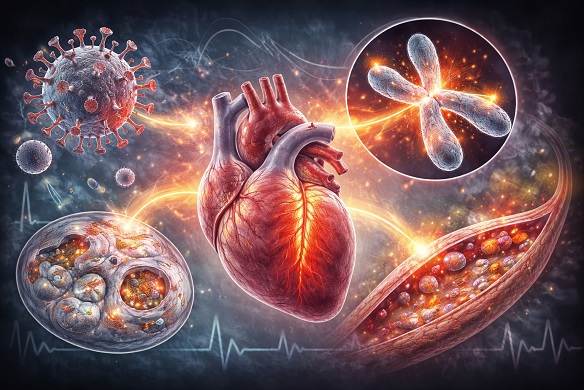 Scientists discover how COVID-19 disrupts multiple cellular systems that together lead to heart damage
The research was conducted by scientists from several international institutions including the National Institute of Virology (ICMR-NIV) in Pune, India; the Department of Pathology and Laboratory Medicine at the University of Calgary Faculty of Medicine in Canada; the National Institute of Translational Virology and AIDS Research in Pune, India; the Bioorganic and Medicinal Chemistry Research Laboratory at Sam Higginbottom University of Agriculture, Technology and Sciences in Prayagraj, India; and the Department of Biochemistry at the Institute of Science, Banaras Hindu University in Varanasi, India.
Heart Complications Are More Common Than Expected
Although COVID-19 initially emerged as a respiratory illness, doctors have increasingly documented serious cardiovascular complications among infected patients. These complications include myocarditis, irregular heart rhythms, heart failure, and damage to the tiny blood vessels that supply the heart.
Researchers have long suspected that inflammation and immune responses play a role. However, the new study shows that deeper cellular processes may also determine why some people develop severe heart injury while others recover without lasting cardiovascular problems.
This
Medical News report explains how the scientists examined the genetic and molecular mechanisms linking COVID-19 infection with heart damage.
Disruption of the Body’s Cellular Recycling System
One of the most important processes examined in the study is autophagy, a natural system cells use to break down and recycle damaged components.
In healthy heart cells, autophagy helps remove defective proteins and worn-out mitochondria, allowing cells to maintain normal energy production and survive stress. However, the study indicates that SARS-CoV-2 may interfere with this protective mechanism.
Certain viral proteins appear to interact with genes and key molecules involved in autophagy such as Beclin-1, ATG5, and ATG7. When these molecules are disrupted, the recycling process becomes inefficient. As damaged cellular components accumulate, oxidative stress and inflammatory signals increase, creating conditions that can damage heart tissue.
Telomere Shortening and Accelerated Cellular Aging
The study also highlights the importance of telomeres, protective structures located at the ends of chromosomes.
Telomeres normally shorten slowly with ag
e. However, severe inflammation and oxidative stress—both common in COVID-19—can accelerate this shortening. When telomeres become too short, cells enter a state known as senescence, where they stop functioning normally and begin releasing inflammatory signals.
Researchers suggest that this accelerated cellular aging could weaken heart and vascular cells, increasing vulnerability to cardiovascular injury during severe COVID-19 infections.
Blood Vessel Lining Plays a Critical Role
Another major factor is endothelial dysfunction, which affects the cells lining blood vessels.
Endothelial cells normally regulate blood flow, prevent unnecessary clotting, and maintain healthy vascular function. SARS-CoV-2 can disrupt these cells by binding to ACE2 receptors, triggering inflammation and reducing nitric oxide levels needed for proper blood vessel relaxation.
As a result, blood vessels may become inflamed and prone to clot formation. Molecules such as ICAM-1, VCAM-1, and inflammatory cytokines like IL-6 and TNF-alpha increase during this process, promoting immune cell adhesion and vascular damage that can ultimately impair heart function.
Three Biological Systems Working Together
The researchers emphasize that these mechanisms are interconnected rather than independent.
Disrupted autophagy can increase oxidative stress, which accelerates telomere shortening. Shortened telomeres then promote cellular aging and endothelial dysfunction. Meanwhile, damaged endothelial cells worsen inflammation and blood vessel injury, further increasing stress on the heart.
This biological feedback loop may explain why some COVID-19 patients experience severe cardiac complications and long-term cardiovascular problems.
Conclusion
The study suggests that COVID-19-related heart injury is not caused by a single pathway but by the interaction of multiple cellular stress mechanisms. Disrupted autophagy, accelerated telomere shortening, and endothelial dysfunction may combine to drive inflammation, microvascular injury, and progressive heart damage. Understanding how these processes interact could help scientists develop new diagnostic markers and therapies aimed at preventing cardiovascular complications in COVID-19 patients, particularly those already at risk due to age or existing heart disease.
The study findings were published in the peer reviewed journal: Frontiers in Cardiovascular Medicine.
https://www.frontiersin.org/journals/cardiovascular-medicine/articles/10.3389/fcvm.2026.1769828/full
For the latest COVID-19 News, keep on logging to Thailand
Medical News.
Read Also:
https://www.thailandmedical.news/articles/coronavirus
https://www.thailandmedical.news/articles/long-covid




 Share
Share
 Tweet
Tweet
 Share
Share

































