Nikhil Prasad Fact checked by:Thailand Medical News Team Jan 17, 2026 8 months, 2 weeks, 3 days, 20 hours, 20 minutes ago
Medical News: Introduction to a New Cancer Fighting Strategy
A new laboratory study by researchers from The Hong Kong Polytechnic University, the Lo Ka Chung Research Centre for Natural Anti-Cancer Drug Development, the Ocean University of China and The Chinese University of Hong Kong has uncovered an encouraging treatment strategy that could help tackle hard-to-treat cancers. The team explored how recombinant human arginase, known as rhArg, could work together with other existing drugs to boost cancer-killing effects. This
Medical News report highlights the key findings in a simple and clear manner for general readers.
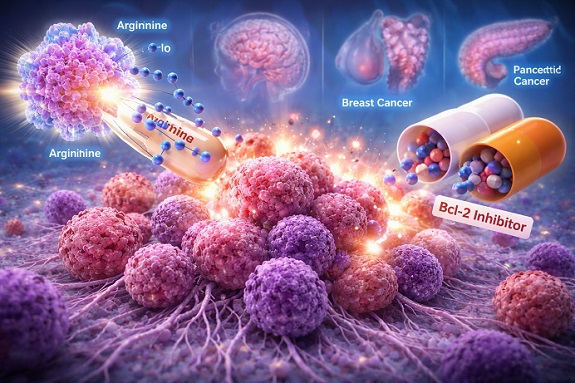 A new study reveals that combining arginine depletion with a Bcl-2 inhibitor sharply boosts cancer cell
death across several cancer types
Why Arginine Matters in Cancer Treatment
Many cancer cells rely on the amino acid arginine to survive and grow. rhArg works by breaking down arginine in the tumor environment, starving cancer cells of this essential nutrient. While rhArg on its own already shows anticancer activity, the researchers aimed to enhance its effects by combining it with other medicines, especially Bcl-2 inhibitors such as ABT263 and ABT199, as well as the diabetes drug metformin.
Strong Synergy Between rhArg and ABT263
Among all tested combinations, rhArg paired with ABT263 delivered the strongest anticancer effect in pancreatic, colorectal, breast and brain cancer cell models. ABT263 is designed to target two major anti-death proteins inside cancer cells, Bcl-2 and Bcl-xL. This dual action makes cancer cells much more sensitive to treatment. When both rhArg and ABT263 were used together, the cancer cells showed high levels of programmed cell death, known as apoptosis. Researchers noted that even low doses of ABT263 became far more powerful when used alongside rhArg.
The combination also triggered cell cycle arrest, which stops cancer cells from multiplying. Important regulators such as CDK2 and cyclin A were significantly reduced, confirming that the treatment halted cell growth in addition to killing cancer cells. Brain cancer cells (U251), which are often difficult to treat, responded especially well to this paired therapy.
Comparing Against Other Drug Partners
The team also tested rhArg with metformin and found that this pair became more effective over longer treatment times. However, the results were still less dramatic compared to the rhArg and ABT263 combination. When rhArg was tested against other amino-acid-depleting agents combined with ABT263, rhArg once again proved to be the most potent and consistent option across all cancer types.
How Cancer Cells Respond to the Treatment
By studying molecular markers, the researchers confirmed that the combined treatment activated caspase-3 and PARP cleavage, both strong indicators of apoptosis. Interestingly, the combination also helped suppress Mcl-1, a protein known to cause resistance to ABT263. This suggests that rh
Arg may help overcome a common drug-resistance pathway and make ABT263 more reliable in future treatment strategies.
Conclusions
This study provides strong early evidence that combining rhArg with ABT263 could form a powerful new cancer treatment strategy with broad usefulness across several difficult-to-treat cancers. The pairing enhances cell death, blocks cancer cell growth and may even help prevent drug resistance. While more research, including future animal and clinical studies, is needed, the findings open the door to a promising therapeutic approach that may allow doctors to use lower drug doses while achieving better results. The results also highlight a new direction in cancer therapy that intelligently targets the survival mechanisms cancer cells depend on, offering hope for more effective and less toxic treatments in the future.
The study findings were published in the peer reviewed journal: Cells.
https://www.mdpi.com/2073-4409/15/2/164
For the latest cancer research, keep on logging to Thailand
Medical News.
Read Also:
https://www.thailandmedical.news/articles/cancer




 Share
Share
 Tweet
Tweet
 Share
Share

































