Nikhil Prasad Fact checked by:Thailand Medical News Team Jun 29, 2026 3 months, 4 days, 18 hours, 14 minutes ago
Medical News: Tattoos have become a common form of self-expression around the world, especially among younger generations. However, new scientific findings are raising concerns about what tattoo ink may be doing beneath the skin. Researchers are now warning that certain chemicals found in tattoo inks could pose long-term health risks, including a possible link to cancer.
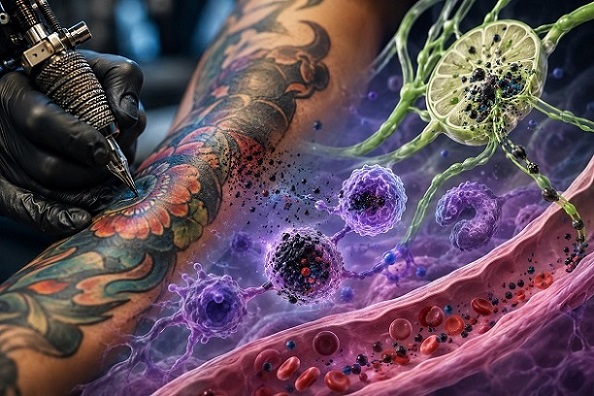 Common tattoo inks may contain toxic chemicals that can travel through the body and potentially increase
cancer risk over time
Tattooing: An Invasive Process with Lasting Effects
Tattooing is not just a surface-level procedure. It involves repeatedly puncturing the skin with needles to deposit ink into the dermis, the layer beneath the outer skin. While some pigment fades over time, a significant portion remains in the body permanently.
Scientists have found that about one-quarter of injected ink does not stay in the skin. Instead, it travels through the lymphatic system and can enter the bloodstream. This means tattoo ink particles may spread to different parts of the body, including vital organs.
What Researchers Found Inside Tattoo Inks
The study was conducted by researchers from the Department of Immunology at the Medical University of Bialystok in Poland. Their analysis revealed that tattoo inks are complex mixtures containing various chemical substances, some of which are known to be harmful.
These include heavy metals such as lead, mercury, chromium, and nickel. In addition, tattoo inks may contain polycyclic aromatic hydrocarbons (PAHs), including substances classified as carcinogens, as well as phthalates, which are known to interfere with hormone systems.
What is especially concerning is that some of these substances have been detected at levels exceeding recommended safety limits. Even more troubling is the fact that tattoo inks are not regulated as strictly as medicines, despite being injected into the body.
The Body’s Reaction to Tattoo Ink
When tattoo ink enters the skin, the body immediately recognizes it as a foreign substance. This triggers an immune response, leading to inflammation. Immune cells attempt to absorb and contain the ink particles, which is one reason tattoos remain visible for years.
However, this constant immune activity may not be harmless. Over time, repeated inflammation and exposure to toxic substances can place stress on the body. Researchers believe this may play a role in the development of chronic diseases.
This
Medical News report highlights that long-term inflammation is a key factor that could potentially contribute to cancer development.
Possible Links to Cancer
Although scientists have not yet established a direct cause-and-effect relationship, several types of cancers have been reported in individuals with tattoos. These include melanoma, squamous cell carcinoma, lymphoma, and basal cell carcinoma.
Experts believe that the movement of toxic ink components through the body may contribute to abnormal cell growth. Larger tattoos may increase the risk because they involve greater amounts of ink, leading to higher exposure to potentially harmful chemicals.
Other Health Concerns
The risks associated with tattoos go beyond cancer. Studies have linked tattooing to a range of other health issues, including allergic reactions, chronic inflammation, autoimmune conditions, and skin disorders.
In some cases, lymph nodes can become swollen due to the accumulation of ink particles. Laser tattoo removal procedures may also introduce additional risks, as the breakdown of ink can produce new toxic compounds.
Gaps in Safety Regulations
One of the major concerns highlighted by researchers is the lack of appropriate regulation. Current safety limits for many chemicals are based on oral exposure, not injection into the skin.
As a result, the actual risks of tattoo ink may be underestimated. Even products labeled as safe may contain substances that are not disclosed or properly controlled.
Conclusion
The findings from this study suggest that tattoo inks may not be as harmless as many people believe. The presence of toxic chemicals, their ability to spread through the body, and the resulting chronic inflammation all raise important questions about long-term safety. While more research is needed to fully understand the risks, the evidence so far indicates that tattoos could be associated with serious health consequences, including cancer. Greater awareness, stricter regulations, and better testing of tattoo ink ingredients are urgently needed to protect public health and ensure safer practices in the tattoo industry.
The study findings were published in the peer reviewed journal: Archives of Toxicology.
https://link.springer.com/article/10.1007/s00204-026-04484-y
For the latest cancer research, keep on logging to Thailand
Medical News.
Read Also:
https://www.thailandmedical.news/articles/cancer




 Share
Share
 Tweet
Tweet
 Share
Share

































