Nikhil Prasad Fact checked by:Thailand Medical News Team Jul 16, 2026 1 month, 2 weeks, 3 days, 20 hours, 33 minutes ago
Medical News: Post-COVID Heart Valve Damage May Be More Common Than Believed
Researchers from the Victor Babeș University of Medicine and Pharmacy, Politehnica University Timișoara, and the University of Life Sciences "King Michael I" Timișoara, Romania, have completed an extensive review revealing that COVID-19 may have a much greater impact on heart valves and heart failure than previously recognized. While much attention has focused on lung damage and heart muscle inflammation after COVID-19, the scientists found growing evidence that the infection can also disrupt the normal function of heart valves, potentially increasing the risk of heart failure in many survivors.
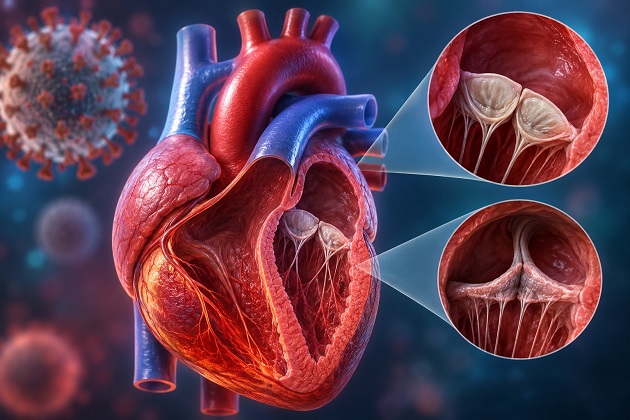 Researchers report that COVID-19 may indirectly damage heart valves by triggering inflammation, blood clots,
and heart remodeling that can lead to heart failure.
COVID-19 Can Trigger a Chain Reaction Inside the Heart
Heart valves work like one-way doors, ensuring blood flows in the correct direction. According to the researchers, COVID-19 does not usually attack the valves directly. Instead, the virus triggers inflammation, damages blood vessels, increases the risk of blood clots, and places extra pressure on the heart. Together, these changes can prevent the valves from closing properly.
The review found that the most common valve problems after COVID-19 involve leakage of the mitral and tricuspid valves rather than permanent structural damage. These leaks are known as functional valve disorders because they occur when the heart enlarges or changes shape, instead of the valve itself becoming diseased.
Existing Valve Disease Makes COVID-19 Far More Dangerous
The researchers also found that people who already have severe heart valve disease face much worse outcomes if they become infected with SARS-CoV-2. Some studies reported that nearly half of hospitalized patients with severe pre-existing valve disease died within 30 days of COVID-19 infection.
Meanwhile, COVID-19 survivors remain at increased risk of developing heart failure months after recovery. This
Medical News report highlights that the review found several biological markers—including NT-proBNP, troponin, and the inflammatory protein interleukin-6—to be reliable warning signs that patients may develop worsening heart function or even die from cardiovascular complications.
Blood Clots, Inflammation and Lung Damage All Play a Role
The review explains that COVID-19 creates a perfect storm for the cardiovascular system. The virus damages the lining of blood vessels, producing widespread inflammation and making blood much more likely to clot. Blood clots in the lungs increase pressure on the right side of the heart, stretching the tricuspid valve and allowing blood to leak backwards.
Inflammation also weakens the heart muscle, causing the chambers to enlarge. As the left ventricle expands, the mitral valve can no longer close t
ightly, resulting in mitral regurgitation. Researchers stressed that these changes are often reversible if the heart recovers, but some patients may continue experiencing symptoms for months.
The review also noted that many survivors develop persistent lung scarring and reduced lung function, placing even more strain on the heart. This ongoing stress may further worsen valve leakage and contribute to heart failure with preserved ejection fraction, a condition where the heart pumps normally but cannot relax properly between beats.
Careful Follow-Up Is Essential
Another important finding was that doctors should avoid assuming every valve problem found after COVID-19 is new. Many older adults already have age-related valve disease, and COVID-19 may simply expose or worsen an existing condition. Comparing heart scans taken before and after infection is the best way to determine whether COVID-19 truly caused new valve dysfunction.
The researchers recommend that patients with persistent breathlessness, fatigue, leg swelling, heart murmurs, elevated cardiac biomarkers, pulmonary embolism, or known heart disease undergo echocardiography and additional heart evaluations. They also emphasize that imaging, blood tests, and long-term monitoring should be focused on higher-risk patients instead of being performed routinely on everyone recovering from COVID-19.
Conclusion
Although direct infection of heart valves by SARS-CoV-2 appears to be uncommon, the review presents convincing evidence that COVID-19 frequently creates conditions that lead to functional valve leakage and heart failure. The authors stress that these complications may remain underrecognized because few studies have specifically examined heart valves after COVID-19. Larger long-term studies are now urgently needed to determine how common these problems truly are, identify which patients are most vulnerable, and develop better strategies for early diagnosis, monitoring, and treatment.
The study findings were published in the peer reviewed Journal of Clinical Medicine.
https://www.mdpi.com/2077-0383/15/13/5007
For the latest COVID-19 news, keep on logging to Thailand
Medical News.
Read Also:
https://www.thailandmedical.news/articles/coronavirus
https://www.thailandmedical.news/articles/long-covid




 Share
Share
 Tweet
Tweet
 Share
Share

































