Nikhil Prasad Fact checked by:Thailand Medical News Team Feb 26, 2026 7 months, 6 days, 4 hours, 55 minutes ago
Medical News: Gastric cancer, commonly known as stomach cancer, remains one of the deadliest cancers worldwide. It is especially common in East Asia, and for patients with advanced disease, long-term survival rates are extremely low. Developing a brand-new cancer drug can take 10 to 15 years and still fail. But what if medicines that already exist could be repurposed to fight stomach cancer?
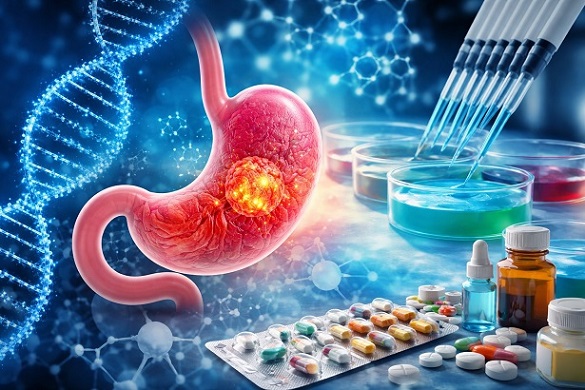 Existing cancer drugs may soon offer personalized new treatment hope for stomach cancer patients
A new study by researchers from the Hallym Translational Research Institute, Hallym University Sacred Heart Hospital, and the Department of Internal Medicine at Hallym University College of Medicine, all in Anyang-si, Republic of Korea, has explored exactly that possibility. This
Medical News report examines how the team tested 35 existing anticancer drugs against 14 different stomach cancer cell lines to see which ones might work best.
Mapping the Genetic Weaknesses of Stomach Cancer
The researchers first studied 14 well-known gastric cancer cell lines obtained from the Korean Cell Line Bank in Seoul. They analyzed 286 cancer-related genes using advanced DNA sequencing techniques to understand which genes were mutated or amplified.
Some of the most important cancer-driving genes they focused on included MET, FGFR2, EGFR, HER2, CDK12, PD-L1, CD44, TGFβR1, and CLDN18. These genes produce proteins that act like switches, telling cancer cells to grow, spread, and avoid death.
They found that certain cell lines showed strong overexpression of specific targets. For example, MET and its activated form p-MET were highly expressed in SNU5, SNU620, MKN45, and Hs746T cells. FGFR2 was strongly amplified in Kato III and SNU16 cells. HER2 and CDK12 were overexpressed in NCI-N87 and MKN7 cells. PD-L1, a protein linked to immune escape, was high in Hs746T and MKN7 cells.
Importantly, there was a very strong correlation between gene amplification and protein overexpression, meaning that when a gene had extra copies, the corresponding protein was usually increased as well. This finding strengthens the reliability of genetic testing in guiding treatment choices.
Screening 35 Approved Drugs
Instead of developing new drugs, the team screened 1,443 FDA-approved drugs and narrowed them down to 35 that were not already standard treatments for stomach cancer but showed strong potential.
Each drug was tested at a fixed dose against the 14 cell lines. Researchers measured how much each drug reduced cancer cell survival.
Ten drugs stood out by reducing cell viability by 50 percent or more in at least half of the cell lines. These included epirubicin, doxorubicin, topotecan HCl, ponatinib, mitoxantrone 2HCl, fostamatinib, fedratinib, daunorubicin, ceritinib, and mitomycin C.
Mitomycin C, in particular, showed strong effects across multiple genetic subtypes. Ponatinib and mitomycin C were especially effective in FGFR2-overexpressing cells. Lapatinib and mitomycin
C worked well in EGFR-activated cells. Several drugs including afatinib, alpelisib, azacitidine, daunorubicin, and fostamatinib reduced survival in HER2- and CDK12-overexpressing cells.
Topotecan HCl and afatinib dimaleate were highly effective in cells overexpressing TGFβR1 and CLDN18. Afatinib dimaleate and topotecan HCl also significantly reduced survival in PD-L1-overexpressing cells.
In CD44-overexpressing cells, which are often linked to aggressive disease and recurrence, drugs such as doxorubicin, daunorubicin, epirubicin, topotecan HCl, mitoxantrone, and mitomycin C showed strong killing effects.
Why This Matters
This study highlights how different stomach cancers are driven by different molecular signals. By matching drugs to specific genetic weaknesses, treatment could become far more personalized and effective.
Instead of using a one-size-fits-all chemotherapy approach, doctors may eventually be able to test a patient’s tumor for gene amplifications and protein overexpression, then select from already approved drugs that target those exact abnormalities.
Conclusion
The findings provide a practical roadmap for drug repositioning in gastric cancer. By carefully analyzing genetic alterations and matching them with drug sensitivity patterns, the researchers demonstrated that many existing anticancer drugs could be repurposed for specific subtypes of stomach cancer. While laboratory results are promising, further animal studies and clinical trials in patients are essential before these drugs can become routine treatment options. If validated in humans, this strategy could dramatically shorten the time needed to deliver effective therapies to patients with advanced gastric cancer.
The study findings were published in the peer reviewed International
Journal of Molecular Sciences.
https://www.mdpi.com/1422-0067/27/5/2133
For the research on gastric cancer, keep on logging to Thailand
Medical News.
Read Also:
https://www.thailandmedical.news/articles/cancer




 Share
Share
 Tweet
Tweet
 Share
Share

































