COVID-19 Warning Signs Across America Raise Questions About Whether CDC's Moderate Risk Ratings Tell the Full Story
Nikhil Prasad Fact checked by:Thailand Medical News Team Nov 02, 2026 1 hour, 9 minutes ago
Concerns are growing over how COVID-19 transmission is being communicated across the United States, as wastewater surveillance continues to detect substantial coronavirus activity even when federal public health assessments describe national infection levels as low or moderate.
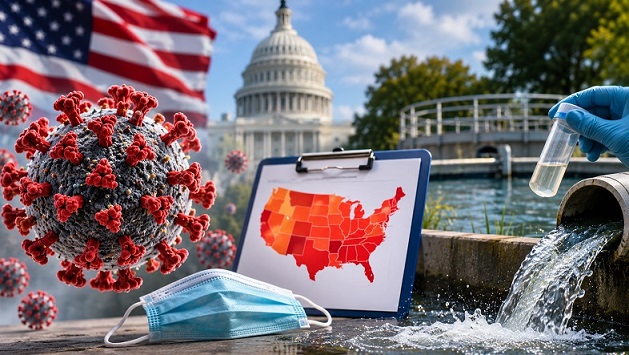 Wastewater Surveillance Reveals a Complicated COVID-19 Picture
The U.S. Centers for Disease Control and Prevention (CDC) has classified national COVID-19 wastewater activity as moderate during parts of October 2026. However, independent wastewater surveillance has reported higher activity, raising questions about whether Americans are receiving a sufficiently clear picture of ongoing coronavirus transmission.
Although available evidence does not confirm extremely high infections across most states, the differences between surveillance systems highlight a significant challenge in measuring the virus's continuing spread as this
Thailand Medical News report warns.
Wastewater Surveillance Reveals a Complicated COVID-19 Picture
Wastewater monitoring has become an increasingly important tool for tracking COVID-19 because it can identify coronavirus circulation without relying on individuals seeking medical attention or undergoing clinical testing.
The technology detects genetic material from SARS-CoV-2 in sewage, potentially identifying increased transmission before corresponding rises in hospital admissions.
According to CDC surveillance information published in October, national wastewater activity reached moderate levels during the month, although substantial geographical differences remained.
Meanwhile, independent monitoring reported high national SARS-CoV-2 wastewater activity in late October, suggesting that different surveillance systems can produce markedly different assessments of the same public health threat.
These findings do not automatically establish that one monitoring system is incorrect. Nevertheless, they raise legitimate questions about how surveillance classifications are calculated and interpreted.
Why the CDC's Moderate Classification Is Facing Questions
The CDC categorizes COVID-19 wastewater activity into five levels: very low, low, moderate, high and very high.
These classifications are calculated using standardized measurements of viral concentrations and historical surveillance information.
Importantly, the designation of moderate does not mean coronavirus transmission is insignificant or that infections cannot cause serious illness.
The concern is that members of the public may interpret moderate activity as reassurance that COVID-19 poses little immediate risk.
Furthermore, a national classification can conceal considerable differences between individual states, cities and communities.
An area experiencing elevated transmission may therefore face substantially different conditions from those suggested by a nationwide average.
;
However, describing this discrepancy as deliberate CDC downplaying would require additional evidence about the agency's decisions and communications.
Gaps in Surveillance Could Make the Situation Harder to Assess
Another complication involves interruptions in wastewater monitoring. On October 30, the CDC acknowledged that a transition to a new wastewater testing contractor would temporarily affect approximately 200 monitoring sites. The agency explained that sampling, testing and reporting would need to restart at affected locations.
Such interruptions can complicate the interpretation of national trends, particularly when surveillance coverage is already uneven.
The CDC also cautions that wastewater results from sites covering less than five percent of a state's population may not accurately represent conditions throughout that state.
Consequently, neither limited wastewater coverage nor a national average can establish the precise number of infections occurring across the country.
COVID-19 Remains a Health Threat Despite Lower Official Ratings
COVID-19 continues to present risks, particularly for older adults, immunocompromised individuals and people with underlying medical conditions.
Even when severe disease indicators remain relatively low, ongoing transmission can produce hospitalizations, deaths and cases of Long COVID.
Public health experts therefore emphasize the importance of considering multiple indicators, including wastewater concentrations, emergency department visits and hospitalization trends.
The CDC's outlook for the 2026–2027 respiratory illness season anticipates that COVID-19, influenza and respiratory syncytial virus will continue placing demands on healthcare systems.
The Need for Greater Transparency in COVID-19 Reporting
The central question is not simply whether the CDC's moderate designation is technically accurate, but whether it communicates the complexity of coronavirus transmission effectively.
Clearer explanations of surveillance limitations, differences between monitoring systems and regional variations could help Americans make better-informed decisions.
As the United States enters another respiratory virus season, transparent reporting remains essential to ensuring that COVID-19 risks are neither exaggerated nor underestimated.
References:
https://www.cdc.gov/wastewater/respiratory-viruses/state.html
https://www.cdc.gov/respiratory-viruses/data/index.html
https://www.cdc.gov/wastewater/about/wval.html




 Share
 Tweet
 Share