Nikhil Prasad Fact checked by:Thailand Medical News Team Jul 09, 2026 1 month, 3 weeks, 3 days, 15 hours, 56 minutes ago
Medical News: Long-Term Vision Problems Linked to Hidden Nerve and Immune Damage
A new study has revealed that even people who experienced only mild COVID-19 may develop persistent eye problems that can last for years after recovering from the initial infection.
Researchers found that these lingering symptoms are associated with chronic immune system abnormalities, damage to the tiny nerves of the eye, and dysfunction of the autonomic nervous system that controls pupil movement. The findings suggest that these patients are suffering from a genuine medical condition rather than unexplained or routine vision complaints.
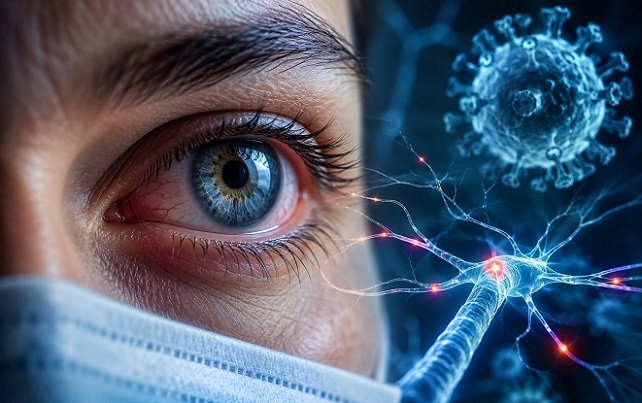 New research shows that even mild COVID-19 may trigger long-lasting nerve and immune damage in the eyes,
causing persistent vision problems for years after infection
The research was conducted by scientists from Linköping University, the Clinical Department of Ophthalmology at Region Östergötland, Linnaeus University in Sweden, the University of Minho in Portugal, and Sørlandet Hospital Arendal in Norway.
Persistent Symptoms Continue Years After Infection
The researchers evaluated 100 individuals who developed persistent eye symptoms after recovering from COVID-19 that did not require hospitalization and compared them with 32 recovered individuals who experienced no lasting eye issues.
The study showed that most participants developed eye symptoms within four months of their COVID-19 infection. Alarmingly, more than 78 percent continued experiencing symptoms for at least one year, while one-third remained affected for over two years. Some participants were still suffering nearly three years after their original infection.
The most frequently reported symptoms included light sensitivity, eye pain, eye fatigue, blurred vision, difficulty focusing, headaches, double vision, burning sensations, and problems reading from books, newspapers, or digital screens.
Many participants experienced several of these symptoms simultaneously, and approximately one-third had reduced their work hours or stopped working altogether because of their condition.
Routine Eye Exams Often Miss the Underlying Problem
One of the study's most important findings was that routine eye examinations frequently failed to detect any obvious abnormalities. However, specialized testing uncovered significant changes affecting both vision and nerve function.
Patients demonstrated poorer near vision and subtle eye misalignment known as strabismus, making it more difficult for both eyes to work together during reading and other close-up activities. They also had reduced ability to compensate for these alignment problems, contributing to headaches, eye strain, and visual discomfort.
Advanced imaging further revealed a significant loss of microscopic nerve fibers within the cornea, the transparent front surface of the eye. At the same time, researchers detected increased numbers of activated immune cells surrounding these nerves, suggesting that ongoing inflammation was contributing to progressive nerve injury.
Chronic Immune A
ctivation May Be Driving the Disease
In this
Medical News report, another major discovery was the identification of an abnormal protein signature in patients' tears. Analysis of hundreds of proteins showed elevated levels of molecules previously associated with severe COVID-19, nerve injury, inflammation, tissue repair, and immune dysfunction.
Among the most significant abnormalities were increased levels of proteins including ITGB6, NFASC, CTGF, TPSAB1, and CKMT1A-CKMT1B. The researchers believe these changes indicate persistent dysregulation of T-cell immune activity, resulting in chronic neuroinflammation that continues long after the virus itself has been cleared from the body.
The study also demonstrated that the pupils responded abnormally to light. Patients showed slower constriction and altered recovery of pupil size, indicating dysfunction of the autonomic nervous system. Several of these abnormalities closely matched complaints of light sensitivity, headaches, and difficulty focusing.
New Diagnostic Models Could Improve Detection
Because conventional eye examinations often fail to identify these lingering problems, the researchers developed new diagnostic models using specialized eye measurements and tear protein biomarkers.
A model using only advanced clinical eye tests correctly identified affected patients with approximately 77 percent accuracy. When tear protein biomarkers were added, diagnostic accuracy increased to about 91 percent. These findings offer hope that clinicians may eventually have objective tools to diagnose this underrecognized condition more reliably and begin treatment earlier.
Conclusion
The findings provide compelling evidence that lingering eye problems following mild COVID-19 are not simply temporary aftereffects or psychological complaints. Instead, they appear to represent a distinct neuroinflammatory condition involving chronic immune activation, peripheral nerve damage, autonomic dysfunction, and persistent inflammation within the eye. Greater awareness of these biological changes could help thousands of patients receive accurate diagnoses, encourage the development of targeted treatments, and improve long-term quality of life for individuals whose symptoms have often gone unrecognized despite normal routine eye examinations.
The study findings were published in the peer reviewed journal: Nature Communications.
https://www.nature.com/articles/s41467-026-74858-4
For the latest COVID-19 news, keep on logging to Thailand
Medical News.
Read Also:
https://www.thailandmedical.news/articles/coronavirus
https://www.thailandmedical.news/articles/long-covid




 Share
Share
 Tweet
Tweet
 Share
Share