Nikhil Prasad Fact checked by:Thailand Medical News Team Feb 14, 2026 6 months, 2 weeks, 2 days, 11 hours, 59 minutes ago
Medical News: Scientists Discover Hypoxia-Targeting Compound That Shrinks Tumors
A team of scientists from the State Key Laboratory of Medicinal Chemical Biology, College of Pharmacy and Tianjin Key Laboratory of Molecular Drug Research at Nankai University, along with researchers from the College of Chemistry at Nankai University, China, have identified a powerful new compound that could change the way triple-negative breast cancer (TNBC) is treated.
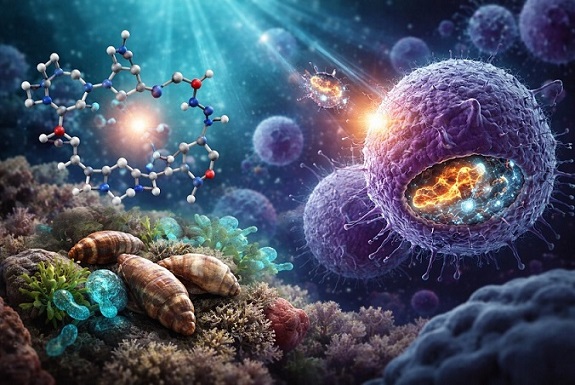 A newly engineered boholamide compound selectively attacks low-oxygen breast cancer cells and shrinks tumors in animal studies
TNBC is one of the most aggressive forms of breast cancer. Unlike other types, it does not respond to hormonal therapy or drugs that target HER2 receptors. As a result, patients often rely on chemotherapy, which is not always effective and can cause severe side effects. Survival rates remain poor, especially when the cancer spreads.
Targeting Cancer Where It Hides
Solid tumors often contain areas with very low oxygen levels, a condition known as hypoxia. These hypoxic zones help cancer cells survive treatment and become more aggressive. The Nankai University team focused on developing a compound called Boholamide A that works better in these low-oxygen environments.
What is Boholamide A
Boholamide A is a novel and highly potent hypoxia-selective anticancer compound originally discovered in marine bacteria associated with Truncatella snails collected near Bohol in the Philippines. It belongs to the rare 4-amido-2,4-pentadieneoate (APD) class of 15-membered cyclic depsipeptides and has drawn attention for its ability to selectively kill cancer cells under low-oxygen conditions, a common feature of solid tumors. First identified by Dr. Joshua Torres and researchers at the University of Utah, the compound acts as a powerful cytotoxic agent by triggering a rapid influx of calcium ions (Ca²⁺) and primarily targeting mitochondria, thereby disrupting cancer cell survival mechanisms. Subsequent total synthesis studies confirmed its complex cyclic structure and corrected the originally proposed stereochemistry at the C6 position. Because it is especially effective against cancer cells in their hypoxic, treatment-resistant state, boholamide A is regarded as a promising and potent drug lead for future anticancer therapy development.
The Research
The Chinese study team started with the natural molecule of boholamide A and chemically modified it to create a series of new analogues. After extensive laboratory testing, one compound—called 1j—stood out. Under hypoxic conditions, 1j showed remarkable potency against TNBC cells, with an IC50 value of just 0.15 micromolar. This means it was extremely effective at stopping cancer cell growth at very low concentrations.
Importantly, 1j was more powerful than the original natural compound and significantly more selective for cancer cells growing in low oxygen. It showed minimal harmful effects on normal cells in laboratory tests.
How the Compound Works
Further investigations revealed that compound 1j directly targets a pro
tein called eEF1A1, which plays a key role in protein production inside cells. Cancer cells often rely heavily on this protein to grow and spread.
The researchers discovered that 1j binds covalently to a specific site—Cys31—on the eEF1A1 protein. This binding disrupts the interaction between eEF1A1 and another protein known as FoxO1. Normally, under hypoxia, eEF1A1 traps FoxO1 in the cell’s cytoplasm. However, when 1j interferes with this interaction, FoxO1 moves into the nucleus, where it can suppress cancer-promoting signals.
Specifically, the compound was shown to shut down the JAK/STAT3 signaling pathway, a pathway strongly linked to cancer growth and metastasis. Laboratory experiments demonstrated that 1j triggered cancer cell death through the mitochondrial pathway. Levels of pro-apoptotic proteins such as Bax increased, while survival proteins including Bcl-2 and Mcl-1 decreased.
The compound also reduced cancer cell migration. Proteins associated with metastasis, such as Vimentin and MMP9, were lowered, while E-cadherin, which helps prevent cancer spread, was increased.
Promising Animal Results
Because compound 1j had limited water solubility, the researchers developed a modified version called compound 16. In mouse models of breast cancer, compound 16 significantly reduced tumor volume and tumor weight in a dose-dependent manner. It also lowered spleen and liver enlargement, suggesting reduced metastasis.
Importantly, toxicity studies showed no major damage to the liver, kidneys, heart, lungs, brain, or spleen at tested doses. Blood markers of organ function remained normal.
A Promising New Direction
This
Medical News report highlights that boholamide A analogues may represent a new class of hypoxia-selective anti-TNBC agents. Compound 1j demonstrated superior potency compared to the original natural molecule, selectively killed cancer cells under low oxygen, triggered apoptosis, reduced migration, and effectively shrank tumors in animal models without severe toxicity.
In conclusion, the study provides compelling evidence that targeting eEF1A1 under hypoxic conditions is a promising therapeutic strategy for triple-negative breast cancer. By combining chemical innovation with detailed biological investigation, the researchers have identified a lead compound with strong anti-cancer activity and manageable safety in early studies. While further clinical research is needed, these findings open an encouraging pathway toward more effective and targeted treatments for one of the most difficult breast cancers to treat.
The study findings were published in the peer reviewed journal: Acta Pharmaceutica Sinica B.
https://www.sciencedirect.com/science/article/pii/S2211383526001115
For the latest on Breast Cancer, keep on logging to Thailand
Medical News.
Read Also:
https://www.thailandmedical.news/articles/cancer




 Share
Share
 Tweet
Tweet
 Share
Share

































