Nikhil Prasad Fact checked by:Thailand Medical News Team Mar 22, 2026 5 months, 1 week, 4 days, 14 hours, 45 minutes ago
Medical News: A new study has uncovered how a common respiratory virus can silently cause long-term damage in the lungs, even after the initial infection appears to be gone. The findings help explain why some children who recover from viral infections later develop breathing problems or chronic lung conditions.
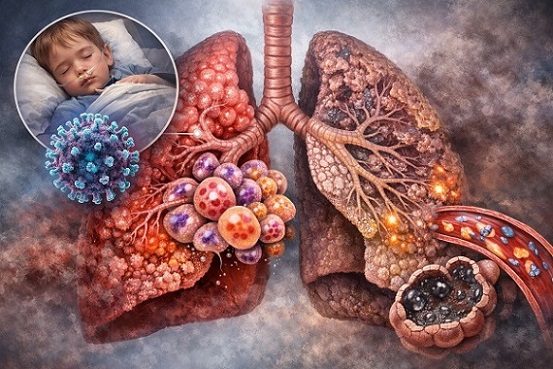 Common RSV infections may trigger long-term lung damage through abnormal repair processes
A Common Virus with Hidden Consequences
Respiratory syncytial virus, or RSV, is one of the leading causes of lung infections in infants and young children worldwide. While most patients recover, many continue to suffer from reduced lung function and increased risk of respiratory diseases later in life.
Researchers from the Department of Medicine, School of Medicine and Public Health, University of Wisconsin-Madison, USA, and the Institute for Clinical and Translational Research, University of Wisconsin-Madison, USA, set out to understand why this happens.
This
Medical News report highlights that the damage caused by RSV does not always end when the infection clears. Instead, it can trigger long-term changes deep inside the lungs.
What Happens Inside the Lungs After Infection?
The study showed that RSV infection disrupts the normal lining of the lungs, damaging cells and forcing the body to repair itself. During this process, special repair cells called progenitor cells become active.
However, instead of restoring healthy tissue, these cells begin forming abnormal lung cells. These unusual cells, known as atypical alveolar cells, do not function properly and may contribute to long-term breathing problems.
The researchers discovered that these abnormal cells arise from a specific group of airway cells known as Scgb1a1-positive progenitor cells, which normally help repair lung tissue.
Key Role of a Powerful Inflammatory Signal
A major breakthrough in the study was identifying a protein pathway called RelA as a key driver of this harmful process.
When RSV infects the lungs, it activates RelA, which triggers inflammation and alters how repair cells behave. This leads to:
-Increased production of abnormal lung cells
-Higher levels of inflammatory molecules
-Disruption of normal lung structure
When researchers blocked RelA in experimental models, many of these harmful effects were reduced. Oxygen levels improved, and abnormal cell growth was significantly limited.
A Surprising Link to the Body’s Internal Clock
One of the most unexpected findings was that RSV disrupts the body’s “biological clock” inside lung cells.
Genes that control daily rhythms—known as circadian clock genes—were found to be abnormally activated. These genes influenced how lung cells commun
icated and repaired themselves.
The study also identified a molecule called ANGPTL4, which became overactive and interfered with normal lung function. This disruption may play a role in ongoing inflammation and tissue damage long after the virus is gone.
No Active Virus, But Damage Continues
Interestingly, the researchers found that by the later stages of the disease, the virus itself was no longer actively replicating.
Despite this, lung damage continued due to the earlier changes triggered by the infection. This explains why some patients experience lasting symptoms even after testing negative for RSV.
Why This Matters for Public Health?
These findings are important because they shift the focus from the virus itself to the long-term effects it leaves behind.
Understanding how RSV alters lung repair mechanisms could lead to new treatments aimed at preventing chronic lung disease rather than just treating the initial infection.
Conclusion
The study clearly shows that RSV is not just a short-term illness but can cause lasting changes in lung biology. By activating inflammatory pathways and disrupting normal repair processes, the virus sets the stage for chronic respiratory problems. Targeting pathways like RelA could offer new hope in preventing long-term lung damage, especially in vulnerable infants and young children.
The study findings were published in the peer reviewed International Journal of Molecular Sciences.
https://www.mdpi.com/1422-0067/27/6/2864
For the latest news, keep on logging to Thailand
Medical News.
Read Also:
https://www.thailandmedical.news/news/erdosteine-emerges-as-a-potent-weapon-against-deadly-respiratory-viruses-including-sars-cov-2-rsv-and-influenza-a
https://www.thailandmedical.news/news/probenecid-offers-new-hope-in-treating-covid-19-and-rsv-coinfections
https://www.thailandmedical.news/news/newly-discovered-mysterious-human-gene-vilmir-found-to-be-activated-by-flu-covid-19-and-rsv-infections




 Share
Share
 Tweet
Tweet
 Share
Share