Nikhil Prasad Fact checked by:Thailand Medical News Team Aug 15, 2026 1 month, 3 weeks, 7 hours, 25 minutes ago
Endometriosis is notoriously difficult to treat because it is not driven by one biological problem. A new scientific review suggests that several naturally occurring bioactive compounds may be able to influence multiple processes that help endometriosis lesions survive, grow and spread.
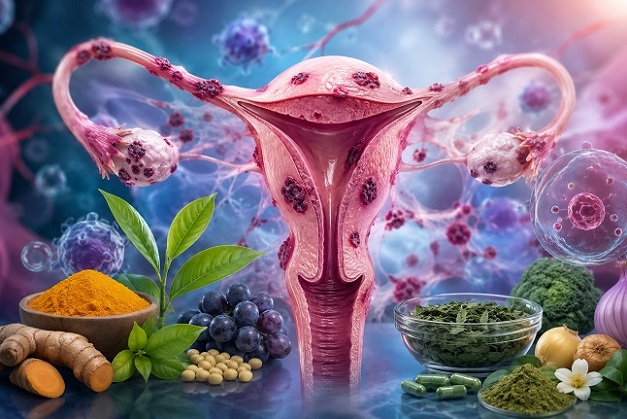 Natural bioactive compounds may simultaneously influence several biological pathways that help endometriosis
lesions survive and progress.
The researchers examined evidence involving compounds including curcumin, resveratrol, quercetin, epigallocatechin-3 gallate (EGCG), genistein, puerarin and ginsenosides.
Why Endometriosis Is So Complicated
Endometriosis occurs when tissue resembling the lining of the uterus grows outside the uterine cavity. The disease involves inflammation, abnormal blood-vessel formation, estrogen activity, oxidative stress and mechanisms that allow abnormal cells to avoid normal programmed cell death.
These processes can reinforce one another. For example, inflammation can increase oxidative stress, while low-oxygen conditions can activate HIF-1α and VEGF, signals that encourage new blood vessels to develop and support lesions.
Current treatments include painkillers, hormonal medications and surgery. However, symptoms may persist or return, creating strong interest in additional treatment strategies.
Researchers Identify Broad-Acting Natural Compounds
The review was conducted by researchers from the West Pomeranian University of Technology in Szczecin, Poland; Pomeranian Medical University in Szczecin, Poland; and National University of Uzbekistan Named After Mirzo Ulugbek in Tashkent, Uzbekistan.
The researchers searched PubMed, Scopus and Web of Science and evaluated experimental, animal and clinical evidence concerning natural bioactive compounds and endometriosis.
Among the most interesting findings, curcumin was associated with reduced inflammatory signaling involving NF-κB, STAT3 and JNK, decreased inflammatory molecules including IL-6 and TNF-α, suppression of VEGF-linked blood-vessel formation, reduced cell proliferation and migration, and increased apoptosis, the natural process through which damaged or unwanted cells die.
Resveratrol also showed broad activity, affecting inflammation, angiogenesis, proliferation and invasion. Quercetin was linked to estrogen-related signaling, PI3K/Akt and ERK pathways, VEGF and p53, while EGCG showed effects involving VEGF, VEGFR2, oxidative stress and pathways controlling cell invasion.
As highlighted in this Thailand
Medical News report, the significance is the possibility of targeting several interconnected disease mechanisms rather than attempting to block only one.
Promising Findings but Major Obstacles Remain
The review also highlighted genistein, puerarin and ginsenosides as compounds potentially affecting several disease pathways. Other substances showed narrower actions, targeting inflammation, estrogen signaling, angiogenesis, invasio
n or abnormal cell survival.
However, most evidence comes from laboratory and animal research. Many compounds also have poor absorption, rapid metabolism or low bioavailability, meaning amounts producing impressive laboratory effects may be difficult to achieve safely inside the human body. Researchers therefore stressed the need for better formulations and properly designed human trials.
Conclusions
The findings suggest that natural bioactive compounds deserve serious investigation because endometriosis involves an interconnected network of inflammation, hormones, oxidative stress, blood-vessel formation, invasion and abnormal cell survival. However, these compounds should not yet be viewed as proven treatments, and carefully controlled clinical studies are essential before their effectiveness, appropriate doses and long-term safety can be established.
The study findings were published in the peer reviewed journal: Antioxidants.
https://www.mdpi.com/2076-3921/15/8/1003
Read Also:
https://www.thailandmedical.news/articles/herbs-and-phytochemicals 



 Share
Share
 Tweet
Tweet
 Share
Share