Nikhil Prasad Fact checked by:Thailand Medical News Team Jan 11, 2026 8 months, 3 weeks, 2 days, 23 hours, 39 minutes ago
Medical News: Brain Metastases Are Far More Common Than Most Realize
Cancer that spreads to the brain is now the most frequent type of tumor found inside the skull among adults. Doctors estimate that between 20 and 40 percent of all people with cancer will eventually develop brain metastases — far more than those with primary brain cancers. Lung cancer contributes the most cases, followed by breast cancer and melanoma.
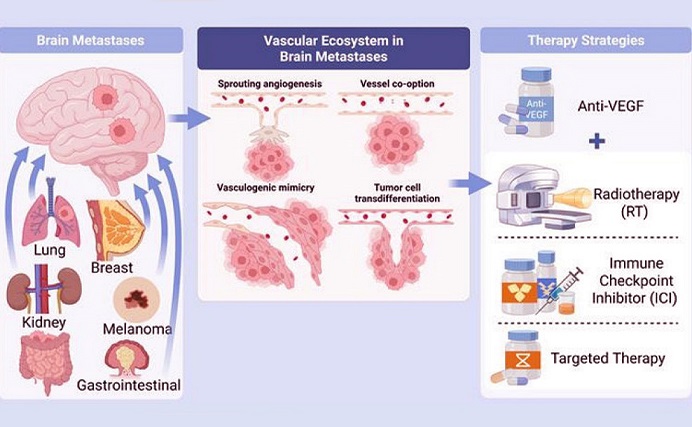 New research reveals brain tumors survive by switching between four blood-supply tricks, making treatment far more complex than once believed.
Researchers behind the review — from the Department of Neurosurgery at Xuanwu Hospital, Capital Medical University, the China International Neuroscience Institute, and the China Clinical Alliance of Intracranial Metastasis (CLAIM) in Beijing — examined how these tumors stay alive and grow despite treatment.
A Maze of Trick Blood Supplies
Normal blood vessels in the brain are tightly sealed to protect the organ. When cancer cells move in, they hijack and reshape these vessels in surprisingly clever ways.
Scientists found that tumors do not depend on a single pathway for nourishment. Instead, they can use four different blood-supply strategies:
1. Sprouting New Vessels
Hypoxia — or lack of oxygen — pushes tumors to release VEGF, a chemical that forces new vessels to grow. These leak badly, causing major swelling seen on MRI scans. Anti-VEGF drugs like bevacizumab reduce this swelling dramatically but often fail to stop long-term tumor growth.
2. Stealing Existing Blood Vessels
Some tumors don’t bother building anything. They cling to and spread along healthy blood vessels, a strategy called vessel co-option. These tumors often do not show dramatic enhancement on MRI, making them harder to spot and harder to treat because anti-VEGF drugs cannot block a supply that already exists.
3. Imitating Blood Vessels
Certain cancer cells form fake channels that act like blood vessels without using any real endothelial cells. This trick, called vasculogenic mimicry, is especially common in melanoma brain metastases and is linked to larger tumors, more bleeding, and aggressive disease.
4. Turning into Vessel Cells
The most shocking ability: some tumor cells shape-shift into cells that resemble the brain’s own vascular lining. These disguised cancer cells help build the blood supply themselves, making them nearly impossible to block with standard treatments.
Imaging Reveals Which Strategy a Tumor Is Using
Modern MRI scans can show which vascular tricks are active:
-Bright ring-like enhancement = new leaky vessels
-Modest enhancement with wide spread = vessel stealing
-Big edema and odd bleeding = vasculogenic mimicry
Doctors hope to tailor treatment based on these imagings.&
lt;br />
Current Drugs Fall Short
Bevacizumab works best as a temporary “calmer,” reducing brain swelling and improving symptoms. Combining it with radiation or immunotherapy shows greater promise — particularly in melanoma — but more trials are urgently needed. The drug however often fails to stop long-term tumor growth.
The Big Picture and What Comes Next
This
Medical News report highlights that brain metastases are far smarter than previously believed. They switch between blood-supply strategies when drug pressure increases, meaning no single treatment is enough. Future therapy will likely require combinations that block multiple vascular pathways at once, paired with radiation, targeted drugs, or immunotherapy.
The conclusion is clear: Brain metastases survive by constantly changing how they get blood. Unless medicine learns to shut down all escape routes — sprouting, stealing, imitating, and transforming — anti-VEGF drugs alone cannot deliver lasting control. Understanding and mapping these shifting patterns will guide a new generation of treatments that finally match the complexity of metastatic brain disease.
The study findings were published in the peer reviewed journal: Biomedicines.
https://www.mdpi.com/2227-9059/14/1/119
For the latest on Brain Cancers, keep on logging to Thailand
Medical News.
Read Also:
https://www.thailandmedical.news/articles/cancer




 Share
Share
 Tweet
Tweet
 Share
Share

































