Nikhil Prasad Fact checked by:Thailand Medical News Team Jul 01, 2026 1 month, 2 weeks, 4 days, 23 hours, 53 minutes ago
Medical News: COVID-19 May Trigger Rare Autoimmune Muscle Disorder in Some Patients
A growing body of research suggests that COVID-19 may be linked to the development of a rare autoimmune disease called myasthenia gravis (MG), although scientists stress that the condition remains uncommon and a direct cause-and-effect relationship has yet to be proven.
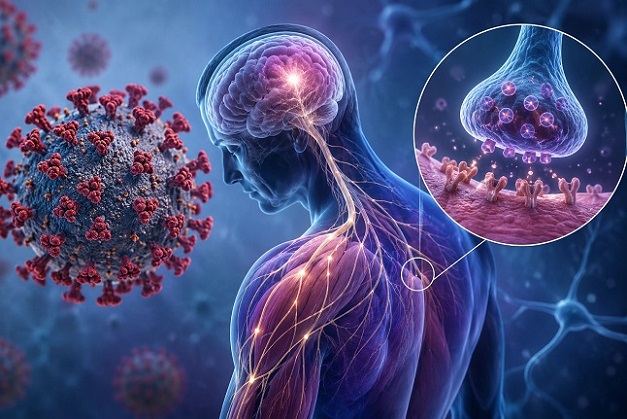 A major review suggests COVID-19 may rarely precede new-onset myasthenia gravis, but most patients respond
well to established treatments.
Researchers from "Prof. Dr. Agrippa Ionescu" Emergency Clinical Hospital, Carol Davila University of Medicine and Pharmacy, Bucharest University Emergency Hospital, and the Marius Nasta Institute of Pneumology, all in Romania, conducted a comprehensive systematic review examining reported cases of people who developed myasthenia gravis for the first time after recovering from SARS-CoV-2 infection.
What Is Myasthenia Gravis?
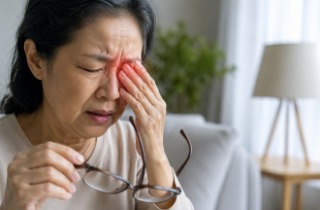
Myasthenia gravis is an autoimmune disease in which the body's immune system mistakenly attacks the communication point between nerves and muscles. As a result, muscles become weak and tire easily. Patients may initially notice drooping eyelids, double vision, difficulty speaking or swallowing, weakness in the arms and legs, and in severe cases, breathing problems requiring emergency treatment.
Scientists have long known that infections can sometimes trigger autoimmune disorders in susceptible individuals. The new review explores whether COVID-19 could be one of those triggers.
What the Researchers Found
The investigators analyzed 44 published studies involving 48 patients from 18 countries who developed newly diagnosed myasthenia gravis following confirmed COVID-19 infection. Most reports came from the United States, followed by Italy and India. The patients had a median age of 61 years, with women making up just over half of the cases.
One of the most striking findings was the timing. Symptoms of myasthenia gravis typically appeared within a relatively short period after COVID-19, with a median interval of just 21 days, although the range extended from five days to 300 days.
Nearly 79 percent of patients developed generalized myasthenia gravis, meaning weakness affected multiple muscle groups instead of remaining limited to the eyes. Around one in five patients initially experienced only eye-related symptoms such as drooping eyelids or double vision.
Severe Illness Was Common
This
Medical News report highlights that many patients experienced serious complications after developing the disease.
Almost 48 percent required admission to an intensive care unit. About 44 percent suffered a life-threatening myasthenic crisis, while roughly 46 percent developed respiratory failure. Nearly 40 percent required mechanical ventilation because their breathing muscles became too weak.
Despite these alarming numbers, researchers caution that published medical literature often favors reporting the most severe or unusual cases, mean
ing these figures probably overestimate how frequently severe illness actually occurs in the wider population.
Immune Clues Behind the Disease
The review also found that approximately two-thirds of patients tested positive for antibodies against acetylcholine receptors (AChR), the same immune markers commonly found in traditional myasthenia gravis. Smaller numbers carried MuSK or LRP4 antibodies, while a few patients had no detectable antibodies.
Researchers believe SARS-CoV-2 may trigger abnormal immune responses through several possible mechanisms, including molecular mimicry, immune overactivation, bystander activation, and disruption of normal immune regulation. Another possibility is that the infection simply unmasks previously silent disease in people who were already genetically susceptible.
Importantly, the study found no definitive evidence proving that COVID-19 directly causes myasthenia gravis.
Standard Treatments Still Worked Well
Encouragingly, most patients responded well to conventional treatments. The majority received pyridostigmine to improve nerve-to-muscle communication, while many also required corticosteroids, intravenous immunoglobulin, plasmapheresis, or longer-term immunosuppressive medications. More than three-quarters of patients experienced meaningful clinical improvement, and several recovered completely.
The findings indicate that even when myasthenia gravis develops after COVID-19, it generally responds to the same therapies that have successfully treated the condition for many years.
Conclusion
Although new-onset myasthenia gravis following COVID-19 appears to be rare, the review provides important evidence that doctors should remain alert for persistent muscle weakness, drooping eyelids, difficulty swallowing, or breathing problems developing after SARS-CoV-2 infection. Early diagnosis allows timely treatment, which can dramatically improve outcomes. However, because the review relied mainly on individual case reports and small case series, larger population-based studies are still needed to determine whether COVID-19 truly triggers the disease or merely reveals previously undiagnosed autoimmune conditions in vulnerable individuals.
The study findings were published in the peer reviewed journal: Life.
https://www.mdpi.com/2075-1729/16/7/1100
For the latest COVID-19 news, keep on logging to Thailand
Medical News.
Read Also:
https://www.thailandmedical.news/articles/coronavirus
https://www.thailandmedical.news/articles/long-covid




 Share
Share
 Tweet
Tweet
 Share
Share