Natural Compound Blocks Bone Loss Trigger and Raises Hope for Safer Osteoporosis Treatments
Nikhil Prasad Fact checked by:Thailand Medical News Team Apr 19, 2026 5 months, 2 weeks, 1 day, 2 hours, 22 minutes ago
Medical News: A newly published scientific study has uncovered promising evidence that a plant-derived compound may help slow down bone loss, offering fresh hope for safer treatments for osteoporosis and other bone-related diseases. Researchers have identified a natural molecule called 8-epixanthatin that appears to stop the formation of bone-destroying cells without harming healthy cells.
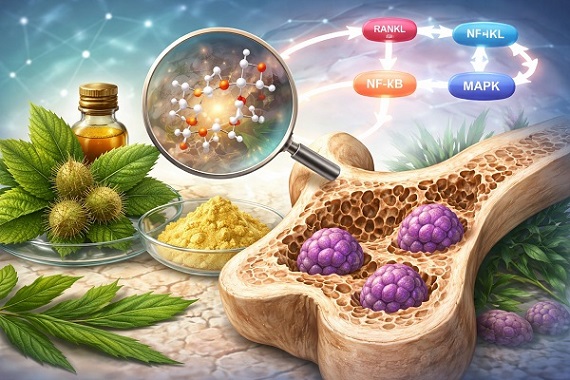
A
plant-derived compound shows strong potential in stopping bone-destroying cells linked to osteoporosis
Understanding the Balance of Bone Health
Bones in the human body are constantly being broken down and rebuilt. This delicate balance is maintained by two types of cells—osteoclasts, which break down bone, and osteoblasts, which build it back up. Problems arise when osteoclasts become overactive, leading to excessive bone loss, a hallmark of conditions like osteoporosis and inflammatory bone diseases.
The new research focused on blocking the signals that trigger osteoclast formation. Scientists zeroed in on a key protein known as RANKL, which acts like a switch that turns on osteoclast production.
A Phytochemical Compound with Powerful Effects
The study explored the effects of 8-epixanthatin, a phytochemical compound extracted from plants belonging to the Xanthium species. This compound belongs to a class of chemicals known as sesquiterpene lactones, which are already known for their anti-inflammatory and antiviral properties.
Laboratory experiments showed that 8-epixanthatin significantly reduced the number of osteoclasts formed when cells were exposed to RANKL. Even at relatively low concentrations, the compound was able to cut osteoclast formation by nearly 70 percent. Importantly, it achieved this without causing damage to the cells themselves, indicating a strong safety profile in early testing.
How It Works Inside the Body
To understand how this compound works, researchers examined the internal signaling pathways that control osteoclast development. They found that 8-epixanthatin interferes with two critical pathways known as NF-κB and MAPK.
These pathways act like communication highways inside cells, transmitting signals that tell precursor cells to become bone-resorbing osteoclasts. By blocking these signals, the compound effectively shuts down the process before it can begin.
Further analysis revealed that key genes responsible for osteoclast activity—such as TRAP and cathepsin K—were also significantly reduced. This suggests that the compound not only prevents osteoclast formation but also suppresses their ability to function.
Institutions Behind the Research
The study was conducted by researchers from multiple institutions, including the Osteoimmunology and Drug Discovery Research Group at Wenzhou-Kean University in China, the Dorothy and George Hennings College of Science, Mathematics and Technology at Kean University in the United States, the International Frontier Interdisciplinary Research Institute (IFIRI), the Wenzhou Municipal Key Laboratory for Applied Biomedical and Biopharmaceutic
al Informatics, the Zhejiang Bioinformatics International Science and Technology Cooperation Center, and the Zhejiang-Malaysia Joint Laboratory for Rare Medicinal Resources.
This
Medical News report highlights how the collaboration across these institutions helped uncover both the biological mechanism and therapeutic potential of the compound.
Why This Matters
Current treatments for osteoporosis, such as bisphosphonates and monoclonal antibodies, are effective but can come with serious side effects when used long term, including unusual fractures and jaw bone damage. This has created an urgent need for safer alternatives.
Natural compounds like 8-epixanthatin may offer a new direction. Because they target internal signaling pathways rather than directly killing cells, they could potentially reduce bone loss with fewer side effects.
Limitations and Next Steps
While the results are promising, the research is still in its early stages. The experiments were conducted in laboratory cell models, not in humans or animals. More studies are needed to confirm whether the compound works the same way in living organisms.
Future research will likely focus on testing the compound in animal models of bone loss and identifying its exact molecular targets. Scientists are also interested in determining whether similar compounds could be developed into new medications.
Conclusion
The discovery of 8-epixanthatin’s ability to block bone-destroying cells represents an exciting step forward in bone health research. By targeting the root signals that drive osteoclast formation, this natural compound could pave the way for safer and more effective treatments for osteoporosis and related conditions. While more testing is needed before it reaches clinical use, the findings open the door to a new class of therapies derived from nature that could transform how bone diseases are managed in the future.
The study findings were published in the peer reviewed International Journal of Molecular Sciences.
https://www.mdpi.com/1422-0067/27/8/3578
For the latest on osteoporosis, keep on logging to Thailand
Medical News.
Read Also:
https://www.thailandmedical.news/articles/herbs-and-phytochemicals




 Share
Share
 Tweet
Tweet
 Share
Share

































