Nikhil Prasad Fact checked by:Thailand Medical News Team Jan 23, 2026 8 months, 1 week, 5 days, 10 hours, 34 minutes ago
Medical News: Researchers from Portugal have uncovered new evidence showing that a key component of the SARS-CoV-2 virus may directly interfere with the normal functioning of placental cells that support fetal growth. The findings raise important questions about how COVID-19 infection during pregnancy could influence long-term health outcomes for babies later in life.
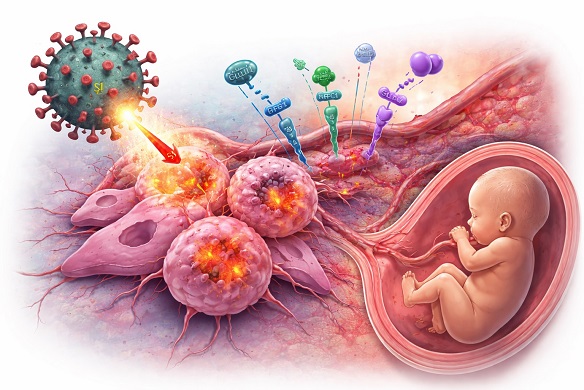 New research shows how a key COVID-19 viral protein may quietly disrupt placental cells and influence long-term
health risks for unborn babies
Understanding the Placenta and Why It Matters
The placenta is a temporary but vital organ that develops during pregnancy. It acts as a life-support system for the unborn baby, delivering oxygen and essential nutrients while removing waste products. Any disruption in placental function can affect how a fetus grows and how its organs develop, a process known as fetal programming. Changes during this sensitive period may increase the risk of metabolic diseases, such as diabetes or heart conditions, in adulthood.
What the Researchers Studied
Scientists from the University of Porto and affiliated medical and research institutions examined how the Spike protein S1 subunit of SARS-CoV-2 affects human placental cells. The research teams were based at the Unit of Biochemistry, Department of Biomedicine, Faculty of Medicine, University of Porto; the Instituto de Investigação e Inovação em Saúde (i3S), University of Porto; and the Department of Obstetrics at Unidade de Saúde Local de São João in Porto, Portugal.
Instead of using the whole virus, the researchers exposed placental trophoblast cells to the Spike S1 protein in laboratory conditions. This approach allowed them to focus specifically on how the viral protein alone influences placental cell behavior.
Key Findings from the Study
The study found that exposure to the Spike S1 protein triggered an inflammatory response in placental cells. Inflammation is the body’s natural defense mechanism, but when it occurs in the placenta, it may interfere with normal fetal development. The researchers also observed mild cell damage and reduced cell growth, particularly in cells that normally divide more actively.
Importantly, the SARS-CoV-2 spike protein altered how placental cells handled key nutrients. While the total uptake of glucose, folic acid, and the amino acid methionine did not dramatically change, the protein interfered with the transport systems responsible for moving these nutrients into the cells. These nutrients are essential for energy production, DNA formation, and healthy organ development in the fetus.
Another significant finding was the increased activity of a gene known as mTOR, which plays a major role in controlling cell growth, metabolism, and nutrient sensing. Elevated mTOR activity in the placenta has previously been linked to abnormal fetal growth patterns and a higher risk of metabolic disorders later in life.
Why These Results Are Important
This
l.news/">Medical News report highlights that even without direct viral infection of the fetus, exposure to viral components like the Spike protein may still influence placental function. The changes observed suggest a possible pathway through which COVID-19 during pregnancy could have lasting effects on children’s metabolic health.
Conclusions
The study shows that the SARS-CoV-2 Spike S1 protein can disrupt normal placental cell function by triggering inflammation, altering nutrient transport mechanisms, and increasing mTOR gene activity. While these changes were subtle, they may collectively influence fetal development and long-term metabolic health. Further research is essential to determine how these laboratory findings translate to real-world pregnancies and whether they contribute to health risks later in life.
The study findings were published in the peer reviewed journal: Placenta.
https://www.sciencedirect.com/science/article/pii/S0143400426000275
For the latest COVID-19 news, keep on logging to Thailand
Medical News.
Read Also:
https://www.thailandmedical.news/articles/coronavirus
https://www.thailandmedical.news/articles/long-covid
https://www.thailandmedical.news/articles/vaccine-news




 Share
Share
 Tweet
Tweet
 Share
Share

































