Nikhil Prasad Fact checked by:Thailand Medical News Team Jun 09, 2026 3 months, 3 weeks, 3 days, 15 hours, 13 minutes ago
Medical News: A growing body of scientific evidence is revealing a troubling consequence of COVID-19 that extends far beyond the acute infection phase. Researchers are increasingly finding that people who recover from SARS-CoV-2 infection face a significantly higher risk of developing new allergic diseases, including asthma and allergic rhinitis, months after recovery. While doctors have long recognized the respiratory complications associated with COVID-19, scientists are now uncovering biological mechanisms that may explain why the virus appears to leave many individuals more vulnerable to allergies.
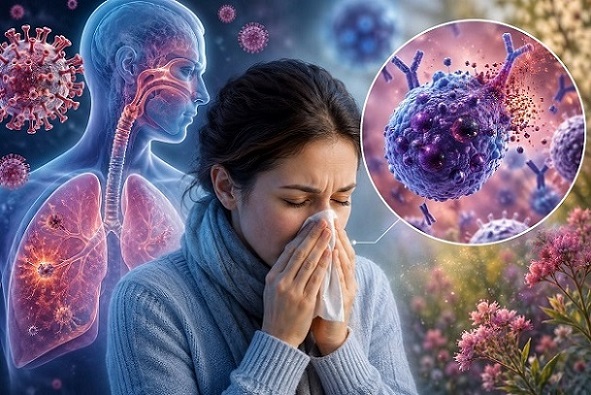 New research suggests that COVID-19 can leave lasting immune changes that increase the risk of developing
asthma, allergic rhinitis, and other allergic diseases months after recovery
A new review by researchers from Nanchang University, Nanchang, China, brings together the latest findings from immunology, epithelial biology, and neuroimmune research to explain how COVID-19 may trigger long-lasting immune changes that promote allergic disease.
Growing Evidence of Increased Allergy Risk
Several large multinational cohort studies have consistently shown that individuals infected with SARS-CoV-2 are more likely to develop allergic disorders after recovering from the virus. The findings indicate that the risk of developing asthma is more than twice as high among COVID-19 survivors, with a hazard ratio of 2.25. The risk of allergic rhinitis, commonly known as hay fever, is also elevated, with a hazard ratio of 1.23.
Importantly, these increased risks remain detectable for more than six months after infection. Scientists are still debating whether COVID-19 creates entirely new allergic sensitivities or simply uncovers previously silent allergic tendencies that had never produced symptoms before.
How COVID-19 Primes the Body for Allergies
The researchers propose that the process begins when SARS-CoV-2 damages the protective lining of the airways and other tissues. This injury triggers the release of powerful immune alarm molecules known as IL-33, TSLP, and IL-25. Collectively referred to as the "alarmin triad," these molecules serve as distress signals that activate immune pathways closely linked to allergic disease.
Once released, these alarm signals stimulate specialized immune cells called group 2 innate lymphoid cells and dendritic cells. These cells help establish a type 2 immune response, the same immune pattern commonly associated with asthma, eczema, and seasonal allergies. The review suggests that these responses may become reinforced through epigenetic memory, allowing the immune system to remain primed for exaggerated allergic reactions long after the virus has disappeared.
Lasting Changes to Immune Regulation
Another major concern is the impact of COVID-19 on regulatory T cells, which normally act as brakes on excessive immune responses. The researchers found evidence that SARS-CoV-2 infection may reduce the number or function of these critical cells, weakening the body's ability to control inflammation.
The review also highlights the possibility that sev
ere inflammation during acute infection, particularly elevated levels of interleukin-6, may reprogram blood-forming stem cells in the bone marrow. Although further studies are needed to confirm this mechanism, such changes could produce generations of immune cells that remain predisposed toward allergic inflammation.
At the same time, dendritic cells may adopt characteristics that encourage allergy-promoting immune responses, lowering the threshold for future allergic sensitization.
Mast Cells, Nerves, and Long COVID Connections
The researchers also identified mast cells as potential key players. These cells are central to allergic reactions and may be directly activated by the SARS-CoV-2 spike protein through ACE2 receptors.
Once activated, mast cells engage in continuous communication with nearby sensory nerves. This interaction amplifies inflammation and may contribute to neuroinflammatory processes associated with long COVID. Scientists believe this mast cell-neuron communication network could help explain why some long COVID patients experience symptoms that overlap with allergic disorders.
This
Medical News report notes that these interconnected biological processes may create a vulnerable post-infection period during which ordinary environmental allergens trigger disproportionately strong immune responses.
Identifying High-Risk Individuals
Researchers suggest that future screening strategies could help identify those most at risk of developing post-COVID allergic diseases. Factors such as the severity of the original infection, eosinophil counts, immunoglobulin E levels, and genetic susceptibility markers may prove useful in predicting future allergy risk.
Potential treatments under consideration include low-dose interleukin-2 therapy, mast cell stabilizers, and biologic drugs that target alarmin pathways. However, these approaches will require extensive clinical testing before becoming standard practice.
Conclusion
The accumulating evidence suggests that COVID-19 may leave behind far more than temporary respiratory symptoms. By damaging epithelial barriers, activating allergy-promoting immune pathways, disrupting immune regulation, stimulating mast cells, and potentially altering the development of future immune cells, SARS-CoV-2 may significantly increase the likelihood of developing allergic diseases after recovery. As millions of people worldwide continue to recover from COVID-19, understanding and monitoring these long-term immune consequences will be essential for reducing the growing burden of asthma, allergic rhinitis, and other allergy-related conditions in the years ahead.
The study findings were published as an abstract in the peer reviewed journal: Frontiers in Immunology. A full paper will be published soon.
https://www.frontiersin.org/journals/immunology/articles/10.3389/fimmu.2026.1879430/abstract
For the latest COVID-19 News, keep on logging to Thailand
Medical News.
Read Also:
https://www.thailandmedical.news/news/covid-19-linked-food-allergy-disorder-emerges-in-infants
https://www.thailandmedical.news/news/pediatricians-warn-that-covid-19-is-fueling-allergies-in-children
https://www.thailandmedical.news/news/unusual-heart-attack-triggered-by-covid-linked-allergic-skin-rash-alarms-doctors-in-china




 Share
Share
 Tweet
Tweet
 Share
Share

































