Nikhil Prasad Fact checked by:Thailand Medical News Team Aug 05, 2026 1 month, 4 weeks, 1 day, 21 hours, 43 minutes ago
A team of Italian researchers has identified what could become one of the most reliable molecular fingerprints of SARS-CoV-2 infection. By examining multiple human lung models, the scientists discovered that one tiny genetic regulator, known as miR-141-3p, was consistently suppressed after exposure to the virus, regardless of the type of respiratory cells studied. The findings may pave the way for future diagnostic tools and new RNA-based therapies against COVID-19.
The research was conducted by scientists from the Department of Biomedicine and Prevention, University of Rome "Tor Vergata", and the Department of Biology, University of Rome "Tor Vergata", Italy.
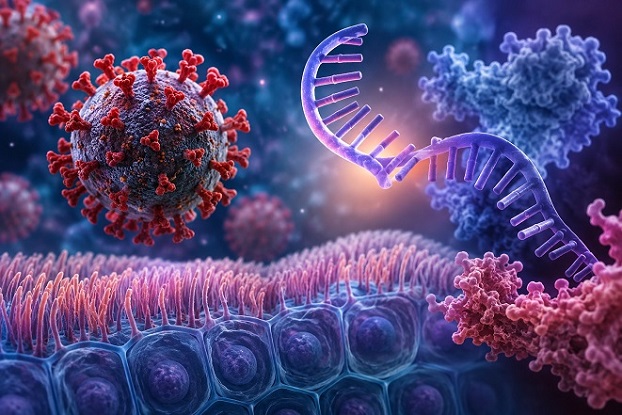 Scientists identify miR-141-3p as a consistent molecular signature that could improve future COVID-19 diagnosis
and treatment
Tiny Genetic Controllers Play a Huge Role
MicroRNAs, often called miRNAs, are extremely small molecules that help regulate how genes are switched on or off inside cells. Although tiny, they influence vital biological processes including immune responses, inflammation, tissue repair, and cell survival.
Viruses frequently interfere with these molecules to improve their chances of infecting cells and avoiding immune defenses. However, previous studies investigating which miRNAs are affected by SARS-CoV-2 have often produced conflicting results, making it difficult to identify reliable markers of infection.
To solve this problem, the researchers compared three different laboratory models that closely resemble human respiratory tissues. These included CALU-3 human lung epithelial cells, human airway epithelial cells (hAECs), and three-dimensional human lung organoids grown from induced pluripotent stem cells. Using multiple models allowed the team to identify changes that occur consistently rather than changes unique to a single laboratory system. This
Medical News report highlights why this comparative approach is considered one of the study's greatest strengths.
One miRNA Stood Out Across Every Model
The researchers first examined hundreds of miRNAs after exposing lung cells to a SARS-CoV-2 pseudovirus that reproduces the virus's entry process without undergoing full replication.
Among nearly 500 miRNAs analyzed, only a small group changed significantly. Most of these became less abundant after infection, showing that SARS-CoV-2 selectively reshapes the cell's genetic control system rather than causing widespread disruption.
The most striking finding involved miR-141-3p, which was consistently reduced in all three respiratory models. Another molecule, miR-33a-5p, also showed substantial changes, although its behavior varied slightly between models.
The team confirmed these results using independent RT-qPCR experiments. In primary human airway epithelial cells infected with an Omicron XBB.1.5 pseudovirus, both miR-141-3p and miR-33a-5p dropped by roughly 90 percent compared to healthy cells, demonstrating a remarkably strong response.
Why Losing miR-141
-3p Matters
The researchers believe miR-141-3p acts as an important guardian of healthy lung tissue. Under normal conditions it helps maintain epithelial cell identity, preserves cell-to-cell connections, and regulates immune signaling.
When miR-141-3p levels fall, several important genes become more active. The investigators identified TGFB2, ZEB2, and TIAM1 as major downstream targets. These genes are involved in tissue remodeling, transforming growth factor-beta (TGF-β) signaling, epithelial-to-mesenchymal transition (EMT), and structural changes within lung tissue.
Such pathways have long been linked to inflammation, abnormal tissue repair, fibrosis, and severe COVID-19. The findings suggest that suppression of miR-141-3p may help trigger many of the harmful biological changes observed during infection.
Importantly, the researchers confirmed that these target genes were activated not only in pseudovirus experiments but also in lung organoids infected with authentic SARS-CoV-2, strengthening confidence that the observations reflect genuine viral biology rather than an experimental artifact.
Additional Pathways Were Also Disrupted
The study revealed that several other important cellular systems were affected simultaneously.
Multiple miRNAs involved in cholesterol metabolism became suppressed, potentially allowing infected cells to accumulate lipids that the coronavirus needs for efficient replication. Other reduced miRNAs normally control autophagy, the cellular recycling system frequently hijacked by viruses. The researchers also observed changes affecting PI3K-AKT signaling, apoptosis, and cytokine-mediated inflammatory pathways.
Despite these broad biological effects, only a relatively small percentage of the overall miRNA population changed significantly, indicating that SARS-CoV-2 carefully targets specific regulatory networks instead of causing indiscriminate damage.
The experiments also confirmed activation of major antiviral immune markers, including interferon-beta and TNF-alpha, across all respiratory models, demonstrating that the infection triggered consistent innate immune responses alongside miRNA alterations.
A Promising Biomarker and Therapeutic Target
The consistent loss of miR-141-3p across diverse respiratory models suggests it could become a valuable biomarker for SARS-CoV-2 infection. Because this single miRNA was reproducibly altered regardless of cell type, it appears to represent a conserved molecular hallmark of the body's early response to viral exposure.
The researchers also believe restoring miR-141-3p activity could eventually become a therapeutic strategy. Future RNA-based medicines, including synthetic genetic circuits or oligonucleotide therapies, may be designed to restore this important regulatory molecule and help normalize disrupted cellular pathways during infection.
Conclusion
This study provides compelling evidence that SARS-CoV-2 consistently suppresses miR-141-3p across multiple human respiratory models, making it one of the strongest candidate molecular hallmarks identified to date. By linking this miRNA to inflammation, epithelial remodeling, TGF-β signaling, and tissue repair pathways, the researchers have uncovered a potential biomarker and therapeutic target that deserves extensive clinical investigation. Although additional studies in patients are still required, these findings significantly improve our understanding of how SARS-CoV-2 manipulates host genetic regulation and may help guide the development of future RNA-based treatments for COVID-19.
The study findings were published in the peer reviewed journal: COVID (MDPI).
https://www.mdpi.com/2673-8112/6/8/142
Read Also:
https://www.thailandmedical.news/articles/coronavirus
https://www.thailandmedical.news/articles/long-covid 



 Share
Share
 Tweet
Tweet
 Share
Share

































