Low-Frequency Ultrasound Shows Promise for Improving Blood Flow and Oxygen Delivery
Nikhil Prasad Fact checked by:Thailand Medical News Team May 21, 2026 3 months, 1 week, 5 days, 19 hours, 21 minutes ago
Medical News: For decades, ultrasound has primarily been associated with medical imaging, helping doctors examine organs, monitor pregnancies, and diagnose disease. However, researchers from Kaunas University of Technology-Lithuania are now uncovering an entirely different role for ultrasound—one that could eventually help improve blood circulation, oxygen delivery, and treatment outcomes in cardiovascular, neurological, and metabolic diseases.
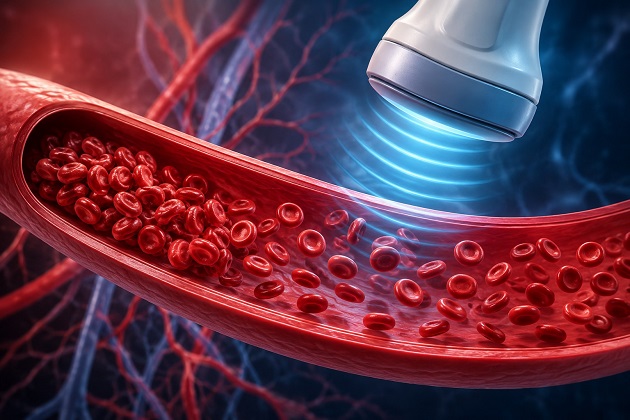 Researchers discover that low-frequency ultrasound can separate red blood cell clusters, potentially improving
circulation, oxygen delivery, and treatment outcomes in multiple diseases
Scientists from the university have discovered that low-frequency ultrasound can directly influence the behavior of red blood cells, potentially opening the door to noninvasive therapies for conditions linked to poor circulation and impaired oxygen transport.
Ultrasound Found to Alter Red Blood Cell Behavior
The research team, led by Professor Vytautas Ostaševičius, found that different ultrasound frequencies produce opposite effects on erythrocytes, more commonly known as red blood cells.
High-frequency ultrasound encouraged red blood cells to cluster together into formations called aggregates or “rouleaux.” This clustering increases blood viscosity, making blood thicker and reducing the efficiency of oxygen exchange.
In contrast, low-frequency ultrasound generated traveling acoustic waves that created gentle shear forces capable of separating aggregated red blood cells into individual cells.
Researchers explained that when erythrocytes separate, gaps form between the cells, lowering blood viscosity and allowing oxygen exchange to occur more efficiently across the entire cell surface.
The scientists believe this is the first demonstration showing that low-frequency ultrasound can successfully dissociate red blood cell aggregates into single cells without invasive intervention.
Research Inspired by the COVID-19 Pandemic
The project began during the COVID-19 pandemic when scientists were urgently seeking non-drug methods to help patients suffering from respiratory complications and poor oxygenation.
Researchers investigated whether ultrasound could intensify the interaction between hemoglobin and oxygen in the lungs. To test the idea, blood from patients was divided into hundreds of samples and exposed to varying ultrasound frequencies and intensities.
The experiments revealed that low-frequency ultrasound improved erythrocyte dissociation while maintaining safe acoustic exposure levels.
The team also developed a patented low-frequency ultrasound transducer capable of delivering acoustic signals nearly four times deeper into biological tissues than conventional ultrasound devices. This deeper penetration could eventually allow physicians to target tissues more effectively without surgery or medications.
Potential Cardiovascular Benefits
The findings could have major implicat
ions for cardiovascular medicine.
When red blood cells aggregate excessively, blood becomes more viscous, circulation slows, and oxygen transport becomes less efficient. According to the researchers, separating these aggregates may help reduce blood viscosity and improve circulation.
Animal experiments involving sheep reportedly demonstrated a 13–15 percent reduction in blood pressure within minutes of ultrasound exposure. Researchers also observed improvements in oxygen exchange and reductions in pulse rate.
This
Medical News report highlights that such physiological effects could eventually support treatments for pulmonary hypertension, circulatory disorders, and other cardiovascular conditions where impaired blood flow plays a central role.
The researchers further suggest that precisely targeted acoustic waves may one day help remove calcified plaques from heart valves without invasive surgery.
Possible Applications in Alzheimer’s Disease and Cancer Therapy
The research team believes the technology may also have applications beyond cardiovascular medicine.
One area under investigation is Alzheimer’s disease. Scientists are exploring whether low-frequency ultrasound might temporarily open the blood-brain barrier, potentially improving targeted drug delivery to brain tissue.
Cancer therapy is another area of interest. Tumor tissues are generally mechanically weaker than surrounding healthy tissues, raising the possibility that traveling acoustic waves could selectively affect tumor structures.
Researchers also noted that improved oxygen delivery within tumors may increase the effectiveness of certain cancer treatments, although these applications remain experimental.
Hope for Diabetic Foot Ulcers
The technology may also benefit diabetic patients suffering from chronic foot ulcers, a major cause of lower-limb amputations worldwide.
Diabetes is associated with increased blood viscosity, poor microcirculation, and reduced oxygen delivery to tissues, all of which impair wound healing.
The Lithuanian team developed and patented an ultrasound-based stimulation device designed to improve blood flow in affected tissues. Researchers believe the technology may help enhance capillary circulation, improve oxygen delivery, and reduce bacterial load in wounds.
Safety Remains Critical
Importantly, the researchers carefully evaluated the risk of hemolysis, a condition in which red blood cells rupture under excessive mechanical stress.
The study found that ultrasound frequencies between 44–48 kHz appeared safe below specific acoustic intensity thresholds, with no evidence of significant hemolysis under controlled conditions.
Although the technology remains experimental, researchers believe the findings significantly expand the understanding of ultrasound as more than a diagnostic imaging tool.
The study concludes that low-frequency ultrasound may eventually become a noninvasive therapeutic platform capable of improving blood rheology, enhancing oxygen transport, and supporting treatment strategies for cardiovascular disease, diabetes complications, pulmonary disorders, and neurological conditions.
The study findings were published in the peer reviewed journal: Sensors.
https://www.mdpi.com/1424-8220/26/8/2428
For the latest on using ultrasound for therapeutic, keep on logging to Thailand
Medical News.
Read Also:
https://www.thailandmedical.news/articles/medical-devices
https://www.thailandmedical.news/articles/alzheimer,-dementia-
https://www.thailandmedical.news/articles/cancer
https://www.thailandmedical.news/articles/diabetes




 Share
Share
 Tweet
Tweet
 Share
Share