Nikhil Prasad Fact checked by:Thailand Medical News Team Jan 17, 2026 8 months, 2 weeks, 3 days, 21 hours, 35 minutes ago
Medical News: A powerful new study by American teams from the Pittsburgh Liver Research Center and School of Medicine at the University of Pittsburgh-USA, supported by scientists from the Organ Pathobiology and Therapeutics Institute, Division of Experimental Pathology, Division of Gastroenterology Hepatology and Nutrition, Division of Microbiology and Immunology, the Emory Vaccine Center, Yerkes National Primate Research Center, and related departments, reveals how common food habits can quietly sabotage immune defenses in the liver. The findings confirm why a fatty and sugary Western diet pushes millions from harmless fatty liver to dangerous inflammation and hardening of liver tissue. This
Medical News report covers the study’s findings.
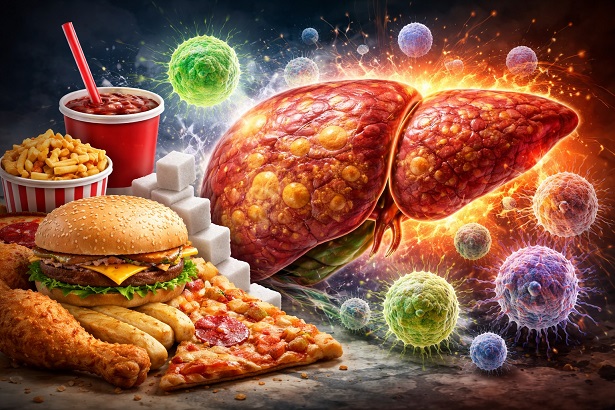 Scientists reveal Western diet shuts down immune control and fuels liver scarring
Western Diet Turns Steady Fat Buildup into Harm
Scientists reveal Western diet shuts down immune control and fuels liver scarring
Western Diet Turns Steady Fat Buildup into Harm
Metabolic dysfunction associated steatotic liver disease also known as MASLD develops when the liver becomes overloaded with fats. But this study shows fat is only the beginning. In mice placed on a typical Western diet made up of high fat cholesterol, sugar and processed nutrients - scientists saw early liver swelling followed by ballooning fat cells and eventually thick bands of scar tissue. Liver enzymes rose sharply in the blood signaling ongoing injury. Human samples taken from patients living with metabolic steatohepatitis showed the same pattern confirming that the Western diet does not just make the liver fatty it transforms it into an inflamed organ unable to repair itself properly.
Immune Cells Rush in But Cannot Do Their Job
One of the biggest surprises was the role of regulatory T cells or Tregs. These special cells normally calm immune reactions and prevent inflammation from spinning out of control. Instead of disappearing, researchers discovered that Tregs actually increased in number inside damaged livers in both mice and humans. Yet the inflammation still grew worse. It turned out the Tregs were present but not functioning well enough to quiet the immune attack suggesting the diet had weakened them.
Removing Tregs Makes Everything Worse
To prove their importance the research team genetically removed Tregs in mice fed a Western diet. Without these immune regulators the liver rapidly became more inflamed than ever. White blood cells poured into the tissue fat, cells burst and scar tissue spread through the liver far faster than in mice with normal Treg levels. This demonstrated that even weakened Tregs desperately slow disease progression and their complete loss speeds liver destruction.
Strengthening Tregs Turns Injury Around
The next breakthrough came when scientists used a special IL2 based therapy to boost Treg numbers and improve their activity. Mice on the same unhealthy diet began to show less inflammation, lower fat buildup and milder scarring. The findings strongly suggest that one day therapies may work by restoring or energizing these protective immune cells rather than shutting the immune system down.<
br />
Dietary Sugars and Fats Cripple Immune Control
Finally, the researchers uncovered how the Western diet weakens Tregs. When Treg cells were exposed to excess glucose or palmitic acid - common dietary fats, they lost their ability to produce IL10 - a key anti-inflammatory signal. Without IL10, Tregs could not suppress the frenzy of immune cells damaging the liver. Interestingly fructose had a smaller effect showing that not all sugars harm immune cells equally.
Conclusion
This research clearly demonstrates that the Western diet damages the liver in two connected ways. It physically loads the liver with fat while simultaneously switching off the body’s immune brakes that normally prevent inflammation and scarring. Instead of acting as peacekeepers, Tregs become exhausted leaving the liver in nonstop crisis mode. By showing that boosting Tregs slows liver damage and that sugar and fat directly weaken immune control, the study uncovers an urgent warning and a new treatment direction. Future therapies may focus on repairing metabolic overload and helping Tregs recover before the disease becomes irreversible and progresses to cirrhosis or liver cancer.
The study findings were published in the peer reviewed journal: Cells.
https://www.mdpi.com/2073-4409/15/2/165
For the latest on Liver issues, keep on logging to Thailand
Medical News.
Read Also:
https://www.thailandmedical.news/articles/diets-and-nutrition




 Share
Share
 Tweet
Tweet
 Share
Share

































