COVID-19 Could be Indirectly Causing the Emergence of Skin Tags or Acrochordons in Many Including the Young
Nikhil Prasad Fact checked by:Thailand Medical News Team Aug 21, 2026 1 month, 2 weeks, 1 day, 5 hours, 45 minutes ago
The long-term health consequences associated with COVID-19 continue to expand beyond the respiratory system, with researchers increasingly examining metabolic, cardiovascular, neurological and dermatological changes after SARS-CoV-2 infection. One intriguing possibility is that COVID-19 could indirectly contribute to the emergence of skin tags, medically known as acrochordons, particularly by promoting metabolic conditions already associated with these benign skin growths.
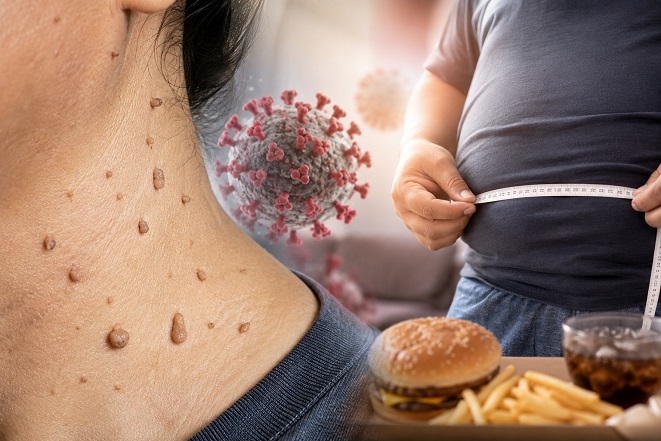 COVID-19-related metabolic disturbances and lifestyle changes may indirectly create conditions that favor the emergence of
skin tags or acrochordons
Importantly, current evidence does not establish that SARS-CoV-2 directly infects the skin and causes acrochordons. Instead, the proposed connection involves metabolic disturbances following infection, combined with pandemic-related weight gain and reduced physical activity. This
Thailand Medical New
s report examines how these interconnected mechanisms could potentially explain reports of new or increasing skin tags, including among younger individuals.
What Exactly Are Skin Tags?
Acrochordons are soft, benign fibroepithelial growths composed of loose collagen fibers, blood vessels and skin cells. They are usually flesh-colored, pink or slightly darker than surrounding skin and frequently develop as small growths attached by a narrow stalk called a peduncle. Typical lesions measure approximately 2 to 5 millimeters, although larger growths can occur.
They most commonly appear around the neck, armpits, groin, eyelids and beneath the breasts—areas where skin frequently rubs against skin, clothing or jewelry. Friction is therefore an important local trigger, but metabolic abnormalities have also been repeatedly associated with their development.
The Important Metabolic Connection
Insulin resistance, obesity, type 2 diabetes and metabolic syndrome are strongly associated with multiple acrochordons. Elevated circulating insulin can function as a growth-promoting signal, encouraging cellular proliferation, while obesity increases both friction within skin folds and chronic low-grade inflammation.
This relationship is particularly important when skin tags begin appearing in larger numbers or at younger ages. Their presence may sometimes provide an externally visible clue that metabolic changes are developing internally. The supplied material notes that pediatric acrochordons can similarly be associated with obesity and dyslipidemia, making the potential emergence of these lesions among younger populations especially noteworthy.
How COVID-19 Could Create Favorable Conditions
SARS-CoV-2 infection can disrupt metabolic homeostasis through several pathways. During acute disease, inflammatory cytokines can contribute to insulin resistance, while effects involving pancreatic beta cells and adipose tissue have also been investigated. The source material additionally highlights increased incidence of new-onset type 2 diabetes following COVID-19 and post-infection abnormalities involving body mass index, waist circumference and glycemic regulation.
The pandemic also produced major lifestyle disruptions. Lockdowns and altered routines reduced physical activity for many people while changing sleep patterns and dietary behavior. Increased consumption of calorie-dense foods and subsequent weight gain could further intensify insulin resistance.
These factors matter because they potentially create precisely the biological environment associated with acrochordon formation: higher insulin levels, increased skin-fold friction and persistent low-grade inflammation.
An Indirect Chain Rather Than Direct Viral Damage
The proposed pathway can therefore be viewed as a sequence. COVID-19 or pandemic-associated lifestyle changes may contribute to weight gain, disturbed glucose metabolism or insulin resistance. Increased body weight creates additional friction, while hyperinsulinemia provides growth signals capable of encouraging keratinocyte and fibroblast proliferation.
Persistent inflammation after infection could theoretically add another proliferative stimulus. The source also notes reports of eruptive seborrheic keratoses following COVID-19 recovery, raising broader questions about whether post-viral immune or growth-factor disturbances might influence certain cutaneous proliferations.
However, this remains a biologically plausible hypothesis rather than proof. No large prospective study cited in the supplied material has demonstrated that COVID-19 itself produces a measurable increase in acrochordon incidence. Skin tags remain primarily associated with friction, genetics, aging, hormonal influences and metabolic factors rather than being recognized as a direct manifestation of SARS-CoV-2 infection.
Why Newly Appearing Skin Tags May Deserve Attention
Individuals developing numerous new skin tags after COVID-19 may benefit from discussing metabolic screening with a healthcare professional. Assessment of body mass index, fasting glucose or HbA1c and lipid levels can help identify metabolic abnormalities that might otherwise remain unnoticed.
Skin tags themselves are benign and removal is generally optional. Dermatologists can remove troublesome lesions using cryotherapy, electrocautery or sterile excision. Growths that spontaneously bleed, change substantially in size or develop multiple colors warrant medical evaluation because other skin conditions can resemble ordinary acrochordons.
What the Emerging Picture Means
The available information supports an indirect association rather than evidence that COVID-19 directly causes skin tags. SARS-CoV-2 infection and pandemic-related lifestyle changes could nevertheless promote insulin resistance, diabetes risk, weight gain, inflammation and increased friction—the same conditions strongly associated with acrochordon development. More prospective research comparing skin-tag incidence before and after infection, particularly among younger populations, is needed to determine whether this proposed relationship represents a measurable post-COVID phenomenon or simply overlapping metabolic risk factors.
References:
https://www.thelancet.com/journals/landia/article/PIIS2213-8587(24)00159-1/fulltext
https://www.nature.com/articles/s41598-023-41523-5
https://www.nature.com/articles/s41598-023-41523-5
https://www.nature.com/articles/s41366-021-00861-y
https://onlinelibrary.wiley.com/doi/10.1002/ccr3.7638
https://jsstd.org/acrochordon-as-a-marker-of-metabolic-syndrome-a-cross-sectional-study-from-south-india/
https://pmc.ncbi.nlm.nih.gov/articles/PMC3991940/
https://www.ijord.com/index.php/ijord/article/view/1385
https://www.jle.com/en/revues/ejd/e-docs/association_between_acrochordons_and_the_components_of_metabolic_syndrome_291854/article.phtml




 Share
Share
 Tweet
Tweet
 Share
Share