COVID-19 Found to Disrupt Brain Orexin System Triggering Long-Term Neurological Damage
Nikhil Prasad Fact checked by:Thailand Medical News Team Apr 29, 2026 5 months, 5 days, 5 hours, 40 minutes ago
Medical News: New research uncovers how SARS-CoV-2 may silently impair brain function through a critical neurochemical pathway
A groundbreaking new study has revealed a concerning biological mechanism that may explain why millions of people suffering from long COVID continue to experience fatigue, brain fog, and sleep disturbances months after infection. Scientists have identified that SARS-CoV-2 directly disrupts the brain’s orexin system—a vital neurochemical network responsible for maintaining wakefulness, energy balance, and cognitive stability.
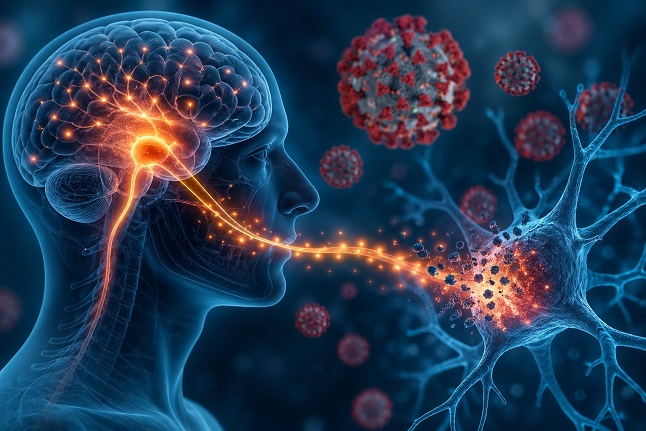 SARS-CoV-2 may impair the brain’s orexin system, driving long COVID fatigue and cognitive decline
Understanding orexin and its vital role in human health
SARS-CoV-2 may impair the brain’s orexin system, driving long COVID fatigue and cognitive decline
Understanding orexin and its vital role in human health
Orexin, also known as hypocretin, is a powerful neuropeptide produced in a small region of the brain called the hypothalamus. Despite being generated by only a limited number of neurons, orexin has widespread influence across the brain. It plays a central role in regulating wakefulness, alertness, appetite, and energy balance.
In healthy individuals, orexin acts like a stabilizer for the brain’s sleep–wake cycle. It ensures that transitions between sleep and wakefulness are smooth and controlled. When orexin levels are adequate, a person feels alert during the day and sleeps soundly at night. When levels drop, the brain becomes unstable—leading to excessive sleepiness, fatigue, and even conditions like narcolepsy.
Beyond sleep, orexin also influences mood, stress response, metabolism, and cognitive performance. It stimulates other brain chemicals such as dopamine and serotonin, helping maintain focus, motivation, and emotional balance.
How SARS-CoV-2 disrupts this critical system
The new study found that SARS-CoV-2 infection significantly suppresses orexin production in the hypothalamus. At the same time, the virus causes subtle but persistent damage in the cerebral cortex—the part of the brain responsible for thinking, memory, and decision-making.
Unlike traditional brain injury, the damage observed was not due to massive cell death. Instead, neurons became functionally impaired. Key neuronal markers such as NeuN were reduced in “patchy” areas of the brain, suggesting that the cells were alive but operating in a weakened or stressed state.
What makes this discovery particularly alarming is that these abnormalities persisted long after the initial infection and even after inflammation subsided. This suggests that COVID-19 leaves behind a long-lasting neurological imprint.
Direct link between viral presence and orexin loss
Researchers also identified a strong inverse relationship between viral load in the brain and orexin levels. The higher the amount of viral RNA detected, the greater the suppression of orexin production.
Importantly, when viral replication was reduced—such as through vaccination—orexin levels remained largely preserved. This indicates that the virus itself, rather than just the immune response, plays a direct role in disrupting this sy
stem.
This
Medical News report highlights that SARS-CoV-2 is not merely causing generalized inflammation but is targeting a highly specific and essential brain network.
Why COVID-19 is neurologically unique
To determine whether this effect was unique, scientists compared SARS-CoV-2 with influenza. Even when influenza reached the brain, it did not suppress orexin or produce the same cortical damage.
This finding confirms that COVID-19 has a distinct neurological signature. The virus appears to selectively impair the orexin system, which may explain why long COVID symptoms—especially fatigue and sleep disorders—are so persistent and difficult to treat.
Additional evidence from other studies supports this mechanism, showing that COVID-19 can directly affect hypothalamic neurons that produce orexin, leading to prolonged sleep disturbances and neurological dysfunction.
Hope from experimental orexin-based interventions
Encouragingly, the study also explored potential treatments. When researchers administered synthetic orexin in experimental models, neuronal function improved significantly. Brain cells regained normal protein expression, suggesting that the damage may be reversible.
Notably, this treatment did not reduce the virus itself but instead protected and restored brain function. This opens the door to a completely new therapeutic strategy focused on repairing neural circuits rather than targeting the virus alone.
Institutions behind the research
The study was conducted by scientists from the Center for Infectious Diseases Vaccine and Diagnosis Innovation at the Korea Research Institute of Chemical Technology, the Korea Institute of Toxicology, Soongsil University, Korea University, Sungkyunkwan University School of Medicine, the AI-Bio Convergence Research Institute, and the University of Science and Technology in Daejeon, South Korea.
Conclusion
This study provides one of the clearest explanations to date for the neurological symptoms of long COVID by identifying orexin disruption as a central mechanism. Rather than causing widespread brain cell death, SARS-CoV-2 appears to weaken critical neural circuits, leaving neurons alive but dysfunctional. This subtle yet persistent impairment may underlie the chronic fatigue, sleep disturbances, and cognitive decline seen in many patients. The discovery that restoring orexin signaling can reverse some of these effects offers real hope for future treatments.
However, further human studies are essential to confirm safety, effectiveness, and long-term outcomes before such therapies can be widely adopted.
The study findings were published on the preprint server: bioRxiv and is currently being peer reviewed.
https://www.biorxiv.org/content/10.64898/2026.01.22.701182v1.full
For the latest COVID-19 news, keep on logging to Thailand
Medical News.
Read Also:
https://www.thailandmedical.news/articles/coronavirus
https://www.thailandmedical.news/articles/long-covid




 Share
Share
 Tweet
Tweet
 Share
Share

































