Nikhil Prasad Fact checked by:Thailand Medical News Team Jun 10, 2026 3 months, 3 weeks, 3 days, 4 hours, 2 minutes ago
Medical News: For millions of people struggling with long COVID, the lingering fatigue, low mood, and mental exhaustion can be as devastating as the original infection itself. Now, a new Japanese study has uncovered evidence that a reactivated dormant virus may be contributing to these symptoms, while also identifying a potential treatment that could help a specific group of patients.
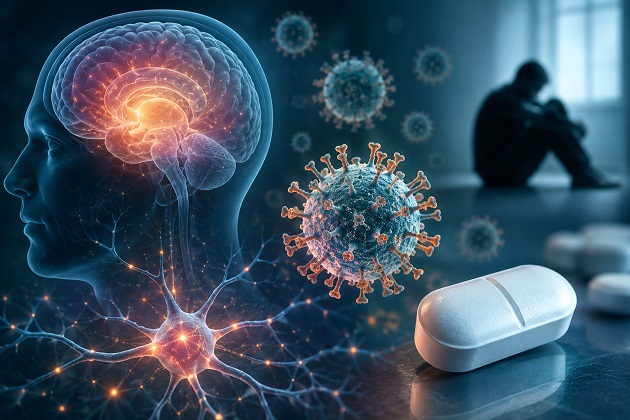 Researchers identify reactivated HHV-6B virus as a possible cause of long COVID fatigue and depression, with
donepezil showing potential benefits in affected patients
Researchers found that many long COVID patients showed signs of reactivation of Human Herpesvirus 6B (HHV-6B), a virus that infects most people during childhood and then remains dormant in the body for life. The study suggests that when this virus becomes active again following COVID-19 infection, it may trigger biological changes in the brain that contribute to severe fatigue and depression.
The research was conducted by scientists from The Jikei University School of Medicine, Yokohama City University Hospital, Hirahata Clinic, Osaka Medical and Pharmaceutical University, Kawasaki Municipal Tama Hospital, TXP Medical Co. Ltd., and St. Marianna University School of Medicine, all in Japan.
Long COVID and the Search for Answers
Post-Acute Sequelae of SARS-CoV-2 Infection (PASC), commonly known as long COVID, affects an estimated 5 to 10 percent of people after COVID-19 infection. Symptoms can persist for months or even years and often include overwhelming fatigue, depression, brain fog, memory issues, and reduced ability to work or perform daily activities.
Despite the enormous global burden, the exact causes of long COVID remain unclear. Scientists have proposed several mechanisms, including persistent viral remnants, immune dysfunction, hormonal changes, and disruptions in neurotransmitter systems.
The new study focused on HHV-6B and a viral protein known as SITH-1, which is produced when the dormant virus becomes active in specialized brain cells located in the olfactory bulb, the brain region involved in smell.
Evidence of Viral Reactivation in Long COVID Patients
The researchers examined blood samples from 156 long COVID patients and compared them with samples from healthy individuals who had never been infected with SARS-CoV-2.
They discovered that 62.8 percent of long COVID patients tested positive for antibodies against SITH-1, compared to only 5.6 percent of healthy controls. This finding suggests that HHV-6B reactivation is occurring in a substantial proportion of long COVID sufferers.
Even more striking was the connection to symptoms. Patients who tested positive for anti-SITH-1 antibodies experienced significantly more severe fatigue and depression than those who tested negative. The association was observed regardless of which COVID variant had originally infected the patient.
What Happens Inside the Brain?
To understand the biological mechanisms involved, researchers developed a mouse model that mimicked SITH-1 expression in the brain.
r />
The experiments revealed that SITH-1 expression caused a significant reduction in acetylcholine production. Acetylcholine is a vital neurotransmitter involved in memory, mood regulation, attention, and communication between nerve cells. The loss of acetylcholine was accompanied by depression-like behaviors, reduced activity levels, damage within the olfactory bulb, and impaired production of new brain cells in the hippocampus, a region essential for learning and emotional regulation.
The researchers believe that SARS-CoV-2 infection may trigger inflammation in the olfactory bulb, creating conditions that reactivate HHV-6B. Once reactivated, the virus produces SITH-1, which then contributes to reduced acetylcholine levels and worsening neuropsychiatric symptoms.
This Medical News report highlights a potentially important biological pathway that may explain why some long COVID patients experience persistent fatigue and depression long after the initial infection has resolved.
Donepezil Shows Encouraging Results
The researchers next investigated whether donepezil, a drug commonly prescribed for Alzheimer's disease, could reverse these effects. Donepezil works by blocking the breakdown of acetylcholine, thereby increasing its availability in the brain.
In mice expressing SITH-1, treatment with donepezil improved depression-like behaviors, restored activity levels, reduced brain damage, and enhanced the generation of new neurons.
The team then revisited data from a previous randomized clinical trial involving long COVID patients. Although the original trial had not shown significant benefits overall, a closer analysis revealed something important.
Among patients who tested positive for anti-SITH-1 antibodies, donepezil significantly improved depression scores and reduced fatigue. Approximately 72 percent of patients included in this subgroup were antibody-positive, indicating that a large proportion of long COVID sufferers could potentially belong to this biologically distinct category.
Conclusions
The findings provide compelling evidence that reactivation of HHV-6B in the brain may be an important contributor to long COVID-related fatigue and depression. By identifying anti-SITH-1 antibodies as a marker of this process, researchers may have discovered a practical way to identify patients who are most likely to benefit from targeted treatment. The study also suggests that acetylcholine deficiency may be a key driver of symptoms in this subgroup. While larger clinical trials are still needed, the results raise the possibility that donepezil, an already approved and widely available medication, could become an effective treatment option for selected long COVID patients. The work represents an important step toward personalized therapies for a condition that continues to affect millions worldwide.
The study findings were published in the peer reviewed journal: Frontiers in Pharmacology.
https://www.frontiersin.org/journals/pharmacology/articles/10.3389/fphar.2026.1807203/full
For the latest on Long COVID, keep on logging to Thailand Medical News
Read Also:
https://www.thailandmedical.news/articles/long-covid




 Share
Share
 Tweet
Tweet
 Share
Share

































