Nikhil Prasad Fact checked by:Thailand Medical News Team Oct 30, 2026 41 minutes ago
A new scientific review has highlighted a potentially powerful approach to fighting viral infections by targeting molecular interactions that viruses depend on to enter human cells. The strategy involves arginine, an amino acid found in viral proteins, and tetrazole, a chemical structure present in several widely prescribed blood pressure medications.
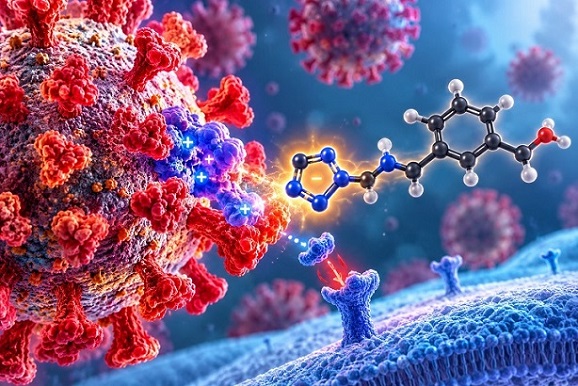 Scientists are exploring whether tetrazole-containing blood pressure drugs and experimental bisartans
could disrupt molecular interactions essential for COVID-19, influenza, and RSV infections
The researchers suggest that existing angiotensin receptor blockers (ARBs), alongside experimental compounds called bisartans, could provide a foundation for developing antivirals against COVID-19, influenza, and respiratory syncytial virus (RSV).
The international research team included scientists from the National and Kapodistrian University of Athens, NewDrug PC, University of West Attica, National Hellenic Research Foundation, THERAmolecular LLC, Victoria University, Pepmetics Inc., RMIT University, University of Calgary, and University of Patras.
Why Arginine Matters in Viral Infections
Arginine carries a positively charged chemical group that allows it to form strong molecular interactions with other substances. Viruses exploit these interactions during receptor attachment, protein activation, and cellular entry.
SARS-CoV-2 provides a particularly important example. Its spike protein contains two regions involved in activating the machinery needed for infection.
The first, called the S1/S2 cleavage site, contains the arginine-rich sequence PRRAR. A human enzyme called furin recognizes this region and cuts the spike protein between amino acid positions 685 and 686.
A second cleavage site, S2′, contains the sequence KPSKR and is processed near positions 815 and 816. This exposes the fusion machinery that helps the virus merge with human cell membranes.
Disrupting these processes could potentially prevent successful viral entry.
How Blood Pressure Drugs Could Interfere
The researchers focused on tetrazole, a chemical group that can carry a negative electrical charge.
Because opposite charges attract, negatively charged tetrazole groups may interact with positively charged arginine residues, potentially disrupting molecular processes essential for infection.
Several established blood pressure medications contain tetrazole structures, including losartan, valsartan, irbesartan, candesartan, and olmesartan.
However, this
Thailand Medical News report emphasizes that the proposed antiviral mechanism differs from these medications' established cardiovascular effects.
The researchers are investigating whether tetrazole-containing compounds can interfere directly with viral proteins or associated human enzymes.
Experimental Findings Reveal Promising Molecular Interactions
The review examined previous computational, biochemical, and biophys
ical investigations involving SARS-CoV-2 and other respiratory viruses.
One investigation evaluated eight compounds, including established ARBs, experimental bisartans, and the antiviral nirmatrelvir, against the human ACE2 enzyme.
Computational modeling identified potentially important interactions involving Arg273, an arginine residue within ACE2. Telmisartan and experimental tetrazole-containing compounds demonstrated favorable predicted interactions in this region.
Importantly, ACE2 is also the cellular receptor used by SARS-CoV-2 for entry, although altering ACE2 enzyme activity does not necessarily prevent infection.
Other investigations reported experimental anti-SARS-CoV-2 activity involving novel benzimidazole ARBs, with activity described as comparable to nirmatrelvir under the particular experimental conditions studied.
These observations provide preliminary support for further antiviral development but do not establish clinical effectiveness.
Bisartans Could Target Multiple Viruses
Particularly interesting are bisartans, experimental compounds containing two tetrazole-bearing structures rather than one.
Their dual configuration could potentially allow simultaneous interactions with multiple positively charged molecular sites, strengthening binding or improving recognition of complex viral proteins.
Computational investigations identified promising interactions involving the experimental bisartan ACC519TT and several targets:
-SARS-CoV-2 spike cleavage regions and nonstructural protein 3.
-Influenza A H1N1 neuraminidase, an enzyme involved in viral spread.
-RSV fusion protein, which helps the virus enter cells.
Some predicted binding profiles compared favorably with those of established antiviral medications.
Nevertheless, these cross-virus findings were primarily computational. They cannot demonstrate that bisartans actually prevent infection across different viruses.
What Must Happen Before Clinical Use?
The researchers recommend laboratory binding measurements, targeted arginine mutations, enzyme inhibition experiments, and tests involving infected cells.
These investigations must determine whether the proposed molecular interactions genuinely suppress viral replication at safe, achievable drug concentrations.
Conclusions
The review identifies an intriguing direction for antiviral drug discovery by exploiting the chemical relationship between arginine and tetrazole. Although existing blood pressure medications and experimental bisartans offer promising molecular starting points, substantial laboratory and clinical research remains necessary before this approach can be considered an effective treatment for viral infections.
The study findings were published in the peer reviewed journal: Pathogens.
https://www.mdpi.com/2076-0817/15/11/1134




 Share
 Tweet
 Share