Has the Nairobi Sheep Disease Virus Evolved for Airborne Transmissions to Humans?
Nikhil Prasad Fact checked by:Thailand Medical News Team Jun 10, 2026 3 months, 3 weeks, 4 days, 16 hours, 17 minutes ago
Medical News: A surprising new study from China has raised fresh questions about the behavior of the little-known Nairobi Sheep Disease Virus (NSDV), a tick-borne virus traditionally associated with livestock. Researchers have now detected the virus in the upper respiratory tract of human patients suffering from febrile illness, prompting concerns about whether the pathogen may be adapting in ways not previously recognized.
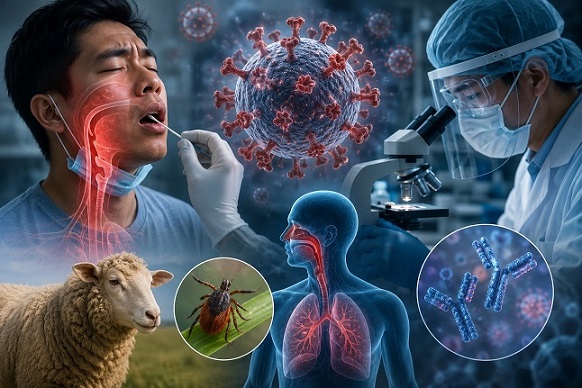 Chinese researchers detected Nairobi Sheep Disease Virus in the upper respiratory tract of fever patients,
raising new questions about viral adaptation and human transmission
The study was conducted by scientists from the 8th Medical Center of the Chinese PLA General Hospital, Beijing, China, and the Academy of Military Medical Sciences National Center for Biomedical Analysis, Beijing, China. Their findings provide the first detailed evidence that NSDV can be found in throat swab samples collected from humans with febrile illness.
An Unexpected Discovery in Fever Patients
The research team investigated 218 patients who attended the fever clinic of the Eighth Medical Center of the People's Liberation Army General Hospital between April and May 2025. Using next-generation sequencing and advanced pathogen analysis technologies, they screened throat swab samples for known and previously overlooked viruses.
To their surprise, NSDV was detected in the upper respiratory tract of 10 patients. Traditionally, NSDV is considered a tick-borne virus that infects sheep and goats, causing severe disease and high mortality in livestock. Human infections have been regarded as rare occupational hazards affecting veterinarians, farm workers, and laboratory personnel.
Finding the virus in human throat samples is significant because the upper respiratory tract is commonly involved in respiratory virus transmission. Although the study did not prove person-to-person spread, the detection of NSDV in this location has sparked speculation about whether the virus may be undergoing adaptation to human hosts.
Evidence of Ongoing Immune Response
Researchers carried out additional testing on infected individuals. Follow-up investigations revealed that two patients remained positive for NSDV antibodies four months after diagnosis, suggesting that the virus may trigger a prolonged immune response.
The persistence of antibodies indicates that the human body continues recognizing the virus long after the initial illness has resolved. Such findings may help scientists better understand how NSDV interacts with human immune systems and whether infections are more common than previously believed.
Who Appears Most at Risk?
Using multi-omics analysis and statistical modeling, the researchers examined factors associated with NSDV positivity. One of the most notable findings was that cancer patients appeared to be at substantially higher risk of testing positive for the virus. The presence of tumors emerged as the strongest statistically significant risk factor.
The study also found that younger individuals were more likely to test positiv
e than older patients. Smoking and abnormal imaging findings were identified as possible contributing factors, although additional studies will be needed to confirm these associations.
Could the Virus Be Adapting?
This Medical News report notes that NSDV belongs to a viral group related to Crimean-Congo hemorrhagic fever virus, another important zoonotic pathogen.
Historically, human infections with NSDV have caused flu-like symptoms including fever, headache, muscle pain, nausea, abdominal discomfort, and fatigue. However, the long-term health issues of human infections with the virus have not been studied.
The discovery of the virus in the human upper respiratory tract does not prove airborne transmission. However, it raises important scientific questions about viral adaptation, tissue preference, and potential changes in transmission dynamics. Researchers believe further surveillance and laboratory investigations are urgently needed.
Conclusion
The detection of Nairobi Sheep Disease Virus in the upper respiratory tract of febrile patients represents an important and unexpected finding. While there is currently no evidence that the virus spreads through the air between humans, its presence in throat swabs suggests it may possess biological characteristics that have not been fully appreciated before. Continued monitoring, larger studies, and experimental investigations will be essential to determine whether NSDV is simply an overlooked human infection or a virus undergoing evolutionary changes that could influence future public health risks.
The study findings were published as an abstract in the peer reviewed journal: Frontiers in Microbiology. A full paper will be published shortly.
https://www.frontiersin.org/journals/microbiology/articles/10.3389/fmicb.2026.1849489/abstract
For the latest on new viruses adapting for human infection, keep on logging to Thailand
Medical News.
Read Also:
https://www.thailandmedical.news/news/tick-microbiomes-may-fuel-future-zoonotic-disease-threats
https://www.thailandmedical.news/news/cancer-causing-viruses-found-rising-in-texas-wastewater




 Share
Share
 Tweet
Tweet
 Share
Share