Nikhil Prasad Fact checked by:Thailand Medical News Team May 20, 2026 3 months, 1 week, 6 days, 12 hours, 22 minutes ago
Medical News: A new clinical study from researchers in Spain has found that eating concentrated tomato paste every day could improve attention, memory, and even influence how the brain functions in healthy middle-aged adults. The findings are creating excitement because tomatoes are already a common part of many diets, especially in Mediterranean countries, and could represent a simple natural strategy to support brain health as people age.
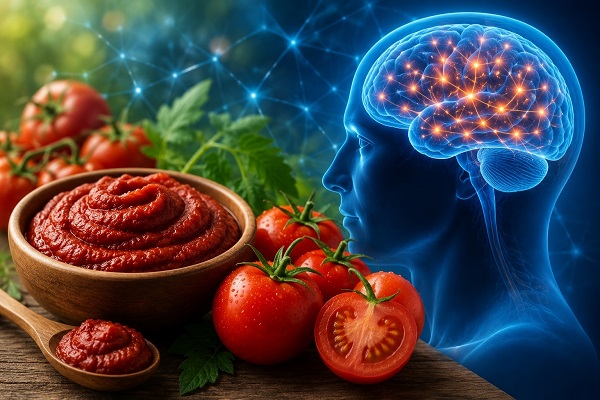 Daily tomato paste intake was linked to better memory, sharper attention, and healthier brain network activity in
healthy middle-aged adults
The research was carried out by scientists from the University of Barcelona, Institut de Recerca en Nutrició i Seguretat Alimentària (INSA-UB), Hospital Clínic de Barcelona, Institut d’Investigacions Biomèdiques August Pi i Sunyer (IDIBAPS), Centro de Investigación Biomédica en Red de Fisiopatología de la Obesidad y Nutrición (CIBEROBN), Instituto de Salud Carlos III, Karolinska Institutet in Sweden, and the Alzheimer’s Disease and Other Cognitive Disorders Unit in Barcelona.
Tomatoes and the Brain
Tomatoes are rich in lycopene, a powerful antioxidant responsible for their bright red color. Scientists have long believed lycopene may help protect the brain because it can cross the blood-brain barrier and reduce inflammation and oxidative stress, two key processes linked to aging and diseases such as Alzheimer’s.
To investigate this further, researchers conducted a randomized crossover clinical trial involving 47 healthy adults between 40 and 55 years old. Participants either consumed concentrated tomato paste daily for three months or followed a low-lycopene diet that restricted tomatoes and similar foods. After a washout period, the groups switched interventions.
The daily tomato paste intake averaged about 35 grams and delivered roughly 38 milligrams of lycopene each day. Blood samples, cognitive tests, and brain imaging scans were used to monitor changes throughout the study.
Significant Improvements in Attention and Memory
The results surprised even the researchers. Participants consuming tomato paste showed measurable improvements in selective attention, concentration, processing speed, and associative memory compared to the control diet.
One important test measured how quickly and accurately participants could focus on visual tasks while ignoring distractions. Those eating tomato paste scored more than seven points higher in concentration performance and over eight points higher in processing speed. Another memory test involving matching faces with names also improved significantly.
Researchers also discovered that people with higher increases in blood lycopene levels tended to perform better cognitively. The data suggested a dose-response relationship, meaning larger increases in lycopene were linked to stronger mental performance improvements.
Interestingly, executive function skills such as strategy shifting and problem solving did not show major changes. However, the gains seen in attention
and memory were considered moderate but statistically meaningful.
Brain Scans Reveal Changes in Neural Connectivity
One of the most fascinating parts of the study involved advanced functional MRI brain scans. A subgroup of participants underwent resting-state brain imaging to see how tomato intake affected communication between brain regions.The scans showed that tomato consumption altered connectivity in several important brain networks, including the frontoparietal network, auditory network, and dorsal attention network. Researchers believe these changes may reflect improved neural efficiency, allowing the brain to focus more effectively while filtering out distractions.
The low-lycopene diet, in contrast, appeared to weaken connectivity in areas involved in sustained attention. This suggests that regular tomato consumption may help maintain healthier brain network activity during middle age.
Possible Role of BDNF
The study also explored levels of brain-derived neurotrophic factor, commonly known as BDNF. This protein is often described as “fertilizer for the brain” because it supports neuron survival, growth, and communication.
Participants consuming tomato paste showed a borderline increase in BDNF levels. Although the increase was not strong enough to be considered fully conclusive, the researchers believe it may indicate that tomato compounds help support neuroplasticity, the brain’s ability to adapt and reorganize itself.
This
Medical News report highlights growing evidence that simple dietary habits may have far-reaching effects on cognitive aging and brain resilience.
Why Lycopene Matters
The tomato paste used in the study contained extremely high concentrations of carotenoids, especially lycopene. Researchers noted that lycopene has one of the strongest antioxidant capacities among carotenoids and may help reduce mitochondrial damage, neuroinflammation, and even harmful protein accumulation associated with neurodegenerative disease.
Importantly, no major adverse effects were reported during the trial, and participants maintained stable lifestyles, body weight, sleep patterns, and physical activity levels throughout the study.
Conclusion
The findings provide compelling evidence that daily tomato paste consumption may support healthier brain function in middle-aged adults. Improvements in attention, processing speed, and memory, combined with measurable changes in brain connectivity, suggest that lycopene-rich foods could play an important role in protecting cognitive health before major decline begins. While larger and longer-term studies are still needed, the results indicate that something as simple and affordable as tomato paste could eventually become part of dietary recommendations aimed at preserving brain performance and reducing age-related cognitive decline naturally.
The study findings were published in the peer reviewed journal: Antioxidants.
https://www.mdpi.com/2076-3921/15/5/644
For the latest on research on enhancing cognitive and memory issues, keep on logging to Thailand
Medical News.
Read Also:
https://www.thailandmedical.news/articles/herbs-and-phytochemicals
https://www.thailandmedical.news/articles/diets-and-nutrition




 Share
Share
 Tweet
Tweet
 Share
Share