Nikhil Prasad Fact checked by:Thailand Medical News Team Mar 23, 2026 5 months, 1 week, 3 days, 20 hours, 24 minutes ago
Medical News: A naturally occurring compound found in many fruits and vegetables is drawing fresh attention after scientists uncovered how it interferes with one of the most stubborn forms of prostate cancer.
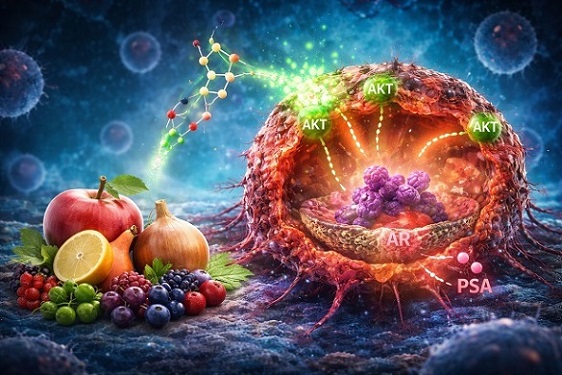 Natural compound quercetin shown to disrupt critical prostate cancer growth signals and slow tumor progression
A Natural Compound with Powerful Potential
Prostate cancer remains one of the most common cancers in men worldwide, and while many patients respond well to hormone-blocking therapies, a dangerous stage known as castration-resistant prostate cancer (CRPC) often develops. At this stage, the disease continues to grow even when testosterone is suppressed. In this
Medical News report, researchers explored how quercetin, a plant-derived antioxidant commonly found in apples, onions, and berries, affects these aggressive cancer cells. Their findings reveal that quercetin does far more than just act as an antioxidant—it directly interferes with critical cancer-driving signals.
The research was conducted by scientists from the Laboratorio de Lipoproteínas y Cáncer, Departamento de Fisiopatología, Facultad de Ciencias Biológicas, Universidad de Concepción, Chile; the Departamento de Química Orgánica, Facultad de Química y de Farmacia, Pontificia Universidad Católica de Chile; the Departamento de Farmacología, Facultad de Ciencias Biológicas, Universidad de Concepción; and the Departamento de Ciencia y Tecnología de los Alimentos, Facultad de Farmacia, Universidad de Concepción.
How Cancer Cells Keep Growing
CRPC cells rely heavily on a molecular pathway involving two major players: AKT and the androgen receptor (AR). These molecules help cancer cells survive, multiply, and resist treatment. Even when hormone therapies block testosterone, this pathway can keep the cancer alive through alternative activation mechanisms.
The researchers discovered that quercetin disrupts this pathway at multiple levels. It significantly reduced activation of AKT by blocking a key chemical modification known as phosphorylation. Without this activation, AKT loses its ability to drive cancer growth.
Slowing Tumor Growth Without Killing Cells
Interestingly, quercetin did not directly kill cancer cells. Instead, it slowed their growth—a process scientists call a “cytostatic effect.” In laboratory experiments using CRPC cell lines, cell proliferation dropped by up to 40 percent depending on the dose, while cell death remained minimal.
This suggests quercetin may act more like a brake than a weapon, preventing tumors from expanding rather than destroying them outright.
Disrupting the Cancer’s Control Center
The study also showed that quercetin interferes with the androgen receptor, which acts like a master switch for prostate ca
ncer genes. Quercetin reduced AR activation, decreased its movement into the cell nucleus, and lowered levels of prostate-specific antigen (PSA), a key marker of disease activity. In some cases, PSA production dropped by up to 30 percent, indicating a meaningful suppression of cancer signaling.
A Unique Mechanism of Action
Using advanced computer simulations, the researchers found that quercetin likely binds directly to AKT at a previously underexplored site. This “allosteric” binding alters the protein’s shape and prevents its activation, offering a different strategy compared to traditional drugs that target the main active site.
This unique mechanism could make quercetin especially valuable, particularly in cases where existing drugs fail.
No Added Benefit with Standard Therapy
The study also tested quercetin alongside enzalutamide, a commonly used prostate cancer drug. Surprisingly, combining the two did not enhance the anti-cancer effect. This suggests quercetin may already be acting upstream in the same pathway, limiting the benefit of adding another drug targeting the same system.
Challenges And Future Directions
Despite these promising findings, quercetin faces practical limitations. Its poor absorption in the body means that effective doses may be difficult to achieve through diet alone. However, researchers point to new formulations and derivatives that could improve its delivery and effectiveness.
Conclusion
The study highlights quercetin as a promising natural compound capable of targeting multiple critical pathways in advanced prostate cancer. By slowing tumor growth, blocking key signaling proteins, and disrupting hormone-driven mechanisms, it offers a multi-layered approach that could complement future therapies. While more research is needed, especially in human trials, these findings open the door to new strategies that harness natural compounds in the fight against treatment-resistant cancers.
The study findings were published in the peer reviewed journal: Antioxidants.
https://www.mdpi.com/2076-3921/15/3/393
For the latest on treating prostate cancer, keep on logging to Thailand
Medical News.
Read Also:
https://www.thailandmedical.news/articles/cancer
https://www.thailandmedical.news/articles/herbs-and-phytochemicals




 Share
Share
 Tweet
Tweet
 Share
Share