Nikhil Prasad Fact checked by:Thailand Medical News Team Jun 18, 2026 3 months, 2 weeks, 2 days, 4 hours, 4 minutes ago
Medical News: A growing body of evidence suggests that Long COVID is far more than a lingering viral illness. Scientists are increasingly discovering that in some patients, the body's immune system may continue causing damage long after the initial infection has resolved. A groundbreaking new study now indicates that autoantibodies—immune proteins that mistakenly attack the body's own tissues—may be responsible for many of the neurological symptoms experienced by Long COVID sufferers.
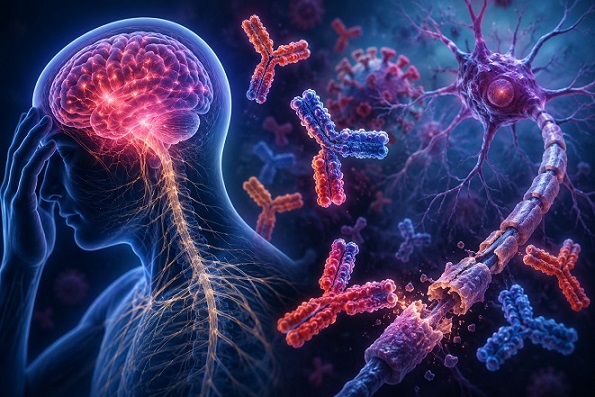 Scientists have found evidence that harmful autoantibodies generated after COVID-19 infection may attack the
brain and nervous system, contributing to many Long COVID symptoms
The research, conducted by scientists from Yale University School of Medicine and the Icahn School of Medicine at Mount Sinai, provides some of the strongest evidence yet that abnormal immune responses may directly contribute to chronic pain, fatigue, dizziness, balance problems, loss of smell and taste, and cognitive issues commonly reported by Long COVID patients.
Long COVID Continues to Puzzle Scientists
Long COVID affects millions of people worldwide. While some individuals recover completely after infection with SARS-CoV-2, others continue to experience symptoms for months or even years. These symptoms can vary greatly from person to person, making the condition difficult to diagnose and treat.
Among the most troubling symptoms are neurological manifestations, including brain fog, headaches, chronic fatigue, memory problems, dizziness, and persistent pain. Scientists have proposed several possible explanations for these lingering effects, including viral persistence, inflammation, vascular damage, and autoimmune reactions.
This
Medical News report focuses on new findings suggesting that autoimmune mechanisms may play a central role in a significant subgroup of Long COVID patients.
Harmful Antibodies Found in Long COVID Patients
In healthy individuals, antibodies are produced to identify and neutralize invading pathogens such as viruses and bacteria. However, in autoimmune diseases, the immune system mistakenly generates antibodies that target the body's own tissues. These are known as autoantibodies.
To investigate whether autoantibodies might contribute to Long COVID symptoms, researchers analyzed blood samples from 147 participants. The study included individuals with Long COVID, people who had recovered from COVID-19 without persistent symptoms, and healthy control subjects.
The researchers discovered that antibodies from Long COVID patients reacted far more frequently with human nervous system tissues than those from healthy individuals. The findings revealed a broad spectrum of autoantibodies targeting both neural and vascular tissues.
Patients experiencing neurocognitive symptoms were especially likely to carry autoantibodies directed against proteins found in the central nervous system and peripheral nervous system.<
;br />
Brain Targets Linked to Specific Symptoms
The study uncovered several intriguing links between specific autoantibodies and particular Long COVID symptoms.
One notable finding involved antibodies targeting the locus coeruleus, a region deep within the brain that helps regulate attention, arousal, stress responses, and sensory processing. Patients with antibodies directed against this brain region were significantly more likely to report loss of smell and taste. They were also more likely to experience nausea and joint pain.
Researchers further identified antibodies that reacted with the thalamus, thyroid gland, adrenal gland, meninges, and peripheral nerve tissues. These findings suggest that multiple nervous system structures may become unintended targets of the immune system following SARS-CoV-2 infection.
The team also identified enhanced immune activity involving antibodies directed against a protein known as MED20. These antibodies demonstrated increased antibody-dependent cellular phagocytosis activity, indicating their potential ability to actively promote tissue damage.
Mouse Experiments Provide Critical Evidence
To determine whether these antibodies were actually causing symptoms rather than merely being associated with them, the researchers conducted a series of transfer experiments in mice.
Purified immunoglobulin G (IgG) antibodies from Long COVID patients were injected into healthy mice. The results were remarkable.
Mice that received antibodies from Long COVID patients with chronic pain developed significantly greater sensitivity to painful stimuli and heat. Detailed examination revealed signs of small-fiber nerve damage, a condition frequently reported in Long COVID patients suffering from neuropathic pain.
The animals also developed fatigue-like behavior, becoming exhausted much more rapidly when tested on a moving treadmill. Many displayed impaired balance and coordination, mirroring symptoms commonly reported by patients experiencing dizziness and instability.
Researchers additionally observed increased pain-related neuronal activity in the nervous systems of the affected animals.
Importantly, the severity of pain behaviors observed in the mice closely correlated with the degree of chronic pain reported by the patients whose antibodies had been transferred. This striking relationship strongly suggests a direct causal role for these autoantibodies.
Potential Path Toward New Treatments
The findings may open the door to more targeted treatments for Long COVID. Several therapies currently used to treat autoimmune diseases aim to reduce harmful antibodies or suppress the immune cells responsible for producing them.
According to the researchers, identifying Long COVID patients who carry these autoantibodies could help clinicians determine who may benefit from such treatments. The antibodies themselves may eventually serve as biomarkers that allow doctors to better classify patients and personalize treatment strategies.
However, the researchers emphasize that Long COVID is likely driven by multiple biological mechanisms. Autoantibodies may explain symptoms in some patients but not all.
Conclusion
This important study provides compelling evidence that autoantibodies generated after SARS-CoV-2 infection may directly contribute to neurological symptoms in a subset of Long COVID patients. By demonstrating that patient-derived antibodies can induce pain, fatigue, nerve damage, and balance problems in laboratory animals, the research strengthens the case for an autoimmune component in Long COVID. While further studies are needed to validate these findings and identify the patients most likely to benefit from treatment, the results offer a promising pathway toward more effective therapies and a better understanding of this complex condition.
The study findings were published in the peer reviewed journal: Cell.
https://www.cell.com/cell/abstract/S0092-8674(26)00509-X
For the latest on Long COVID, keep on logging to Thailand
Medical News.
Read Also:
https://www.thailandmedical.news/articles/long-covid
https://www.thailandmedical.news/articles/coronavirus




 Share
Share
 Tweet
Tweet
 Share
Share

































