American Study Finds That COVID-19 And Influenza Infections Quietly Trigger Lung Cancer Growth
Nikhil Prasad Fact checked by:Thailand Medical News Team Mar 14, 2026 6 months, 2 weeks, 6 days, 18 hours, 9 minutes ago
Medical News: Scientists are raising serious concerns that severe respiratory viral infections such as COVID-19 and influenza may do more than just damage the lungs temporarily. New research suggests these infections can change the lung environment in ways that allow lung cancer to grow faster and become more aggressive.
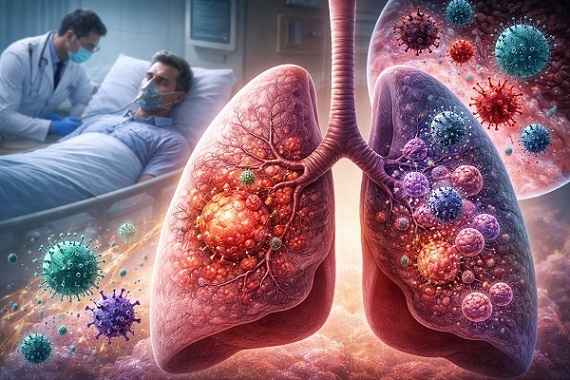 Severe respiratory infections like COVID-19 and influenza may reprogram the lungs in ways that accelerate
lung cancer growth.
Researchers from the Beirne B. Carter Center for Immunology Research at the University of Virginia, the Division of Infectious Disease and International Health at the University of Virginia, the Division of Pulmonary and Critical Care Medicine at the University of Virginia, the Department of Microbiology, Immunology and Cancer Biology at the University of Virginia, the Department of Family Medicine at the University of Virginia, the University of Pittsburgh School of Medicine and UPMC Children’s Hospital of Pittsburgh, the Department of Biostatistics and Health Data Science at the University of Pittsburgh School of Public Health, the Department of Quantitative Health Sciences at Mayo Clinic in Jacksonville, and the Women’s Guild Lung Institute at Cedars-Sinai Medical Center conducted the study.
Evidence From Real Patient Data
The scientists analyzed health data from more than 44 million individuals aged 55 to 74 during the first two years of the COVID-19 pandemic. The analysis revealed that people who had been hospitalized with severe COVID-19 had a 19 percent higher risk of being diagnosed with lung cancer compared to people who were never infected.
Interestingly, individuals who experienced mild infections did not show the same increased risk. This suggests that the severity of the infection and the amount of lung damage may play an important role in later cancer development.
Similar patterns have also been observed after influenza infections, suggesting that severe viral pneumonia may be a shared trigger that increases lung cancer risk.
How Viruses Change the Lung Environment
To better understand the biological reasons behind this risk, researchers conducted several experiments in laboratory mouse models of lung cancer.
They infected mice with SARS-CoV-2 or influenza and then introduced lung cancer cells after the virus had been cleared. During the first week, tumor growth appeared similar in infected and uninfected mice. However, by the third week tumors in previously infected mice expanded dramatically, forming large masses in the lungs.
The infected animals also had shorter survival times, indicating that prior viral infection had created conditions that allowed tumors to grow much faster.
Immune Cells That Help Tumors Grow
One of the most important discoveries involved immune cells called neutrophils. Normally these cells help the body fight infections. But after severe viral pneumonia, researchers found that neutrophils in the lungs were reprogrammed into a special type called SiglecF-high tumor-associated neutrophils.
;
Instead of fighting disease, these altered cells began supporting tumor growth. They released signals that promoted inflammation, helped tumors obtain blood supply, and suppressed the activity of cancer-fighting immune cells such as CD8 T cells.
The researchers also found that the lungs contained higher levels of inflammatory molecules like IL-6 and G-CSF, which further attracted these tumor-promoting neutrophils.
Long Lasting Biological Changes
Even after the virus was cleared, the lungs did not completely return to normal. The infection left behind epigenetic changes, meaning certain genes became permanently easier to activate.
These changes allowed lung cells to produce inflammatory signals more quickly when new tumors appeared, creating a microenvironment that favored cancer growth.
In simple terms, the infection appeared to “train” the lung tissue to remain in a chronic inflammatory state, which is known to encourage cancer development.
Possible Ways to Prevent the Risk
Encouragingly, the researchers found that mRNA vaccination before infection reduced the cancer-promoting effects of the virus in experimental models. Preventing severe infection prevented the harmful immune changes that promote tumor growth.
In addition, therapies that block neutrophil recruitment or combine CXCR2 inhibitors with PD-L1 immunotherapy were able to reduce tumor growth and restore anti-tumor immune responses.
Conclusions
The findings suggest that severe respiratory viral infections can leave lasting biological scars in the lungs that may increase the risk of lung cancer or accelerate tumor growth months or even years later. This does not mean everyone who had COVID-19 will develop cancer, but it highlights the importance of monitoring people who suffered severe viral pneumonia, especially those with additional risk factors such as smoking or long-term lung damage.
The research also emphasizes the protective value of vaccination and early treatment of respiratory infections to prevent severe disease and the long-term inflammatory changes that may contribute to cancer development.
This
Medical News report highlights the growing need for long-term monitoring of individuals recovering from severe viral infections as scientists continue to investigate how post-infection inflammation may shape cancer risk in the years ahead.
The study findings were published in the peer reviewed journal: Cell
https://www.cell.com/cell/abstract/S0092-8674(26)00220-5
For the latest COVID-19 News, keep on logging to Thailand
Medical News.
Read Also:
https://www.thailandmedical.news/articles/coronavirus
https://www.thailandmedical.news/articles/long-covid




 Share
Share
 Tweet
Tweet
 Share
Share

































