Nikhil Prasad Fact checked by:Thailand Medical News Team Apr 09, 2026 5 months, 3 weeks, 4 days, 5 hours, 28 minutes ago
Medical News: A troubling new discovery has raised fresh concerns about how viruses from the natural world can quietly cross into humans. Scientists have identified a virus commonly found in fish and shrimp that is now linked to a persistent and potentially serious eye disease in people. The finding sheds light on a previously unexplained rise in cases of a condition affecting eye pressure and inflammation, especially in parts of Asia.
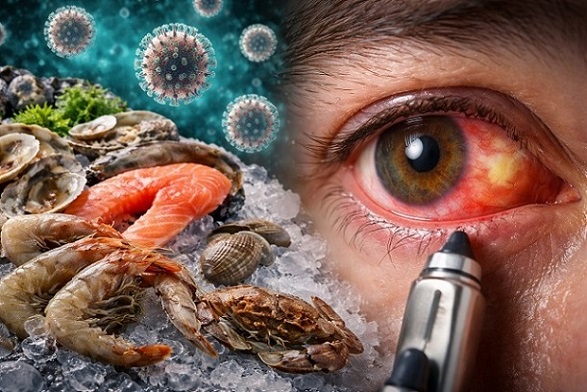 A common seafood virus is now linked to a rising human eye disease risk
A Mysterious Eye Condition on the Rise
A common seafood virus is now linked to a rising human eye disease risk
A Mysterious Eye Condition on the Rise
In recent years, doctors in China have observed an increasing number of patients suffering from a condition known as persistent ocular hypertension viral anterior uveitis (POH-VAU). This illness causes unusually high pressure inside the eye along with inflammation, which can lead to discomfort, blurred vision, and long-term damage if not treated.
What puzzled doctors was that these patients consistently tested negative for well-known viral causes such as herpes or shingles. This raised suspicions that an unknown or overlooked virus might be responsible.
Scientists Trace the Culprit
Researchers from several institutions in China, including leading ophthalmology and virology centers, began investigating the condition more closely. They recruited 70 patients diagnosed with POH-VAU between January 2022 and April 2025.
Using advanced electron microscopy, the team examined eye tissue samples collected during surgery. They discovered tiny virus-like particles measuring about 25 nanometers in size. These particles closely resembled covert mortality nodavirus (CMNV), a virus known to infect marine animals like shrimp, fish, and crabs.
To confirm their findings, the scientists used a gold-labeled antibody designed specifically to bind to CMNV. Genetic sequencing further revealed a striking 98.96 percent match between the virus found in human eye tissue and the version commonly seen in aquatic animals.
Strong Links to Seafood Exposure
To understand how this virus might be infecting humans, the researchers conducted detailed interviews with the patients. The results were revealing. Nearly three-quarters of those affected reported frequent exposure to raw seafood, either through handling it without protective gloves or consuming it uncooked.
These exposure patterns strongly suggest that the virus may enter the human body through direct contact or ingestion. This
Medical News report highlights that such everyday activities, especially in regions where raw seafood consumption is common, could unknowingly increase infection risk.
Further analysis using statistical models confirmed that higher exposure frequency and severity were directly associated with a greater likelihood of developing the disease.
Laboratory Evidence Confirms the Risk
To prove that CMNV was not just present but actually causing the disease,
researchers conducted laboratory experiments. They introduced the virus into mammalian cells and observed successful infection. In addition, mice exposed to the virus developed symptoms similar to those seen in human patients, including elevated eye pressure and tissue damage.
These findings provide strong biological evidence that the virus is capable of infecting mammals and triggering disease, marking a significant step forward in understanding this emerging health issue.
A Global Concern in the Making
The implications of this discovery extend far beyond a single country. A global survey conducted as part of the study revealed that CMNV is present in at least 49 different species of aquatic animals. These species are distributed across Asia, Africa, Europe, the Americas, and even Antarctica.
This widespread presence suggests that the risk of human exposure may not be limited to specific regions. As global seafood consumption rises and environmental changes alter ecosystems, opportunities for viruses to jump between species are increasing.
What This Means Moving Forward
The study paints a concerning picture of how easily viruses from aquatic environments can move into humans under the right conditions. It also highlights the importance of proper food handling practices, including wearing gloves when handling raw seafood and avoiding consumption of uncooked marine products.
More importantly, the findings underscore the need for increased surveillance of zoonotic diseases, especially those originating from less-studied environments like oceans and aquaculture systems. Early detection and awareness could play a critical role in preventing wider outbreaks.
The emerging evidence suggests that this eye condition is not an isolated phenomenon but may represent the early stages of a broader public health issue. Continued research will be essential to determine how widespread the infection is and whether it could evolve further.
The study findings were published in the peer reviewed journal Nature
Microbiology, and they offer a crucial warning about the hidden risks lurking in everyday interactions with the natural world.
https://www.nature.com/articles/s41564-026-02266-x
Also Read:
https://www.nature.com/articles/s41564-026-02306-6
For the latest on new viruses that are affecting humans, keep on logging to Thailand
Medical News.




 Share
Share
 Tweet
Tweet
 Share
Share

































