Nikhil Prasad Fact checked by:Thailand Medical News Team Mar 14, 2026 6 months, 3 weeks, 1 hour, 59 minutes ago
Medical News: Prostate cancer remains one of the most common cancers affecting men worldwide, and scientists continue searching for new strategies to slow its progression and improve treatment outcomes. New research now suggests that intermittent fasting, a dietary pattern that alternates periods of eating and fasting, could interfere with key biological systems that drive prostate tumor growth.
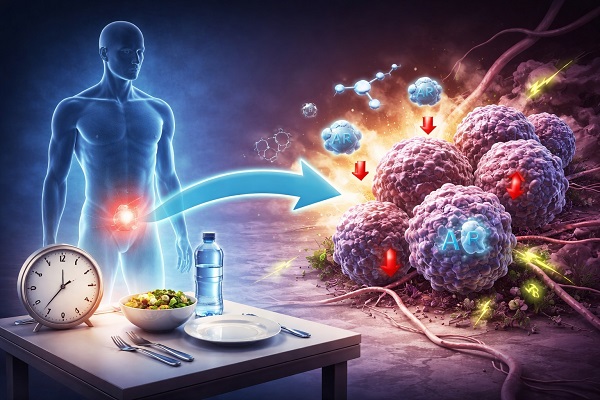 New research suggests intermittent fasting may weaken the hormone signaling pathways that drive prostate cancer growth
Researchers from the Department of Biomedical Sciences, Faculty of Medicine, Collegium Medicum at Cardinal Stefan Wyszynski University in Warsaw, Poland, and the Military Institute of Medicine in Warsaw, Poland, investigated how fasting-related metabolic changes may influence androgen receptor signaling, a critical pathway that fuels prostate cancer progression.
The Hormone System That Fuels Tumor Growth
Prostate cancer is strongly influenced by male hormones known as androgens. These hormones activate a protein inside cells called the androgen receptor. Once activated, this receptor moves into the cell nucleus and switches on genes that promote tumor growth, survival, and metabolic activity.
Because of this dependence on hormones, many prostate cancer treatments aim to block androgen signals through therapies such as androgen deprivation therapy or drugs that inhibit the androgen receptor pathway. While these treatments can initially be effective, many tumors eventually develop resistance and continue growing despite therapy.
Scientists therefore continue searching for ways to weaken androgen receptor activity and enhance treatment responses.
How Intermittent Fasting Alters Tumor Metabolism
Intermittent fasting creates metabolic conditions that differ significantly from those during constant eating. When food intake stops for extended periods, blood glucose and insulin levels drop while the body begins using stored energy sources.
These metabolic shifts place stress on cancer cells, which rely heavily on nutrients such as glucose and amino acids to sustain their rapid growth. According to this
Medical News report, the fasting-induced metabolic environment may interfere with the production and function of androgen receptors inside tumor cells.
Studies suggest that reduced nutrient availability can suppress the cellular machinery responsible for producing androgen receptor proteins. When the levels of this receptor decline, the tumor’s ability to activate growth-promoting genes becomes weakened.
Stress Signals Inside Cancer Cells
Fasting also activates several cellular stress response pathways. These include energy-sensing systems that regulate how cells use nutrients and produce energy.
When these stress pathways are triggered, they can suppress anabolic processes such as lipid synthesis and protein production, both of which are essential for tumor growth. The resulting metabolic pressure appears t
o reduce androgen receptor signaling activity and limit the tumor’s capacity to expand.
Researchers also observed that fasting-related metabolic stress may interfere with the movement of androgen receptors into the nucleus of cancer cells. Since this step is necessary for activating cancer-promoting genes, blocking this process could significantly weaken tumor activity.
Possible Impact on Drug Resistance
Another important discovery involves androgen receptor splice variants, particularly a variant known as AR-V7. This altered form of the receptor is commonly associated with resistance to important prostate cancer drugs such as enzalutamide and abiraterone.
Metabolic stress caused by fasting may influence RNA processing mechanisms that control how these receptor variants are produced. By disrupting these processes, intermittent fasting could potentially reduce the impact of treatment-resistant receptor forms.
Enhancing the Effectiveness of Existing Therapies
Laboratory studies suggest that fasting may enhance the effectiveness of androgen receptor–targeting drugs. In experimental models, fasting reduced androgen receptor production and improved tumor responses to therapies such as enzalutamide.
Scientists believe this combined approach could slow tumor progression and delay the development of treatment resistance. However, researchers caution that more clinical studies are needed to determine how fasting regimens can be safely incorporated into prostate cancer treatment strategies.
Conclusions
The findings indicate that intermittent fasting may influence prostate cancer biology by altering metabolic pathways that support tumor growth. By lowering nutrient availability and activating cellular stress responses, fasting appears capable of weakening androgen receptor signaling and potentially improving the effectiveness of existing therapies. While promising, these strategies must still be evaluated through well-designed clinical trials before they can be recommended as part of routine prostate cancer management.
The study findings were published in the peer reviewed International Journal of Molecular Sciences.
https://www.mdpi.com/1422-0067/27/6/2652
For the latest on Prostate Cancer, keep on logging to Thailand
Medical News.




 Share
Share
 Tweet
Tweet
 Share
Share

































