Nikhil Prasad Fact checked by:Thailand Medical News Team Jan 07, 2026 6 months, 2 weeks, 1 day, 15 hours, 15 minutes ago
Medical News: A team of Brazilian scientists has uncovered startling evidence that a quiet cellular transformation may be pushing the brain toward memory loss faster than anyone expected. The research group from the Instituto de Ciências Biomédicas da Universidade Federal do Rio de Janeiro, the Centro Nacional de Biologia Estrutural e Bioimagem CENABIO, and the Instituto de Educação Médica IDOMED has revealed that astrocytes, once dismissed as simple support cells, become harmful saboteurs as they age. This
Medical News report highlights how astrocytic senescence appears to be a driving force behind cognitive decline.
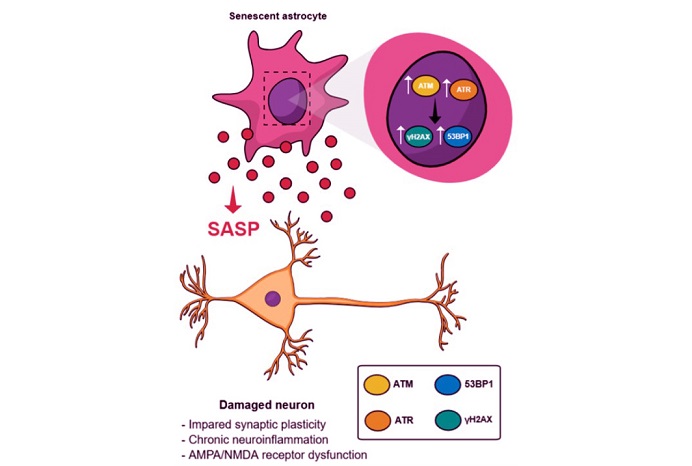 Aging astrocytes quietly collapse and trigger widespread memory decline
When Helpful Cells Turn Hazardous
Aging astrocytes quietly collapse and trigger widespread memory decline
When Helpful Cells Turn Hazardous
Astrocytes normally nourish neurons, clear toxic chemicals from synapses, regulate brain ions and help maintain the blood–brain barrier. In youth they enable smooth communication between billions of neurons. However, as the years pass and stress accumulates, astrocytes enter a biological dead-end state called senescence. In this state they stop dividing, deform structurally and their nuclei lose stability. Even more concerning, their mitochondria falter and energy production drops sharply.
Senescent astrocytes are not passive. They begin releasing inflammatory factors known collectively as the SASP. These include cytokines such as IL6 and IL1beta along with tissue damaging enzymes. Instead of defending brain health, these aging cells flood the neural environment with signals that destabilize the very networks they once protected.
How Astrocytes Turn Against the Brain
One of the most critical changes uncovered is the failure of glutamate and potassium clearance. These processes normally prevent overload and keep the firing of brain cells balanced. Once astrocytes lose efficiency, neurons are exposed to toxic buildup that destabilizes communication. Meanwhile collapsing mitochondria rob both astrocytes and neurons of energy.
The team also showed that senescent astrocytes cannot fuel neurons with lactate effectively, breaking a key energy-sharing system. As a result, neurons begin to starve, shrink their branches and produce weaker electrical responses. Long-term potentiation, the cellular foundation of learning and memory, becomes impaired as inflammatory molecules seep into synapses.
A Hidden Engine of Decline
In models of aging, oxidative stress and chemical injury, the pattern remained consistent. Senescent astrocytes lost their ability to form and support synapses while neurons exposed to their secretions showed reduced metabolism, shorter processes and greater vulnerability to stress. The findings suggest that astrocyte failure may begin long before neurons show irreversible degeneration.
The Bigger Picture
The work reframes brain aging as a community breakdown rather than a neuron-only collapse. If astrocytes can be protected, cleaned up or reprogrammed,
therapies may slow or even reverse loss of cognitive function. Targeting senescence-associated inflammation, repairing mitochondria or eliminating toxic astrocytes are all emerging strategies. The conclusion is stark but hopeful. Aging brains may be saved not only by shielding neurons but by restoring the silent partners that sustain them.
The study findings were published in the peer reviewed journal: Brain Sciences.
https://www.mdpi.com/2076-3425/16/1/76
For the latest on brain aging, keep on logging to Thailand
Medical News.
Read Also:
https://www.thailandmedical.news/articles/anti-aging




 Share
Share
 Tweet
Tweet
 Share
Share