Emodin Shows Therapeutic Potential in Reducing Inflammation and Angiogenesis in Rheumatoid Arthritis
Nikhil Prasad Fact checked by:Thailand Medical News Team Apr 13, 2026 5 months, 3 weeks, 1 day, 17 hours, 24 minutes ago
Medical News: A Natural Compound Gains Scientific Attention
Rheumatoid arthritis is a chronic autoimmune condition that affects millions worldwide, causing persistent joint pain, swelling, and progressive damage that can lead to disability. While current treatments such as methotrexate and anti-inflammatory drugs can help manage symptoms, they are often limited by side effects and incomplete disease control.
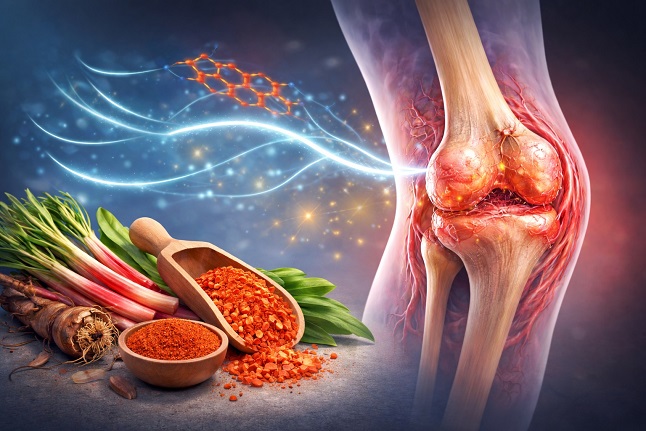 Emodin demonstrates powerful anti-inflammatory and anti-angiogenic effects in rheumatoid arthritis research
A new study conducted by researchers from the Department of Combination of Chinese and Western Medicine, The First Affiliated Hospital of Chongqing Medical University, China, and the Institute of Literature in Chinese Medicine, Nanjing University of Chinese Medicine, China, has revealed that a natural compound known as emodin may offer a promising alternative approach by targeting multiple disease mechanisms simultaneously.
What Is Emodin
Emodin is a naturally occurring red-orange crystalline compound found in plants such as rhubarb, buckthorn, and knotweed. It has a long history of use in traditional Chinese medicine and belongs to a class of compounds known as anthraquinones.
Scientifically, emodin is recognized for its diverse biological activities, including anti-inflammatory, antibacterial, laxative, and potential anticancer effects. It has also shown promise in antiviral research and immune system modulation. Its ability to act on multiple biological targets makes it particularly valuable in treating complex diseases like rheumatoid arthritis.
Understanding the Root of Joint Damage
Rheumatoid arthritis is driven by a combination of excessive inflammation and abnormal blood vessel growth within the joints. These processes reinforce each other, creating a cycle that worsens joint destruction over time. The study focused on a key signaling pathway involving NF-κB, HIF-1α, and VEGF, which plays a central role in promoting both inflammation and angiogenesis.
When this pathway is activated, it leads to the release of inflammatory molecules and the formation of new blood vessels that supply nutrients to inflamed tissues, allowing the disease to progress more aggressively.
Key Findings from the Study
Using both animal models and laboratory cell experiments, the researchers demonstrated that emodin significantly reduced joint damage and inflammation. Histological observations described in the study showed that untreated subjects developed severe synovial thickening, inflammatory infiltration, and cartilage erosion. In contrast, those treated with emodin displayed markedly improved joint structures, with reduced tissue damage and preserved cartilage integrity.
At the molecular level, emodin was found to suppress the activity of NF-κB, a major regulator of inflammation. This resulted in a significant reduction in pro-inflammatory cytokines such as TNF-α, IL-6, and IL-1β, all of which are known to contribute to joint destruction.
Importantly, emodin als
o reduced the expression of HIF-1α and VEGF, proteins that drive abnormal blood vessel formation. By lowering these factors, the compound effectively limited angiogenesis, which is a critical component of rheumatoid arthritis progression.
This
Medical News report notes that these combined effects position emodin as a dual-action therapeutic agent capable of targeting both inflammation and vascular changes in the disease.
Evidence From Cellular Experiments
Further experiments using endothelial cells confirmed these findings. Cells exposed to inflammatory stimuli showed a strong tendency to form dense, vessel-like networks. However, treatment with emodin significantly reduced both the number and length of these structures, indicating a clear inhibition of angiogenesis.
In addition, gene-silencing experiments targeting NF-κB produced similar results, reinforcing the conclusion that this pathway is a key mechanism through which emodin exerts its effects.
Why These Findings Matter
The significance of this research lies in its demonstration that emodin can intervene at multiple stages of disease development. By simultaneously reducing inflammation and blocking abnormal blood vessel growth, it disrupts the cycle that drives joint damage.
This multi-target approach could potentially overcome the limitations of current therapies, which often focus on only one aspect of the disease.
Conclusion
The findings from this study provide compelling evidence that emodin is a promising candidate for the treatment of rheumatoid arthritis. By inhibiting the NF-κB/HIF-1α/VEGF signaling pathway, it effectively reduces inflammatory responses while also suppressing pathological angiogenesis, two critical processes that fuel disease progression. The ability of emodin to preserve joint structure, reduce cytokine production, and limit abnormal vascular growth highlights its potential as a comprehensive therapeutic agent. Although further clinical studies in humans are necessary to confirm its safety and efficacy, the current evidence strongly supports its role as a future treatment option that could improve outcomes and quality of life for patients suffering from rheumatoid arthritis.
The study findings were published in the peer reviewed International Journal of Molecular Sciences.
https://www.mdpi.com/1422-0067/27/8/3460
For the latest on arthritis, keep on logging to Thailand
Medical News.
Read Also:
https://www.thailandmedical.news/articles/arthritis
https://www.thailandmedical.news/articles/herbs-and-phytochemicals




 Share
Share
 Tweet
Tweet
 Share
Share