Nikhil Prasad Fact checked by:Thailand Medical News Team Mar 02, 2026 7 months, 2 days, 3 hours, 59 minutes ago
Medical News: A widely used epilepsy drug may hold powerful promise against Parkinson’s disease—if given at the right dose. Scientists in Mexico have discovered that a higher dose of valproic acid significantly protected brain cells, preserved movement, and prevented harmful receptor changes in a laboratory model of Parkinson’s disease.
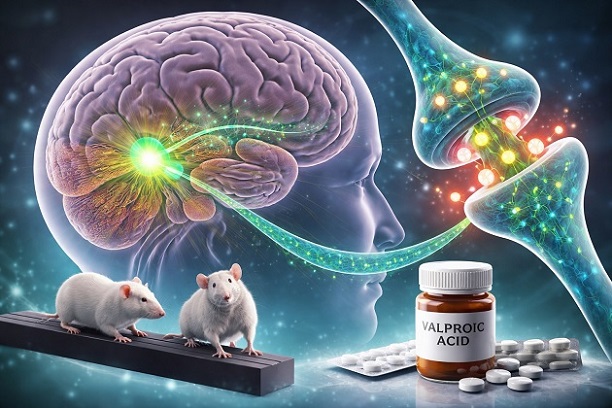 High-dose valproate preserves dopamine and stabilizes brain receptors in a Parkinson’s disease model
The research was conducted by scientists from the División de Neurociencias Básicas at the Instituto Nacional de Rehabilitación “Luis Guillermo Ibarra Ibarra” in Mexico City; the Laboratorio de Morfología Celular y Tisular and the Centro de Investigación Traslacional at the Instituto Nacional de Pediatría, Secretaría de Salud, Mexico City; the Departamento de Biología de la Reproducción at Universidad Autónoma Metropolitana, Ciudad de México; the Universidad Estatal del Valle de Ecatepec; and the Laboratorio Nacional CONAHCyT en Inteligencia Artificial y Ciencia de Datos, Ecatepec de Morelos.
Why Parkinson’s Disease Is So Devastating
Parkinson’s disease develops when brain cells that produce dopamine gradually die. Dopamine is a chemical messenger that helps control smooth and coordinated movements. As dopamine levels drop, patients develop tremors, stiffness, slow movement, and balance problems.
Current treatments such as L-DOPA can ease symptoms, but they do not stop the disease from progressing. Over time, many patients develop serious movement complications due to long-term therapy. Scientists have therefore been searching for treatments that can actually protect brain cells rather than simply mask symptoms.
Testing Valproic Acid at Two Different Doses
Valproic acid is already approved to treat epilepsy and bipolar disorder. It also affects gene activity in brain cells by blocking enzymes known as histone deacetylases. This action can activate protective genes that help neurons survive stress.
In this study, researchers tested two doses—200 mg/kg and 400 mg/kg—in rats that were given a neurotoxin called 6-OHDA, which destroys dopamine-producing cells and mimics Parkinson’s disease.
The results were striking.
Rats receiving the lower dose showed only mild and statistically insignificant improvements. However, rats treated with the higher 400 mg/kg dose maintained motor coordination comparable to healthy animals. In balance beam tests, they performed almost normally, while untreated rats showed severe motor impairment.
In open-field behavioral testing, untreated rats displayed anxiety-like behavior, staying close to walls and corners. The higher-dose group behaved normally, exploring the center of the area just like healthy controls.
Protecting Dopamine and Stabilizing Brain Receptors
Perhaps most importantly, chemical analysis revealed that the higher dose signi
ficantly preserved dopamine levels in both the striatum and motor cortex—two critical brain regions for movement control.
When dopamine disappears, the brain attempts to compensate by increasing dopamine D2 receptors, a phenomenon called “denervation supersensitivity.” In untreated rats, D2 receptor levels rose to about 180 percent of normal. This abnormal increase is linked to movement complications seen in Parkinson’s patients.
Remarkably, the high-dose valproic acid group showed D2 receptor levels almost identical to healthy animals. This suggests the drug not only protected dopamine-producing cells but also prevented harmful receptor overreaction.
This
Medical News report highlights that protecting dopamine alone is not enough; stabilizing receptor activity may be equally crucial in preventing long-term complications.
How the Drug May Work
The researchers believe the protective effect stems from epigenetic changes. At sufficient concentration, valproic acid increases histone acetylation, switching on survival genes such as BDNF and GDNF. These molecules nourish and support vulnerable neurons. The higher dose likely crossed a biological threshold needed to trigger these protective genetic mechanisms.
Study Implications and Conclusion
The findings strongly suggest that valproic acid’s benefits are dose-dependent and that only the higher tested dose achieved meaningful neuroprotection. By preserving dopamine levels and preventing abnormal D2 receptor upregulation, the drug appears to protect both sides of the neural communication pathway—presynaptic dopamine release and postsynaptic receptor balance. This dual action could potentially slow disease progression and reduce future complications from standard therapies like L-DOPA. While further studies in humans are necessary, these results offer renewed hope that an already available medication could be repurposed as a disease-modifying therapy for Parkinson’s disease.
The study findings were published in the peer reviewed International Journal of Molecular Sciences.
https://www.mdpi.com/1422-0067/27/5/2320
For the latest research on Parkinson’s Disease, keep on logging to Thailand
Medical News.
Medical Disclaimer: All content published by Thailand Medical News is based on scientific research and is intended for informational and educational purposes only. It is not medical advice, diagnosis, or treatment. Readers must not attempt to use, apply, or experiment with any protocols, compounds, or therapies mentioned without first consulting a qualified and licensed medical doctor. Many findings discussed are experimental or preliminary, and only a licensed healthcare professional can determine what is safe and appropriate for an individual’s specific medical condition.




 Share
Share
 Tweet
Tweet
 Share
Share

































